The 10 Most Common Sales Objections, and the One No List Includes
The most common sales objections, what each one means underneath the words, and how to respond without a script, plus the silent objection that kills more deals than all the spoken ones combined.
Common sales objections are the recurring reasons buyers give for not moving forward (price, timing, budget, authority, and the rest), and the most expensive one is rarely voiced: indecision, the silent objection that ends 40 to 60 percent of qualified deals.
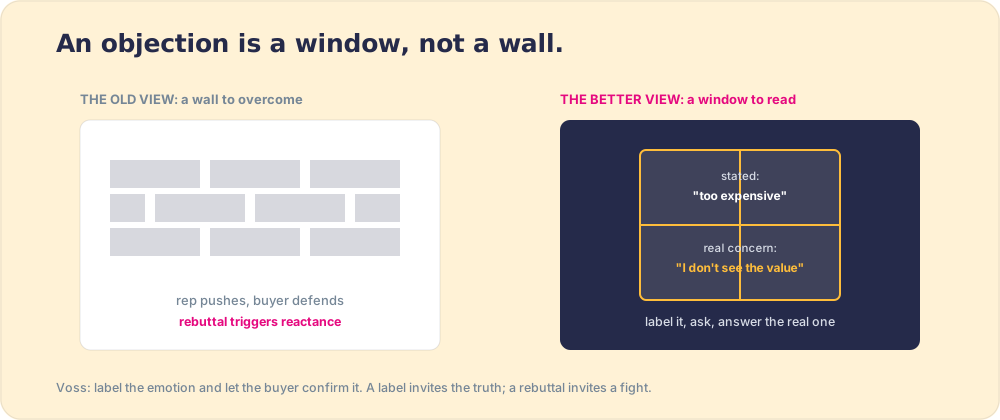
Open any “common sales objections” article and you get the same drill: a list of ten things buyers say, each paired with a snappy comeback to “overcome” it. The format has a hidden assumption baked in, that an objection is an obstacle between you and the sale, a wall to be talked through. That assumption is why most objection-handling advice makes deals worse. An objection is rarely a wall. It is usually information, a window into what the buyer cares about, and the most dangerous objection of all is the one they never say out loud.
So here are the ten most common sales objections, what each one means underneath the words, and how to respond without reaching for a script. Then the eleventh, the silent one, which kills more deals than the other ten combined and appears on no other list. The throughline, and the real answer to how to overcome sales objections: stop overcoming them and start reading them, because the buyer is telling you where the deal stands.
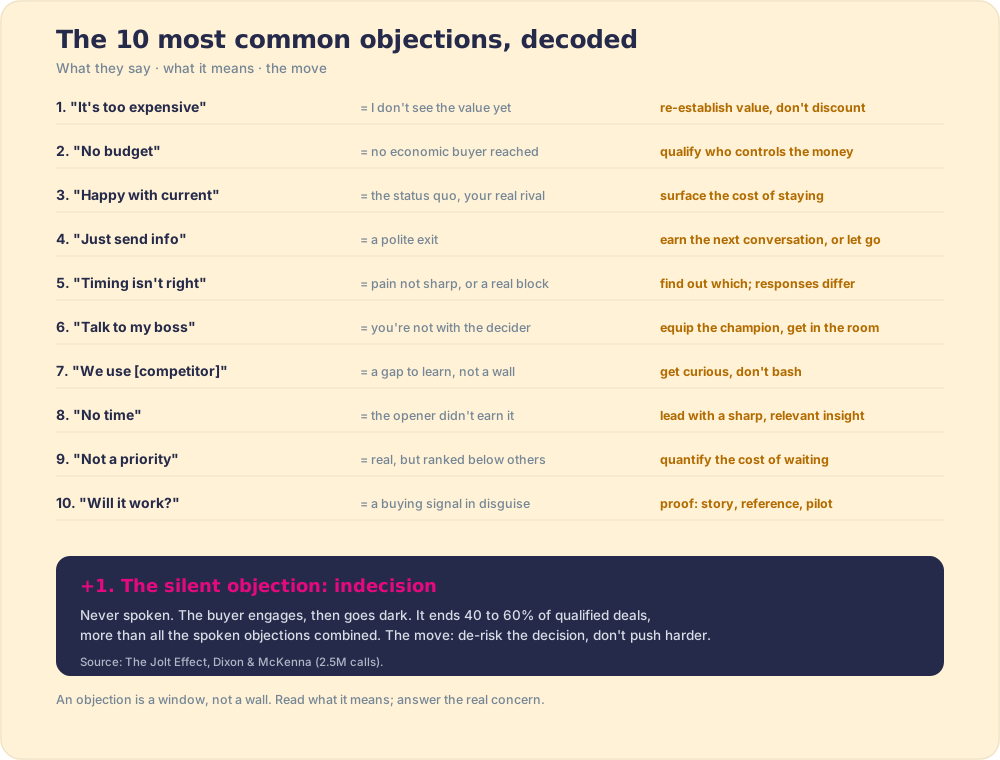
What are the most common sales objections?
Ten you will hear in every pipeline, decoded, the heart of any honest guide to sales objections and responses. The words are the symptom; the meaning is what you are dealing with; the move is the principle, not a script.
- “It’s too expensive.” The classic price objection, and almost never about money in the absolute. It means the buyer does not yet see enough value to justify the price. The move: return to the cost of their problem and the size of the gap, do not discount, because a discount tells them the price was never real. (This is the gap selling muscle.)
- “We don’t have budget.” Sometimes true, often a polite no, frequently a sign you never reached the economic buyer. The move: qualify whether budget exists and who controls it, rather than arguing; a deal with no path to money is not a deal yet.
- “We’re happy with our current solution.” The status quo talking, and the status quo is your real competitor. The move: do not attack their choice; surface the cost of staying, the gap they have stopped noticing.
- “Send me some information.” The brush-off, a polite exit dressed as interest. Underneath it is a buyer who has not felt enough reason to spend more time with you and would rather end the call politely than say no to your face. The move: do not send a deck into the void; ask one question that earns the next conversation, or let it go. Information is not a next step.
- “The timing isn’t right.” Usually means the pain is not sharp enough to act now, or a real event is in the way. The move: find out which, because the response is completely different. Manufactured urgency on a real timing block destroys trust.
- “I need to talk to my boss.” You are not talking to the economic buyer, and you may be talking to a coach, not a champion. The move: equip your contact to sell internally, and try to get into the room, because a deal sold to people who can only say no rarely closes.
- “We already use [competitor].” Not a wall; a chance to learn the gap their current tool leaves. The move: get curious about what is working and what is not, rather than bashing the rival.
- “I don’t have time for this.” Rarely about the clock. It is a ranking statement: the buyer has weighed you against everything else on their desk and you came up short, so the opener did not earn the next ten minutes. The move: lead with a sharp, relevant insight or a specific reason this is worth those minutes, not a generic pitch.
- “This isn’t a priority right now.” The honest cousin of the timing objection: the problem is real but ranked below others. The move: quantify the cost of leaving it unranked, or agree to a future trigger rather than forcing it.
- “How do I know it’ll work?” A buying signal in disguise: they are imagining owning it. The move: proof, a relevant story, a reference, a pilot, the de-risking the buyer needs to say yes.
What is behind a sales objection?
An objection is a buyer telling you where their concern lives, and the stated words are usually a polite stand-in for the real one. “Too expensive” is the most misread sentence in sales: it is a value statement, not a budget statement, the vast majority of the time. Treat objections as signals and your whole posture changes, from defending to diagnosing.
Jeb Blount, who wrote the book most reps were handed on this, agrees on the diagnosis. In Objections he is blunt about what an objection is: “Objections are not rejection, but they often feel that way. Objections are signs of confusion, concerns, the sorting out of options, subconscious cognitive biases, risk aversion, cognitive overload, and the fear of change” (Blount, Objections, 2018). Read that list again. Not one item on it is answered by a clever comeback. Confusion is answered by clarity, risk aversion by proof, the fear of change by a smaller first step. The thing the buyer says is the smoke; Blount’s list is the fire.
Why do scripted objection rebuttals backfire?
Because the buyer has watched the trick before. The classic “Feel, Felt, Found” formula (“I understand how you feel, others felt the same way, here is what they found”) is so worn that buyers hear the gears turn the moment the first word lands. It is a card trick performed to an audience that knows where the card went, and the instant they recognize the script, they stop hearing a person and start hearing a pitch.
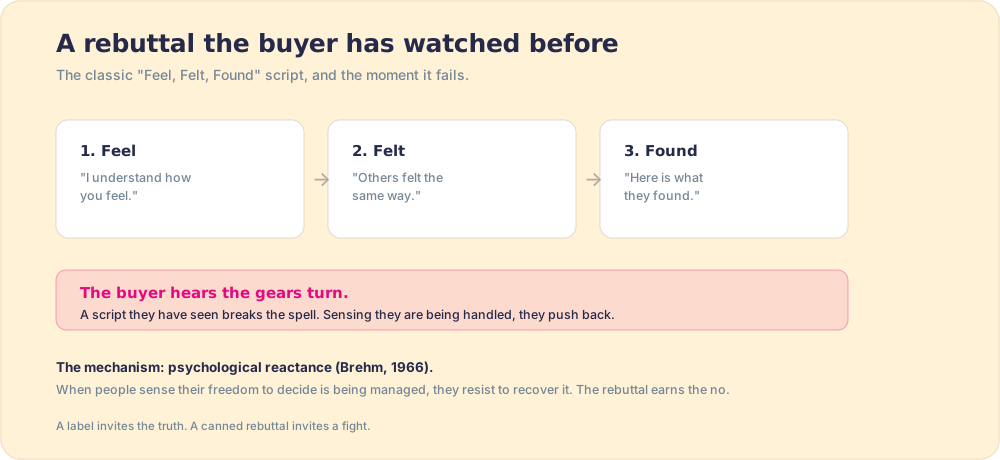
The mechanism has a name. Psychologist Jack Brehm called it reactance, “a motivational state with a specific direction, namely, the recovery of freedom” (Brehm, 1966, summarized by The Decision Lab). When a person senses that their freedom to decide is being managed, they move to take it back, often by doing the opposite of what they were pushed toward. A memorized rebuttal is a freedom-removal the buyer can feel, so it manufactures the resistance it was meant to dissolve. This is the deeper reason a script underperforms a question. It is not that the script is unkind. It is that the human nervous system is built to fight being steered.
Chris Voss, the FBI hostage negotiator, built his whole method on the opposite move. In Never Split the Difference he defines tactical empathy as “understanding the feelings and mindset of another in the moment and also hearing what is behind those feelings so you increase your influence in all the moments that follow” (Voss, Never Split the Difference, 2016). The tool is labeling, naming the emotion out loud, and Voss is precise about why it works: “Once they have been labeled and brought into the open, the negative reactions in your counterpart’s amygdala will begin to soften.” Say “it sounds like the price feels hard to justify right now” and the buyer either corrects you or confirms you, and either way they hand you the real concern. A label invites the truth. A canned rebuttal invites a fight.
So the honest verdict on the rebuttal scripts most reps memorized: retire them. Not because acknowledging an objection is wrong, Voss and Blount both start with acknowledgment, but because the rigid three-step formula is recognized, resented, and counterproductive. Keep the empathy. Drop the script.
What is the objection no list includes?
Indecision, and it is the most expensive objection in B2B sales by a wide margin. The buyer who never raises a real objection, who likes you, engages, takes the calls, and then goes dark or selects “no decision,” is not lost to a competitor. They are lost to their own inability to move, and almost no objection-handling list mentions them because there is nothing spoken to rebut.
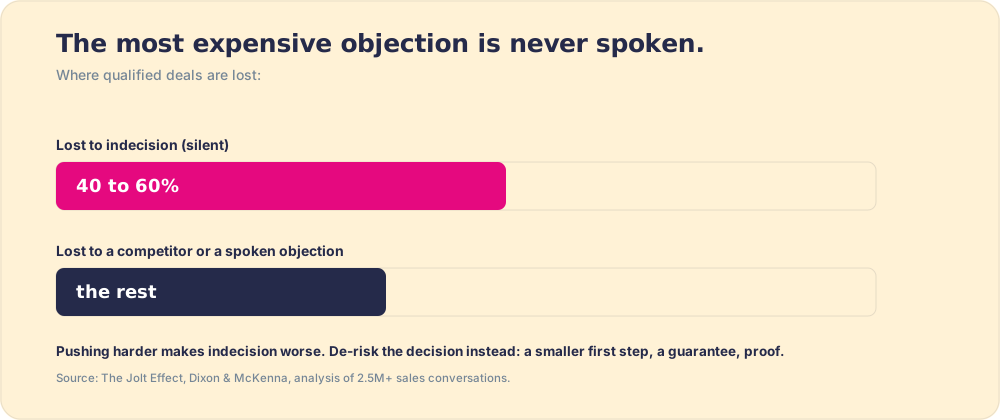
The evidence is hard to argue with. In The Jolt Effect, Matt Dixon and Ted McKenna analyzed more than 2.5 million recorded sales conversations and found that 40 to 60 percent of qualified deals end in no decision (Dixon and McKenna, The Jolt Effect, 2022). The driver is not price and not a competitor. It is what they call FOMU, the fear of messing up. Their finding cuts against everything most reps were taught: once purchase intent is established, customers stop caring about succeeding and start caring, in the authors’ words, about “not failing.” The buyer already wants the thing. They are frozen by the risk of being the person who chose wrong.
This is where the standard playbook does real damage. Dixon and McKenna are direct that the instinct to push harder backfires: “deeply entrenched business advice says to double down on your efforts to sell a buyer on all the ways they might win… But this approach backfires dramatically.” Selling the upside to a buyer who is afraid of the downside is pouring fuel on the wrong fire. The move that works is to shrink the fear, not amplify the prize: take options off the table to reduce overwhelm, set a smaller first step, offer a guarantee or a pilot, so the cost of being wrong gets small enough to act on. That reframes objection handling entirely. The biggest opportunity in your pipeline is not a better comeback to “too expensive.” It is surfacing the indecision nobody said, early, while you can still de-risk it.
Why are objections surfaced too late to handle?
Because most pipelines record what the rep did, not where the buyer stands. The deal shows three calls logged, a demo delivered, a proposal sent. All true, all good to know, and none of it tells you the buyer has started to fear the switch, or that the real decision maker has never been in the room. Tracking the rep’s activity matters; it is how you confirm the process ran and it shapes the buyer’s experience. The gap is that activity alone reads as progress, so the indecision builds underneath a healthy-looking record until the day the buyer goes dark. By then the objection is no longer a window. It is a wall, and you are talking to it.
The fix has two halves, and neither is a better rebuttal. First, diagnose early: ask about risk and decision confidence while the deal is warm, so FOMU surfaces while you can still shrink it. Second, equip the rep with the right move at the moment the objection lands, not in a training deck they read in onboarding. This is where objection handling breaks down today: the best rep on your team reads “too expensive” as a value problem on instinct, and that instinct lives in one head while everyone else reaches for the discount. When the documented process does not reach a rep in the moment they need it, that is a system failure, not a rep who needs more willpower. The fix is the same as every behavior problem in sales: capture the move that works and make it appear where the work happens.
The State of Sales Enablement 2026 found teams that consistently inspect deals against a defined process hit quota at 6.3 times the rate of those that rarely do (The State of Sales Enablement). For objections that means two things: the response to each common objection is documented and coached, not improvised, and the silent objection gets surfaced on purpose, by asking about risk and decision confidence before the buyer disappears. A consistent objection-handling motion across the team, the subject of sales process adoption, beats a few naturals every time.
What we recommend
Two ways to treat objections. You can collect comebacks, arm reps with a rebuttal for each of the ten, and run “objection handling techniques” drills that train them to win the argument. Or you can treat objections as diagnosis: read what each one means, respond to the real concern with a question rather than a script, and hunt the silent objection before it ends the deal.
We recommend the second, and the named research settles it. Blount’s own list says an objection is confusion, risk aversion, and fear of change, none of which a comeback answers. Voss shows a label beats a rebuttal because it works with the buyer’s nervous system instead of against it. Dixon and McKenna’s 2.5 million conversations show the deals you are losing are mostly lost to unspoken indecision, not to the objections you rehearsed for, and that pushing harder makes it worse. Our own data shows a consistent, inspected motion beats individual talent. Put together, the verdict is plain: stop collecting comebacks and start diagnosing, surface the response in the moment the rep needs it, and spend most of your energy on the one objection nobody says.
Start with the full method in how to handle a sales objection; the discovery that prevents half of them in gap selling and SPIN selling; and the system that makes the response consistent in the sales playbook guide.
Frequently asked questions
What are the most common sales objections?+
What is the best way to handle a sales objection?+
How do you overcome a price objection?+
What is the silent sales objection?+
Your process, running itself.