Sales Techniques That Move Deals, and the Ones to Drop
The sales techniques that actually move deals, ranked by evidence and the experts behind them, the popular ones to retire, and why every technique only works if reps run it consistently.
Sales techniques are the specific, repeatable moves a rep makes to advance a deal: how they question, frame value, handle objections, and close, and the ones that work share a trait the famous lists miss, which is that they only pay off when every rep runs them consistently.
There is a famous scene in Glengarry Glen Ross where Alec Baldwin’s character barks “Always Be Closing” at a room of beaten-down reps, and for thirty years that line has been the patron saint of sales technique: push, pressure, close, repeat. It made for a great monologue. As advice it is mostly wrong, and we now have the data to say so out loud. The most replicated finding in modern sales research is that pushing harder on a hesitant buyer does not close the deal; it loses it.
So a list of sales techniques is worth doing, but only if it is honest about what the evidence says, names the people behind each idea, and is willing to tell you which beloved techniques to throw away. That is what this is: the modern sales techniques that survive contact with an informed buyer, each tied to a named source and a real finding, with three at the end we retire because they survive on nostalgia alone. One warning runs through all of it, and it is the thing the other lists leave out: a technique is the easy part. Whether your reps run it on every deal is where deals are won or lost.
What are sales techniques, and why do most fail?
Sales techniques are the specific, repeatable moves a rep makes to advance a deal: how they open, question, frame value, handle objections, and close, from the cold-calling tips that earn the first conversation to the close that ends it. The category is enormous and most of it is noise, because the typical “sales techniques” list confuses two different things: knowing a move and running it. In 2026 the knowing is free. Any rep can read about implication questions in a minute, and any AI can explain mirroring on request. Knowledge of technique has been fully commoditized.
What has not been commoditized is behavior. The reason two reps with the same training post different numbers is not that one knows a secret technique. It is that one runs the diagnosis on every deal and the other runs it when they feel like it. So the useful way to read the list below is not “which of these do I not know,” but “which of these does my team do, every time, on every deal.” That reframing is the difference between a blog post you nod at and a quarter that changes. The best sales techniques, the sales techniques that work, all share that one trait: they survive a busy Tuesday.
The most effective sales techniques (and the catch)
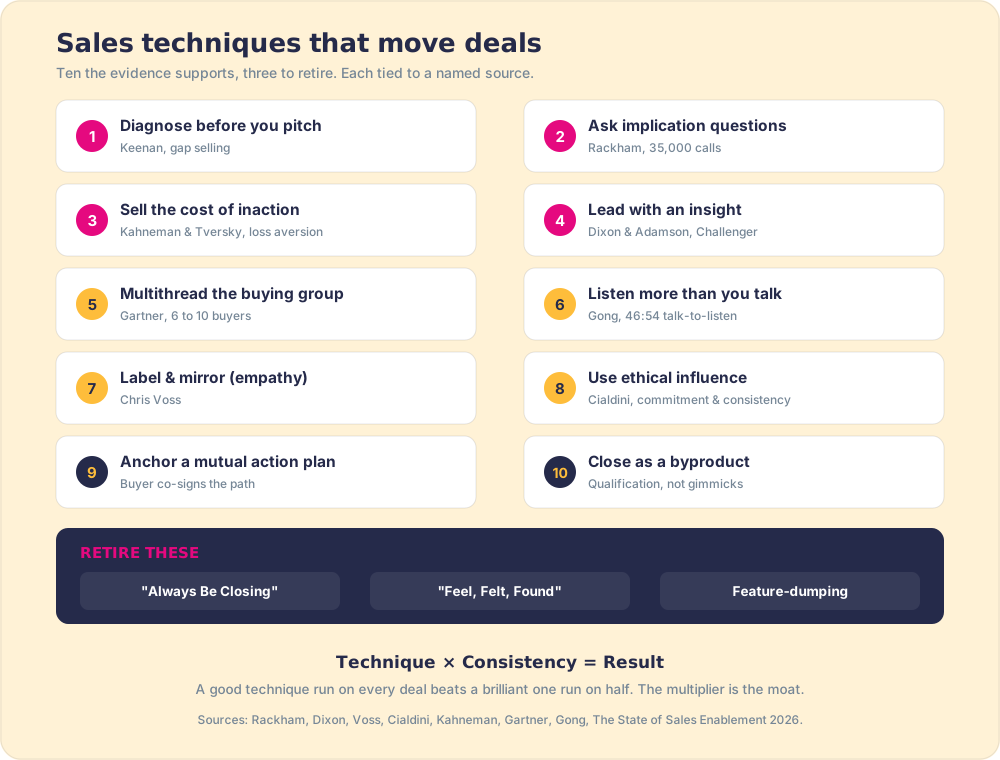
Ten techniques with real evidence behind them, each tied to the person or study that established it, and each with the catch that decides whether it works for you. They are roughly sequenced by where they land in a deal, not ranked one-to-ten, because the order you need them in depends on your motion.
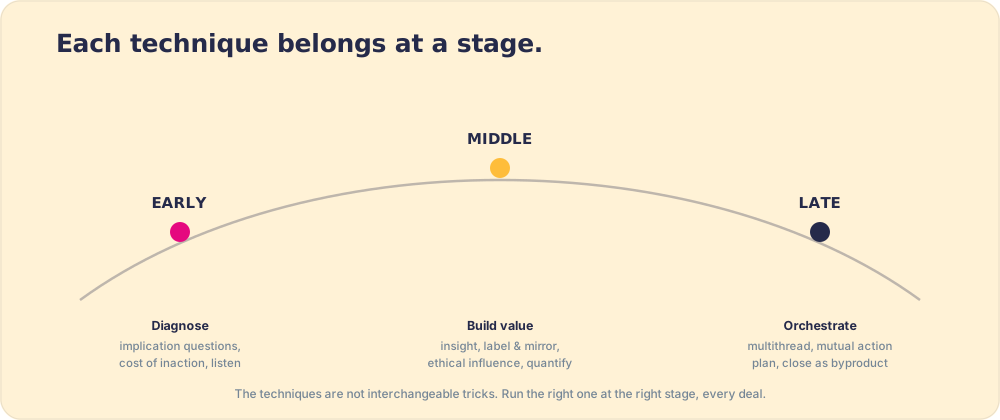
- Diagnose before you pitch. The single highest-value move in selling, and the one most reps skip. Keenan built gap selling on it (current state, future state, the gap), and the discipline is older than the label. Sell nothing until you have diagnosed the buyer’s real problem and its cost. A pitch before a diagnosis is an optician grinding lenses before the eye exam.
- Ask implication questions. Neil Rackham’s team studied 35,000 sales calls across 12 years and found that in large deals, top performers asked roughly four times more implication questions than average reps, the ones that make a buyer feel the growing cost of their problem (Rackham, SPIN Selling). Rackham’s central finding overturned the era’s orthodoxy: the hard-closing techniques the field had taught for decades were built for small consumer sales and break down in large, complex deals, where questioning, not pressure, does the work. The technique is not asking more questions; it is asking the one kind that makes the problem feel expensive. The fuller method is in SPIN selling.
- Sell the cost of inaction. Daniel Kahneman and Amos Tversky showed people feel a loss about twice as hard as an equivalent gain (prospect theory). So a future upside (“you could grow”) is a weak motivator next to a present cost (“you are losing two deals a month now”). Frame the status quo as the expensive choice, because it usually is.
- Lead with an insight (the Challenger move). Matt Dixon and Brent Adamson’s CEB research distilled the best reps into three verbs, “teach, tailor, take control,” and argued they win by teaching the buyer something new about their own business rather than asking what keeps them up at night (The Challenger Sale). It is a genuinely strong technique and a deserved classic. Here we part ways with the popular reading of it: most lists treat “always teach, always challenge” as a universal command, and we think that is wrong for our reader. The Challenger data came from large enterprise deals; in mid-market and SMB, a sharp diagnosis usually outperforms a provocative teach, because a smaller buyer feels lectured faster than an enterprise committee does. Use the teach where the deal is big and the buyer is sure they already understand their problem. Lead with diagnosis everywhere else.
- Multithread the buying group. Gartner finds the typical B2B decision now involves six to ten people (Gartner). A rep working a single contact is one reorg away from losing the deal, and the late discovery of a new stakeholder is the most expensive loop in the sales cycle. Map the group early; sell to the room, not the friend.
- Listen more than you talk. Gong’s analysis of sales calls puts top performers near a 46:54 talk-to-listen ratio while weaker reps dominate the call (Gong). The deal is built in the buyer’s mouth, not the seller’s. Most “talk less” advice stops there; the technique is to engineer the listening with questions, rather than only falling silent.
- Label and mirror (tactical empathy). The former FBI hostage negotiator Chris Voss teaches naming the other side’s emotion, and his labels almost always start the same way: “It seems like… It sounds like… It looks like…” (Voss, Never Split the Difference). Pair that with mirroring, repeating the last few words the buyer said, and they keep talking, usually onto the real objection rather than the stated one. Voss’s own line is the spirit of it: “He who has learned to disagree without being disagreeable has discovered the most valuable secret of negotiation.” A label lowers the buyer’s guard precisely because it disagrees with nothing; it only shows you heard.
- Use ethical influence, not tricks. Robert Cialdini’s Influence documented the levers (reciprocity, commitment and consistency, social proof, authority, liking, scarcity, unity) that move human decisions (Cialdini). The technique that ages best is commitment and consistency, which Cialdini describes as “our nearly obsessive desire to be (and to appear) consistent with what we have already done.” In a deal that means small, voluntary buyer commitments that build toward the decision. The line to hold is ethical; manufactured scarcity is the cousin everyone misuses, and Cialdini himself warns that his principles are weapons that work on the user’s behalf or against the buyer’s interest, depending entirely on the hand that holds them.
- Anchor the next step in a mutual action plan. Co-author a written plan to the decision with the buyer, with dates and owners on both sides. It converts a vague “we’ll be in touch” into a shared commitment and exposes a deal that is not real, because a buyer who will not co-sign the path is telling you something.
- Quantify value in the buyer’s own numbers. A benefit you assert is marketing; a number the buyer says out loud is a business case. Push gently until the buyer puts a figure on the prize, because a value they calculated themselves is one they will defend to their CFO.
- Treat the close as a byproduct, not an event. The strongest “closing technique” is a deal so well qualified and advanced that the close is a formality. Summarize, confirm the next step, and ask. The gimmick closes (the assumptive, the puppy-dog, the takeaway) are lipstick on weak qualification.
Which sales techniques should you retire?
Three that everyone still teaches and the evidence has buried. We are naming them plainly because a list that only adds, and never subtracts, is being polite instead of useful.
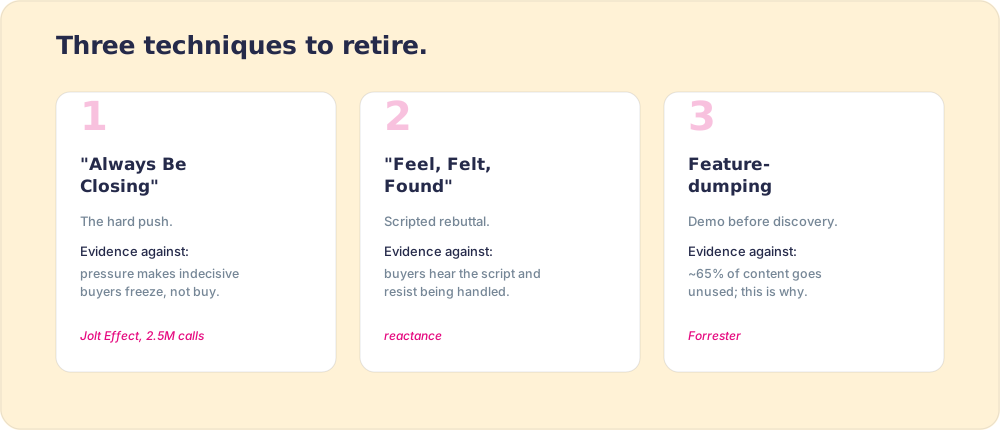
- “Always Be Closing” / the hard push. In The Jolt Effect, Dixon and McKenna analyzed more than 2.5 million recorded sales conversations and found that 40 to 60 percent of qualified deals end in no decision, and that the cause is not a preference for a competitor but the buyer’s own fear of making a mistake (The Jolt Effect). Their punchline lands the contradiction with “Always Be Closing” directly: only by addressing the customer’s fear of failure can you move an indecisive buyer from a verbal yes to a signature. Pressure makes that fear worse, so the harder you push a frozen buyer, the more reasons you hand them to stall. The real competitor is the buyer’s inertia, and you cannot bully someone out of fear. Retire the push; reduce the buyer’s risk instead.
- “Feel, Felt, Found.” The scripted objection rebuttal (“I understand how you feel, others felt the same, here’s what they found”) is so worn that buyers hear the gears turning. Worse, it pattern-matches as a canned move and triggers reactance, the instinct to resist when we sense we are being handled. Acknowledge the real objection and get curious about it instead.
- Feature-dumping before discovery. The demo-first reflex, walking the buyer through the product before diagnosing their problem, is the most common own-goal in software sales. Forrester found roughly 65 percent of sales content goes unused (Forrester); a feature recited against an undiagnosed problem is content nobody asked for, delivered live.
Why does the same technique work for one rep and fail for ten?
Because a technique is knowledge, and knowledge is the part that copies for free. The differentiator is never the move itself; it is whether the move becomes a behavior the whole team runs on every deal. This is the throughline of everything we publish, and it is grounded in one of our core convictions: a mediocre process run on every deal beats a brilliant one run on half.
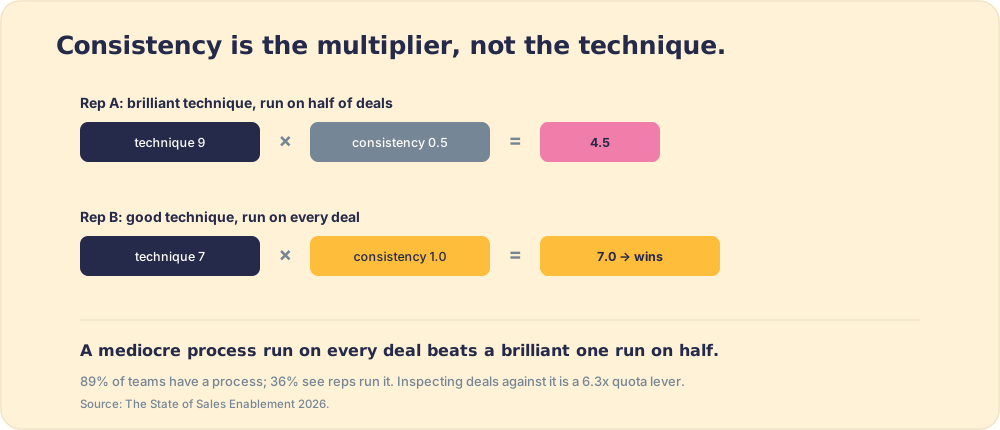
The numbers make the point concrete. The State of Sales Enablement 2026 found that 89 percent of teams have a defined process and only 36 percent see reps follow it, and that teams who consistently inspect deals against their process hit quota at 6.3 times the rate of teams that rarely do (The State of Sales Enablement). Read that against this whole list and the lesson lands: the gap between your team and a better one is almost never a technique they know and you do not. It is the consistency with which the known techniques get run, and whether anyone can see that they did.
How do you make a sales technique stick?
Stop treating technique as training and start treating it as behavior, which means surfacing the right move in the moment and measuring whether it happened. A technique taught in a Tuesday workshop is mostly gone by the next live call (the forgetting curve guarantees it). A technique that shows up the instant the rep needs it, the implication question to ask at this stage, the stakeholder still unmapped, gets run, because in that moment following the process is the easiest thing to do.
That is the deeper subject of sales process adoption: the win is not adding techniques, it is making the few that matter automatic. AI raises the stakes here, because AI amplifies the process you already have. Pointed at a team that runs a clean motion, it compounds the result; pointed at a team that does not, it produces more of the wrong move, faster. Get the behavior right first.
What we recommend
Two ways to use a list like this sit in front of every sales leader. You can treat it as a menu, hand it to the team, run a training on the techniques, and hope they take. Or you can treat it as a behavior problem, pick the three or four techniques that matter most for your motion, surface them in the moment the rep is working, and measure whether reps run them.
We recommend the second, without hedging, and the evidence on this page is why. Rackham, Dixon, Voss, Cialdini, and Kahneman give you techniques that genuinely work. The Jolt data and our own field research say the techniques are not the constraint, consistency is: 89 percent have a process and 36 percent run it, and inspection is a 6.3x lever. So the move is not to collect more techniques. It is to make the right few unmissable in the moment of the work, and inspectable after, so a good motion runs on every deal instead of the lucky ones.
Pick your few, make them a habit, and drop the three that nostalgia keeps alive. If you want the methods these techniques come from, read the sales methodologies guide, SPIN selling, and gap selling; for why a known technique still goes unrun, the sales execution gap; and for the system that makes them stick, the sales playbook guide.
Frequently asked questions
What are the most effective sales techniques?+
Which sales techniques should you stop using?+
Do classic sales techniques still work with modern buyers?+
Why do sales techniques work for some reps but not others?+
Your process, running itself.