Sales Enablement Audit: Stop Counting Assets, Start Grading Adherence
Most sales enablement audits count assets, tools, and programs and report everything present.
Here is the audit that actually predicts whether the spend pays off: one that grades whether the process is followed and whether the system makes the right action easy.
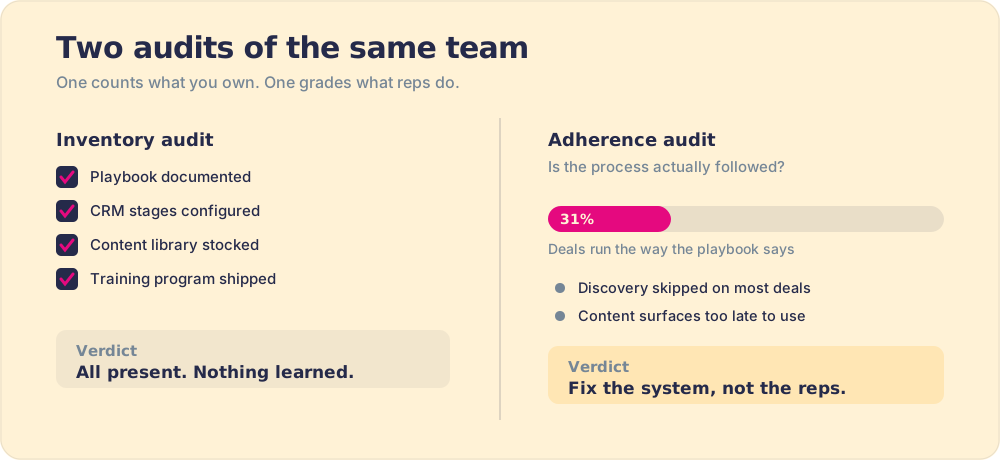
A sales enablement audit is a periodic inspection of how a revenue team is enabled to sell; the audit worth running grades whether the defined process is being followed and whether the system makes the right action easy, not whether the assets exist or reps are trying hard.
Picture the morning a sales enablement audit comes back clean. The playbook is documented. The CRM stages are configured. The content library holds nine hundred approved assets, and the training program shipped on time. Every box is checked, every line reads green, and the deck gets a slide titled “Enablement: healthy.” Now sit in on a deal review the same afternoon and watch what reps actually do: discovery skipped on half the pipeline, the qualification fields blank, the case study that would have moved the deal still sitting unopened in that nine-hundred-asset library. The audit said healthy. The work said otherwise.
That gap is the whole subject here, and almost no audit names it. The market treats a sales enablement audit as an inventory, a stocktake you run until the picture looks complete. Count the assets, list the tools, check the programs, and you have audited enablement. The trouble is that owning the assets tells you nothing about whether the behavior happens. Possession is not use. Our point of view is blunter: an audit is just inspection made periodic, and the only audit worth running grades whether the process is being followed and whether the system makes the right action easy, not whether reps are trying hard. When it finds non-adherence, the finding points at the system, the friction, the late delivery, the missing inspection, never at lazy reps.
So here is the more useful definition. A sales enablement audit is a periodic inspection of how a revenue team is enabled to sell. The version that predicts whether the spend pays off grades whether the defined process is actually followed in the moments that decide deals, and whether the system makes the right action easy. Judge it by the behavior it produces, not the boxes it fills.
What is a sales enablement audit, exactly?
Strip away the templates and an audit is a stocktake with a verdict at the end. You walk the shelves, list what is there, and report the state. Run that way, a sales enablement assessment produces a tidy inventory: a CRM, an engagement tool, a content platform, a training program, a set of playbook docs. Useful as a starting list, and worth doing once. The error is mistaking the list for the answer.
The reason the behavioral reading matters is that the two versions lead to different decisions. Read the audit as an inventory and every gap looks like a purchase: no readiness tool, buy one; thin battlecards, write more. Read it as a behavior check and the question changes to whether reps do the thing the asset was bought for. A playbook nobody runs mid-deal is not a process. It is a document. The asset exists and the behavior is missing, and only one of those shows up when you count the shelves.
This is the same confusion that hollows out a sales enablement audit template you download off the internet. Most of them are a long checklist of things to possess: do you have a value framework, do you have a content taxonomy, do you have an onboarding plan. Every line is answerable with a yes that means nothing about July’s pipeline. A template that grades possession audits the wrong noun. The thing to grade is the verb.
Why do most sales enablement audits miss the real problem?
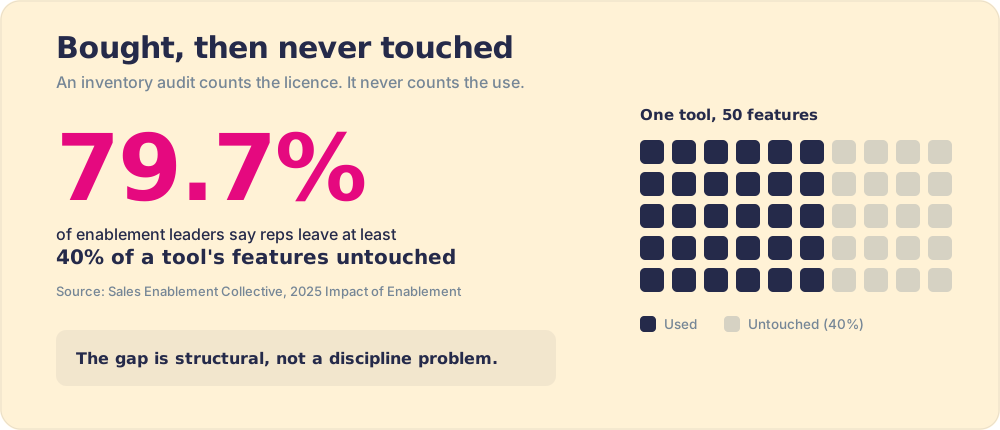
Because they count capability and never count its use, and the two have drifted miles apart. The clearest number on this comes from the Sales Enablement Collective’s 2025 Impact of Enablement report: 79.7% of enablement leaders say their reps leave at least 40% of a stand-alone tool’s features untouched (SEC). Read that slowly. Four out of five teams pay for capability the people it was bought for never use. An inventory audit cannot see that, because the licence is present and the feature exists. The asset is there. The behavior is not.
The content shelves tell the same story. Forrester’s report on the state of sales content found that 65% of the content marketing creates for sellers goes unused, much of it because reps cannot find it or it has gone stale (Forrester). An inventory audit counts that content as an asset on the books. Two-thirds of it never touches a deal, and the count cannot tell the live asset from the dead one.
This is not a discipline failure on the rep’s part, and it is the single most important thing to hold onto in an audit. Features that live in a separate tool, away from the work, do not get adopted, because adopting them means leaving the flow of the deal to go somewhere else. The cause is structural. When the audit finds that gap, it has found a property of the system, not a flaw in the people, and the place every credible reading of the data lands is the same: non-adherence is a system failure, not a people failure.
The budget keeps feeding the miss. Enablement spend is not shrinking, which means more tools, more programs, more shelves to count, and more places a rep has to go. The hard part was never acquiring capability. It is getting capability to show up in the moment a rep needs it, and an audit that only counts what you bought is grading the easy half of the problem.
What should a sales enablement audit grade instead?
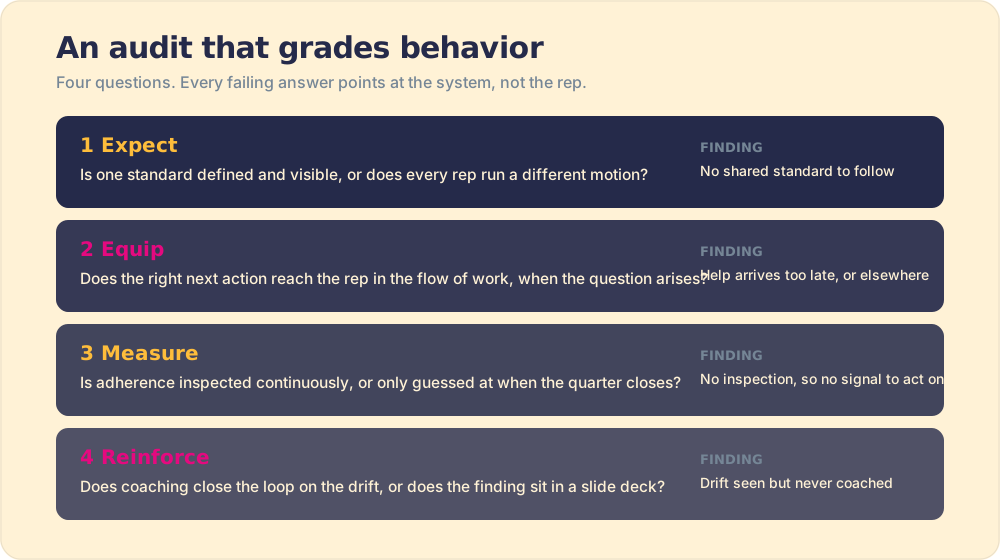
Four things, in order, and each one turns a vague “is enablement working” into a question you can answer on a real deal. Think of it less as a checklist of possessions and more as a loop you inspect: Expect, Equip, Measure, Reinforce. Each grades behavior, and each failing answer points the finding at the system, not the rep.
- Expect: is one standard defined and visible? Before you can grade adherence, there has to be something to adhere to. Audit whether a single motion is written down and reachable, or whether every rep runs their own version. A finding here is not “reps are inconsistent.” It is “there is no shared standard for them to follow,” which is a documentation and visibility problem you fix, not a character flaw you scold.
- Equip: does the right next action reach the rep in the flow of work? Grade the moment of delivery, not the existence of the content. Does the qualification question, the case study, the next step arrive the instant it is relevant, where the rep already works, or does it sit in a tool they have to leave the deal to open? A low grade here means help arrives late or elsewhere. That is a delivery failure in the system.
- Measure: is adherence inspected continuously? This is the keystone, and the one most audits skip entirely. You cannot ask “what should we change?” until you can answer “is the process being followed?” Grade whether adherence is watched as deals move, or only guessed at when the quarter closes. No inspection means no signal, and no signal means the drift is invisible until it is expensive.
- Reinforce: does coaching close the loop? A finding that lands in a slide deck changes nothing. Grade whether the drift the audit surfaces reaches a manager who coaches it, this week, while the work is still in motion. A loop that sees the problem and never acts on it is not enablement. It is reporting.
You might say this is just an audit with extra steps, and that the old inventory still has its place. Fair, and it does. Knowing what assets exist is a reasonable first pass, the way taking stock of the pantry is a reasonable first step before you ask whether anyone can cook. But a full pantry is not a meal, and a stocked enablement shelf is not a sold deal. The inventory tells you what is on hand. The four questions tell you whether any of it reaches the work.
Why does a low adherence score point at the system, not the reps?
Because every reason a rep skips a step is a property of the system that surrounds them. Walk it through. A rep skips discovery: either the expectation was never made checkable, or the prompt to run it never reached them at the moment of the call, or nobody was inspecting whether it happened. Late delivery, missing visibility, no inspection. Look closely at any case of non-adherence and you find one of those three, and all three are things you built, not things the rep is.
This is why the audit’s verdict has to point inward, at the process, and never outward, at the person. The instinct to read a low score as “my reps are undisciplined” is the most expensive mistake an audit can make, because it sends you to write a memo about accountability when the fix is to make the right action easy and visible in the moment. We build tooling instead of selling accountability for exactly this reason. You can lecture a rep about discipline every quarter and the curve will not move, because discipline was never the broken part.
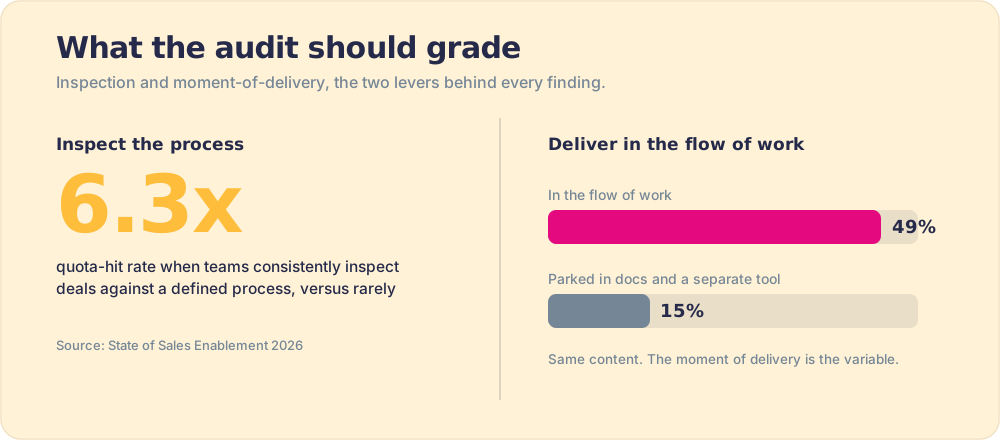
There is hard evidence the lever is the system, not the will. The State of Sales Enablement 2026 found that teams whose guidance is embedded in the flow of work hit quota at 49%, against 15% for teams whose guidance lives in docs, wikis, and a separate tool. Same content. The moment of delivery, a property of the system, more than triples the share of reps hitting quota. No amount of rep effort closes a 49-against-15 gap that the delivery model opened.
Teams whose guidance is embedded in the flow of work hit quota at 49 percent. Teams whose guidance lives in docs, wikis, and a separate tool hit quota at 15 percent. Same content. The system, not the rep's effort, is the variable.
What does a usable sales enablement audit framework look like?
Run the four questions against a sample of real deals, not against your asset list. Pull the last quarter’s closed and slipped deals, and for each one grade the loop: was the standard defined, did the right action reach the rep in the moment, was adherence inspected, did coaching close the gap. The output is not a tidy green checklist. It is a percentage, the share of deals that actually ran the way the playbook said, and a short list of where the system, not the rep, let the motion drift.
The lever the framework exists to find is inspection, and it is worth grading hardest of all. In our survey, teams that consistently inspect deals against a defined process hit quota at 6.3 times the rate of teams that rarely do, the largest single effect we measured (State of Sales Enablement 2026). Inspection is what turns an audit from a once-a-year snapshot into a system you can steer. The catch is that manual inspection eats the time managers should spend coaching, which is why so many teams skip it and fly on intuition instead. The win is automating the inspection burden so the audit runs continuously and the human time goes to coaching the drift.
The payoff is not internal alone. CSO Insights, the research arm now inside Korn Ferry, found that teams running dynamic, data-backed coaching post win rates roughly 28% higher than teams without it (cited via SEC). The 28% does not come from owning a coaching tool. It comes from the coaching happening, reliably, against real deals, which is precisely what the Reinforce question grades. The framework and the lift are the same thing read from two ends.
What we recommend
Two ways forward sit under this topic, and they are not equally good. You can run the audit you were handed, the inventory: count the assets, list the tools, check the programs, and present a clean green deck that tells you what you own and nothing about what your team does. Or you can run the audit that grades behavior: pull real deals, score the loop, report the share that ran to standard, and point every finding at the system that let the motion drift.
We recommend the second, without hedging, and the data is why. The 79.7% of capability left untouched says counting what you bought audits the wrong half. The 49-against-15 quota gap says the moment of delivery, a system property, is the variable. The 6.3x inspection effect says the thing to grade hardest is whether anyone is watching the process at all, and the 28% coaching lift says the loop only pays off when it closes. Those four point one direction. An audit that counts assets grades the easy, comfortable half and misses the gap that decides the number.
So when you run your next sales enablement audit, do not start by counting the shelves. Start by pulling a handful of real deals and asking, of each one, whether the system reached the rep in the moment that mattered. That one change reorders the whole exercise, and it stops you blaming reps for a gap the system opened. If you want the deeper diagnosis of why a well-built process still goes unrun, start with the sales execution gap; if you want to know where your team sits on the longer arc, the sales enablement maturity model maps the stages; and if you want the metrics that turn this audit into an ongoing dashboard, the sales enablement KPIs are where to look next, and the sales enablement software guide is the foundation underneath all of it.
Frequently asked questions
What is a sales enablement audit?+
What should a sales enablement audit include?+
What is the difference between an inventory audit and an adherence audit?+
How often should you run a sales enablement audit?+
Does a low adherence score mean my reps are the problem?+
Your process, running itself.