Pendo vs Gainsight: Analytics, Success, and the Missing Lever
Pendo vs Gainsight comes down to which problem you have: product analytics and in-app guidance, or customer-success management. Here is the honest 2026 breakdown and the lever both leave on the table.
Pendo vs Gainsight is a choice between two different jobs: Pendo is a product-analytics and in-app guidance platform that shows how users behave inside software, while Gainsight is a customer-success platform that manages the post-sale relationship and renewal risk.
Pendo vs Gainsight gets framed as a head-to-head, two product-adoption vendors fighting over the same buyer. That framing is the first mistake, because the two are built for different jobs, and most teams who pit them against each other are trying to decide which of two problems they have. So before the comparison, the honest move is to separate the jobs, because once they are separate the choice nearly makes itself. Both are strong tools with strong reviews. The interesting question is not which is better; it is which question you are really asking, and a third question neither of them answers.
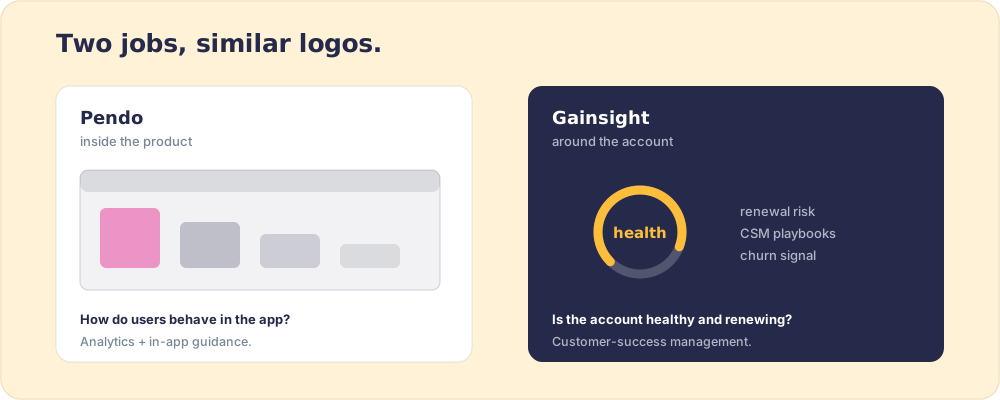
Pendo vs Gainsight is a choice between two different jobs wearing similar logos: Pendo is a product-analytics and in-app guidance platform that shows how users behave inside software, while Gainsight is a customer-success platform that manages the post-sale relationship and renewal risk. Hold that line, because nearly every other difference flows from it.
What does each tool do best?
Pendo lives inside the product. It instruments your software to show how users behave: which features they touch, where they abandon, how a cohort moves from first login to habit. Then it lets you act on that signal from the same place, with in-app guides, tooltips, and onboarding flows you ship without an engineering ticket. Its appeal is the loop: see the behavior, change the behavior, see if it moved, all in the product. Reviewers reward it for exactly this. On G2, Pendo carries a 4.4 out of 5 across roughly 1,765 reviews as of mid-2026, with users consistently praising the combination of analytics and in-app guidance (Pendo on G2). It has also kept widening, acquiring Chisel Labs in February 2026, its fourth acquisition in eighteen months, to push further into AI-assisted product management (Pendo, on the Chisel Labs acquisition).
Gainsight lives around the relationship. It is a customer-success platform: it pulls signals from usage, support, and contracts into an account health score, flags renewal and churn risk, and orchestrates what the customer-success manager does about it, the playbooks, the check-ins, the escalations. Its job is keeping accounts healthy and renewing across the whole post-sale lifecycle. It is well regarded in that lane: Gainsight Customer Success holds a 4.5 out of 5 across roughly 1,632 G2 reviews as of mid-2026 (Gainsight Customer Success on G2), and the company has been owned by Vista Equity Partners since a 2020 take-private valued at about 1.1 billion dollars. Gainsight PX overlaps with Pendo on in-product analytics, but the company’s heart is account management, not feature usage.
So the choice resolves on which question keeps you up at night, and a clean pendo vs gainsight comparison names the split rather than counting features:
- The product question. If you need to know how users behave inside the app and guide them there, that is product adoption software, and Pendo is the more direct answer.
- The account question. If you need to know whether accounts are healthy and will renew, and to run the CSM motion against that, that is customer success software, and Gainsight is built for it.
- The overlap. Both stretch into the other’s edge (Gainsight PX into analytics, Pendo into broader product ops), so a team can run both for different reasons without redundancy.
Pendo vs Gainsight: how should you choose?
The decision is cleaner than the marketing makes it look.
| Pendo | Gainsight | |
|---|---|---|
| Core job | Product analytics + in-app guidance | Customer success + renewal management |
| Answers | How do users behave in the product? | Is the account healthy and renewing? |
| Lives | Inside the application | Around the account relationship |
| G2 rating (mid-2026) | 4.4 / 5 (~1,765 reviews) | 4.5 / 5 (~1,632 reviews) |
| Status (2026) | Independent; acquired Chisel Labs Feb 2026 | Independent; owned by Vista since 2020 |
| Best for | Product teams driving feature adoption | CS teams managing post-sale health |
Choose Pendo if your problem is in-product behavior: onboarding, feature adoption, finding where users drop. Choose Gainsight if your problem is account health: renewal risk, CSM orchestration, the post-sale relationship. If you are a gainsight vs pendo shopper who genuinely has both problems, running both is defensible, since they instrument different layers.
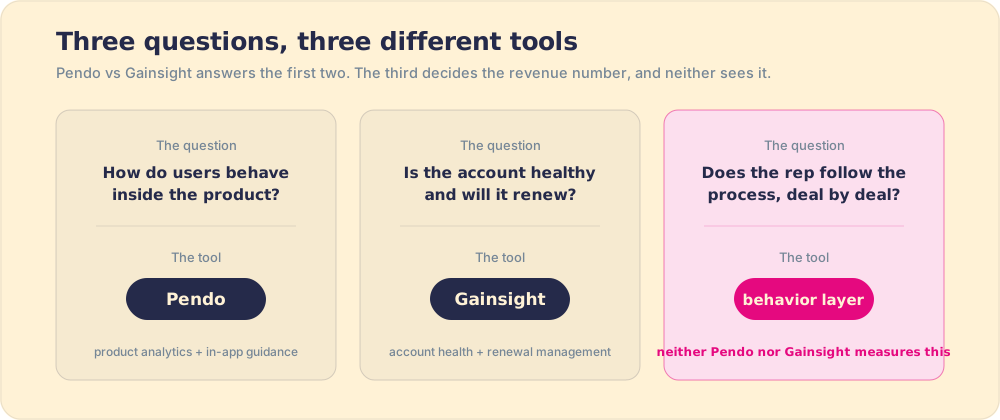
Why does neither answer the question of a team running a process?
Because both were built for the product and customer-success motions, and a process a team runs by hand is a different animal with a different failure point. Pendo and Gainsight are superb at telling you what happened: which features got used, which accounts are trending down. What they do not do is define the standard a team should follow while the work is live and check, case by case, whether it is followed.
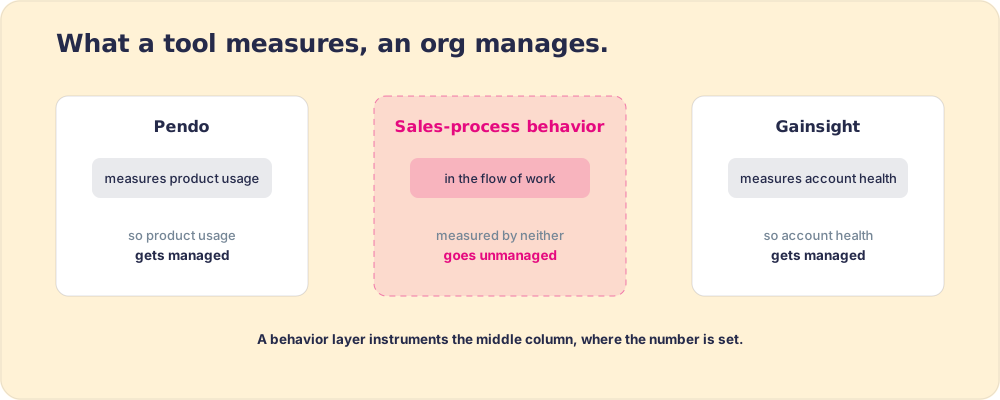
There is a principle underneath this worth naming, from the management theorist Peter Drucker, who is widely paraphrased as saying that what gets measured gets managed (Drucker, on management by objectives). The deeper, less-quoted half is the warning inside it: you tend to manage only what your tools measure, so the tool you pick decides which behaviors get attention and which go dark. Pendo measures product usage, so product usage gets managed. Gainsight measures account health, so account health gets managed. Neither measures whether a team ran the documented steps, recorded the real requirements, and took the next right step in the flow of work, so for a services firm onboarding a big client, the behavior that protects the account goes unmanaged by default. The tool’s blind spot becomes the org’s blind spot.
Notice that this is not a knock on either tool. It is a category boundary. Pendo and Gainsight are both, at root, instruments for a product or a relationship, and they are strong inside those walls. Pendo’s in-app guidance even proves the deeper point in the team’s favor: a tooltip that appears at the moment of confusion changes user behavior precisely because it arrives in the flow of the work, not in a help center the user would have to leave to find. That is the same mechanism an internal team needs, applied to a different surface. The product team gets a behavior layer for the end user inside the app. The team onboarding a client across project software, the inbox, and a call recording has no equivalent instrument watching whether the process is followed (a sales team running a deal is one more instance of the same unmet need). The lesson Pendo teaches about end-user adoption, that guidance in the moment beats documentation out of the moment, is the digital adoption principle, and it is exactly the lesson most internal teams have never applied to their own process. The tool that guides the customer inside the product does not guide the team through the work.
What we recommend
Stop treating pendo vs gainsight as one decision; it is two questions you can answer independently. If you need to understand and guide how users behave inside your product, Pendo is the more direct product adoption software. If you need to keep accounts healthy and renewing, Gainsight is the customer success software built for it. Many teams legitimately run both, because they instrument different layers of the same business.
What neither will do is manage an internal process a team runs by hand. Drucker’s principle is the reason: you manage what your tools measure, and both of these measure something other than the team’s behavior in the flow of work. If that behavior is where your outcomes leak, a services firm onboarding a big client being the sharpest case, the fix is not a product analytics tool or a customer-success platform; it is a behavior layer that lives where the team works, sets the standard, and inspects adherence so the process is followed rather than assumed.
From here: the wider category in digital adoption, the independent options in Pendo alternatives, the same measured-behavior argument in user adoption, and the data on the process gap in the sales execution gap.
Frequently asked questions
What is the difference between Pendo and Gainsight?+
Is Pendo or Gainsight better for product adoption?+
Did Pendo get acquired or make acquisitions recently?+
What do Pendo and Gainsight both miss for teams running an internal process?+
Your process, running itself.