Knowledge Transfer: Methods That Make the Handoff Land
Knowledge transfer is moving what one person knows to another so the receiver can do the work.
The methods that carry tacit know-how, why handover sessions fail, and how to prove the transfer happened.
Knowledge transfer is moving specific knowledge from one person or group to another so the receiver can do the work unaided, and it is complete only when the receiver performs without the source in the room.
A relay race is often decided in the handoff, in the half-second when the baton has to pass from one fist into another at full speed. At the 2008 Beijing Olympics, both American 4x100 teams, men and women, had the legs to contend, and both went out before the final on dropped batons. The speed was there. The pass was not.
Knowledge transfer is that handoff, and companies grade it by the first runner: the handover doc written, the training delivered, the session held. The research says the race turns on the receiving hand. Gabriel Szulanski studied 122 transfers of best practice inside eight companies and found that the barriers were mostly about the knowledge and the receiver, not about motivation; firms fail at transfer, he concluded, “less because organizations do not want to learn and more because they do not know how to” (Szulanski, 1996). So the work is in the how: methods matched to the kind of know-how being moved, and a way to prove the baton landed.
What is knowledge transfer?
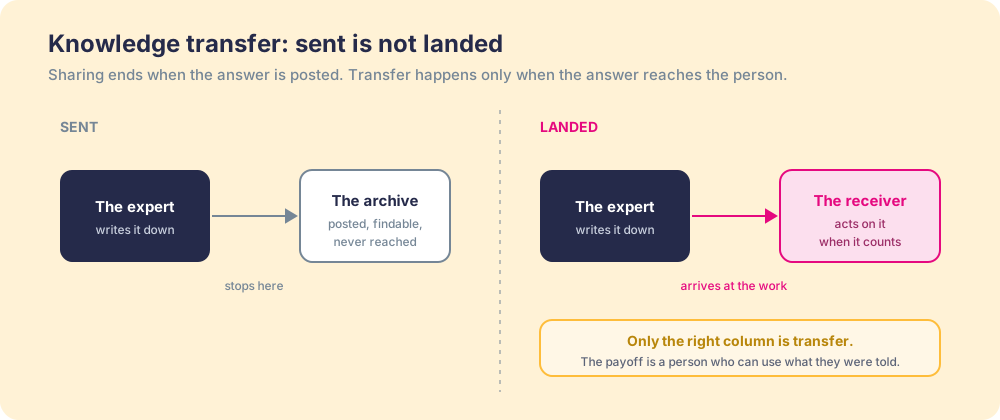
Knowledge transfer is moving specific knowledge from one person or group to another so that the receiver can do the work unaided. The test is the receiver’s performance. If the new owner of a book of accounts runs the renewal the way the departing rep would have, the transfer happened. If they have a forty-page handover doc and call the old rep every week, it did not.
Three situations account for most of it on a revenue team:
- The handover. A rep leaves, gets promoted, or changes territory, and their accounts, relationships, and half-finished deals go to someone else.
- The ramp. A new hire has to learn how this team sells, which is mostly knowledge that lives in the heads of the people already here.
- The spread of a practice. One team figures out a better discovery call or renewal motion, and the company wants the other teams running it.
Transfer is narrower than knowledge sharing, the everyday habit of a team passing what it knows around. Sharing is many-to-many and ongoing. Transfer has a named sender, a named receiver, a deadline, and a pass or fail. It is also different from training, which teaches a skill to many people at once; transfer moves one person’s particular know-how, often knowledge that was never written down, to the person who has to carry it next.
What is the difference between tacit and explicit knowledge transfer?
Some knowledge fits in a document and some does not, and the methods that work for one fail for the other.
Explicit knowledge is the part you can write: the discount approval rule, the contract terms on an account, the steps to build a renewal quote. It transfers well through documents, checklists, and job aids. Tacit knowledge is the part that resists words. The philosopher Michael Polanyi put it in one line in 1966: “we can know more than we can tell” (Tacit knowledge). The departing rep knows that one customer’s CFO stops asking questions when she is about to say no, and that the champion at another account needs a heads-up before any email goes to his boss. Ask them to write down everything they know about the account and neither will make the doc, because they do not know they know it.
The best-known story of tacit transfer comes from Matsushita in the 1980s, told by Ikujiro Nonaka and Hirotaka Takeuchi. The company was building a home bread-making machine and the bread came out wrong. A software developer named Ikuko Tanaka apprenticed herself to the head baker at the Osaka International Hotel and watched him knead until she saw what no recipe described: he twisted the dough as he stretched it. The engineers built that “twisting stretch” into the machine. The baker could not have written it down. She had to stand next to him.
That story is the template for any handover of judgment. Someone who will carry the knowledge has to watch it done, try it, and get corrected. A handover doc can carry the account history. It cannot carry the CFO’s tell.
Why do knowledge transfer sessions so often fail?
The typical handover is a one-time meeting: the departing person walks the receiver through everything, maybe records it, and leaves a doc. Both leave feeling the knowledge moved. A month later the receiver is calling the old owner, or worse, cannot reach them. Szulanski’s study names three reasons, and none of them is that someone did not try:
- Absorptive capacity. The receiver lacks the background to take the knowledge in. A new rep told about a five-year account history in an hour has nowhere to put most of it, the way a chess position means little to someone who has never played.
- Causal ambiguity. The source cannot fully explain why the practice works. The top rep’s renewal rate is real, but which of her habits produce it is unclear, so the transfer copies the visible steps and misses the ones that count.
- An arduous relationship. The source and receiver do not have the easy, repeated contact that transfer needs. A departing employee with two weeks left and a full calendar is the extreme case.
Then memory does the rest. Hermann Ebbinghaus measured his own forgetting in the 1880s and found it steep and early; later summaries put the loss at roughly 70 percent of new information within a day without reinforcement (Forgetting curve). A handover session crammed into one afternoon is mostly gone by the time the first renewal on that account comes up, and there is no second delivery when it does.
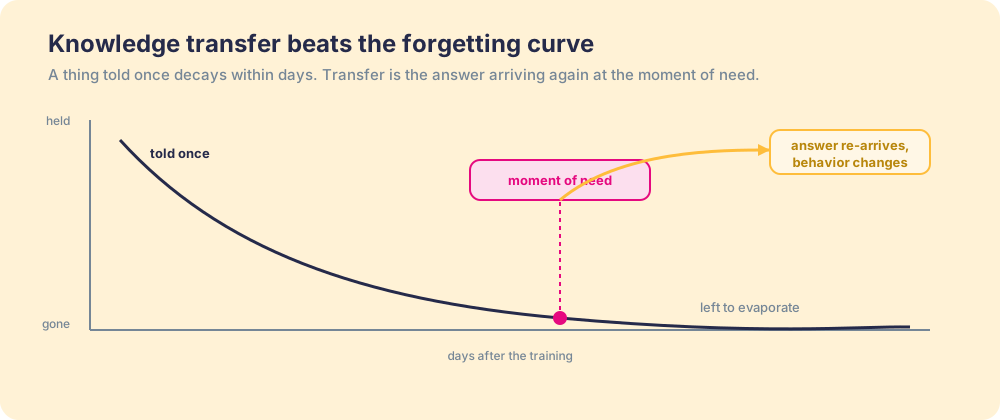
Put the three barriers and the curve together and the familiar complaint answers itself: the marketing-to-sales or sales-to-success handoff that needs hours of transfer sessions and still does not work. The sessions are one-time tellings, to a receiver without context, of knowledge that is partly tacit, delivered weeks before it is needed. More sessions of the same shape will fail the same way. For the specific seam between closing and onboarding, see the sales to customer success handoff.
What are the main knowledge transfer methods?
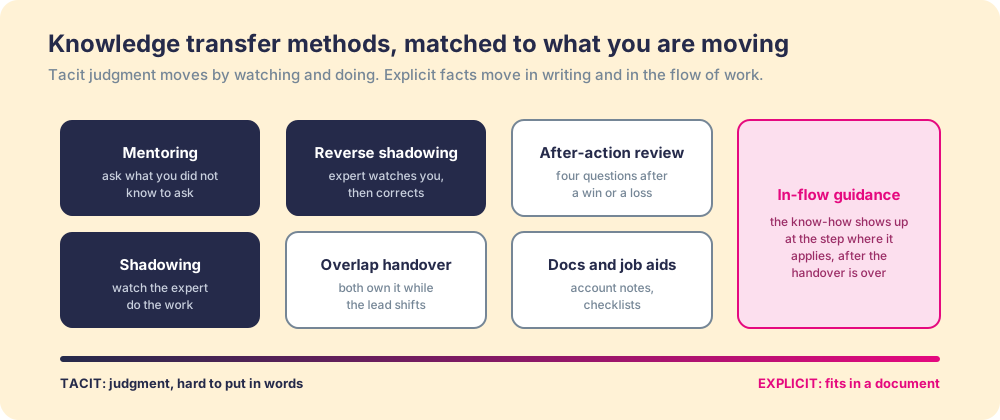
Match the method to the kind of knowledge and the size of the gap. These are the ones that work, roughly ordered from most tacit to most explicit:
- Mentoring. A sustained relationship where the receiver can ask the question they did not know to ask in the handover meeting. Best for judgment that builds over months; it directly fixes Szulanski’s arduous-relationship barrier.
- Shadowing. The receiver sits in on the expert’s calls and meetings. Tanaka learned the twisting stretch this way: watch until you see what the words leave out. Most useful early, before the receiver owns anything.
- Reverse shadowing. The expert watches the receiver run the call and corrects afterward. This catches the gap between what the receiver thinks they learned and what they do, which shadowing alone never reveals.
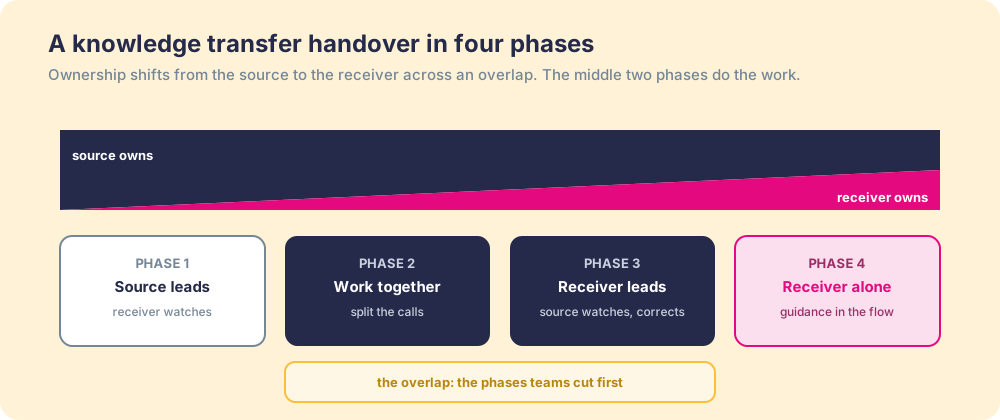
- Structured handover with overlap. Both people own the accounts for a set period, with a planned shift from “I lead, you watch” to “you lead, I watch.” The overlap gives the receiver time to move from watching to doing, and it is the first thing cut when notice periods are short.
- After-action reviews. The U.S. Army’s method for turning an event into shared learning, built on four questions: What was supposed to happen? What actually happened? Why were there differences? What can we learn? (Center for Army Lessons Learned, via CityGov). Run one with the receiver after a lost deal and the departing rep’s reasoning comes out in the open.
- Documentation and job aids. Account notes, contract summaries, the renewal checklist. Necessary for the explicit layer and nearly useless for the tacit one. Capture the account-level tribal knowledge here, but do not mistake the doc for the transfer.
- In-flow guidance. The know-how shows up at the step where it applies, inside the CRM or email draft, so the receiver gets the reminder when the situation arrives instead of weeks earlier in a meeting. That timing beats the forgetting curve.
How do you measure whether knowledge transfer happened?
Measure the receiver, not the sender. The usual handover checklist tracks inputs: sessions held, docs written, accounts reassigned in the CRM. Those prove effort. They do not prove the receiver can do the work. Four checks do:
- Unassisted performance. The receiver runs the task without the source available: the renewal call, the pricing exception, the escalation. It decides pass or fail.
- Time to first unassisted run. How many days from the handover until the receiver handles the situation alone. Shorter is better, and comparing it across handovers shows which methods work on your team.
- Teach-back. The receiver explains the account or the practice back in their own words, including why. Gaps in the “why” are Szulanski’s causal ambiguity showing up before it costs a deal.
- Error rate against the source. Do the receiver’s deals stall at the same rate and the same stages the source’s did? If they stall somewhere new, part of the know-how did not transfer.
The timing of delivery shows up in outcomes. In our State of Sales Enablement research, 49 percent of reps hit 76 to 100 percent of quota when guidance lived in the flow of work, against 15 percent when it sat in docs or wikis (The State of Sales Enablement). The knowledge in both groups was available. In the first group it reached the rep at the moment of the work, which is where transfer either happens or does not.
What does a knowledge transfer plan look like?
A plan for a handover fits on one page. Run it in four overlapping phases, then fill in the table.
| What to transfer | Explicit or tacit | Method | Owner (source / receiver) | Proof it landed |
|---|---|---|---|---|
| Account history and contract terms | Explicit | Account notes, job aid | Source writes / receiver reviews | Receiver answers five contract questions without the doc |
| Stakeholder map and politics | Tacit | Shadowing on two calls, then a mentoring session | Source / receiver | Receiver names the real decision-maker and why |
| Renewal motion for each account | Mostly tacit | Reverse shadowing on the next renewal call | Receiver leads, source watches | Receiver runs the call unaided |
| Open deals and risks | Both | Joint deal review, then an after-action review on any loss | Both | Deals close or stall at the source’s historical rate |
| Team practices and plays | Explicit | In-flow guidance at the relevant stage | Manager | Receiver runs the play at the step it applies |
The last column is the one people skip, and it is the plan. Without proof that the knowledge landed, the plan is a list of meetings. For the onboarding version of this, see how sales onboarding ramps new reps, and for keeping the know-how after the person leaves, knowledge retention.
What we recommend
Run every important handover as a short project with a pass mark, and treat the handover meeting as its first step rather than the whole of it. Sort the knowledge into explicit and tacit. Send the explicit layer through documents and in-flow guidance, and the tacit layer through shadowing, reverse shadowing, and mentoring. Protect the overlap. Then hold off on calling it done until the receiver has run the work unaided.
The evidence lines up behind that plan. Szulanski’s 122 transfers put the barriers in the knowledge and the receiver, which more sessions of the same shape do not fix. Ebbinghaus shows a single telling fading within a day. And our data shows guidance in the flow of work more than triples the share of reps near quota compared with knowledge left in docs. A long transfer session feels thorough. A receiver who runs the renewal call alone is the only evidence the baton landed.
Transfer moves know-how between two people. Keeping a whole team’s knowledge circulating day to day is a different habit, covered in knowledge sharing, and running the full cycle from identifying critical knowledge to retiring stale answers is the knowledge management process. Related reading: where expertise hides in tribal knowledge, what to keep in the internal knowledge base, the sales-specific build in the sales knowledge base, and the cost of answers that never reach the rep in the sales execution gap.
Frequently asked questions
What is knowledge transfer?+
What are the main knowledge transfer methods?+
Why do knowledge transfer sessions fail?+
What is the difference between tacit and explicit knowledge transfer?+
How do you measure knowledge transfer?+
What goes in a knowledge transfer plan?+
Your process, running itself.