Chorus Alternatives: Past the Recording, to the Moment
Chorus is now ZoomInfo Chorus, which reshapes the alternatives question. Here is the honest 2026 list of conversation intelligence options and the deal-moving job none of them was built to do.
Chorus alternatives are the conversation-intelligence tools teams weigh against Chorus, now sold as ZoomInfo Chorus; the credible options are Gong, Fireflies, and Avoma for call analysis, plus a behavior layer for teams whose goal is changing what reps do while the deal is live.
Chorus alternatives is a search that outgrew its own premise, because the thing being compared changed owners. Chorus.ai is now ZoomInfo Chorus: ZoomInfo bought it in 2021 and folded it into the suite, and by 2026 reviewers note its standalone roadmap has slowed as development bends toward platform integration, leaving it “increasingly hard to recommend over Gong” for a team not already on ZoomInfo (ZoomInfo acquires Chorus.ai; Chorus by ZoomInfo review, 2026). So part of the honest answer is that some teams are not shopping for a better recorder; they are shopping for a way off the ZoomInfo stack. And a larger group is after something a recorder was never built to give. Both deserve a straight answer.
Chorus alternatives are the conversation-intelligence tools teams weigh against Chorus, now sold as ZoomInfo Chorus, with the credible options being Gong, Fireflies, and Avoma for call analysis, plus a behavior layer for teams whose real goal is changing what reps do while the deal is live. Hold that fork, because the right alternative depends entirely on which side of it you are on.
The honest place to start is that a fork is hiding inside the search box. Two different people type “chorus alternatives.” One has compared recorders, likes the category, and wants a better or cheaper one, a clean shopping problem with clean answers. The other has watched call recordings for a year, learned exactly what their reps do wrong, and keeps searching anyway, because watching has not changed a single call. That second person does not need another recorder. They have mistaken a behavior problem for a tooling problem, and no entry on the conversation-intelligence list will fix it. Sorting which person you are is the most useful thing this page can do, so do it first.
Who are the credible Chorus alternatives?
Sort them by what you want, and a clean read of the zoominfo chorus alternatives names the trade for each:
- Gong, the leader. The deepest standalone conversation intelligence, with the richest deal and forecast analytics and the largest review base in the category, north of 6,400 reviews at 4.7 of 5 on G2 and named G2’s #1 Best Software Product in multiple years. The default if call analysis is a priority in its own right.
- Fireflies and Avoma, the lighter options. Lower-cost tools strong on transcription, meeting notes, and basic analysis, with Avoma listing around $49 per user per month, a fit for smaller teams that want the recording and search without enterprise pricing (Avoma pricing).
- Staying on ZoomInfo Chorus. Defensible if you already run ZoomInfo and value one contract with your contact data and intent signals over best-of-breed depth.
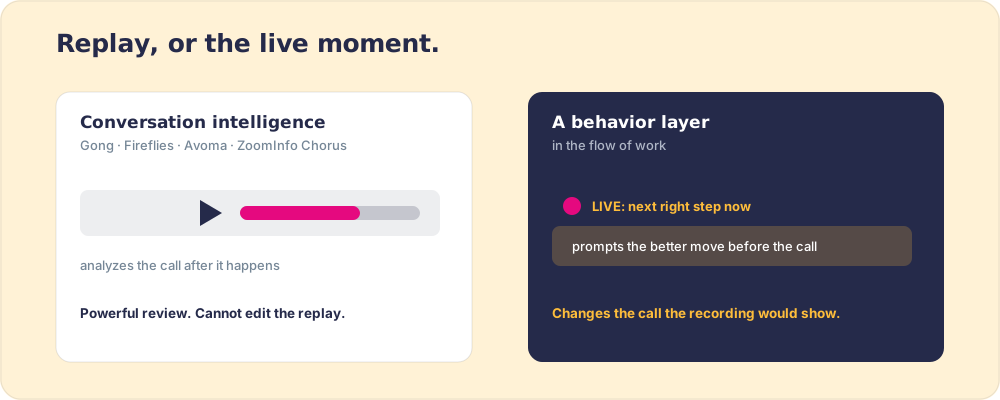
- A behavior layer, off the axis. Not conversation intelligence at all, for teams whose goal is changing rep behavior while the deal is live rather than analyzing it afterward.
Be fair to Chorus first, with proof, because the evenhandedness is what makes the verdict credible. As conversation intelligence software it does the core job competently, and inside a ZoomInfo shop the consolidation is real value: calls analyzed against the same contact data and intent signals that power prospecting, under one contract and one login, which is exactly the kind of stack simplification a mid-market RevOps lead is right to want. If your team already lives in ZoomInfo, Chorus is most likely the correct pick, and you can stop reading. The honest case against it is not quality; it is ownership. Since 2021 its roadmap answers to ZoomInfo’s platform priorities rather than to conversation intelligence as a standalone race, which is why the 2026 reviews keep landing on the same line: capable, but hard to choose over Gong unless the suite is the reason you are choosing it.
How should you choose a Chorus alternative?
The table sorts the call-analysis options, then names the one that sits off the axis.
| ZoomInfo Chorus | Gong | Fireflies / Avoma | Behavior layer | |
|---|---|---|---|---|
| Core job | Call analysis in the suite | Deep standalone call analysis | Lightweight transcription + notes | Change rep behavior while live |
| Best for | ZoomInfo shops wanting one contract | Teams wanting best-of-breed depth | Smaller teams, lower budget | Teams whose gap is execution |
| Works | After the call | After the call | After the call | In the flow of work |
| Status (2026) | Part of ZoomInfo (since 2021) | Independent leader | Independent | Runs inside the CRM |
Choose Gong if conversation intelligence is a priority and you want the deepest analysis without being tied to a suite. Choose Fireflies or Avoma if you want capable recording and notes at a lower price. Stay on ZoomInfo Chorus if you are committed to ZoomInfo and value consolidation. Choose a behavior layer if analyzing calls is not the gap, and what you need is for reps to run the call right the first time. (Teams who type chorus.ai alternatives expecting a recorder list often land here once they name the gap.)
Why do Chorus alternatives all share the same blind spot?
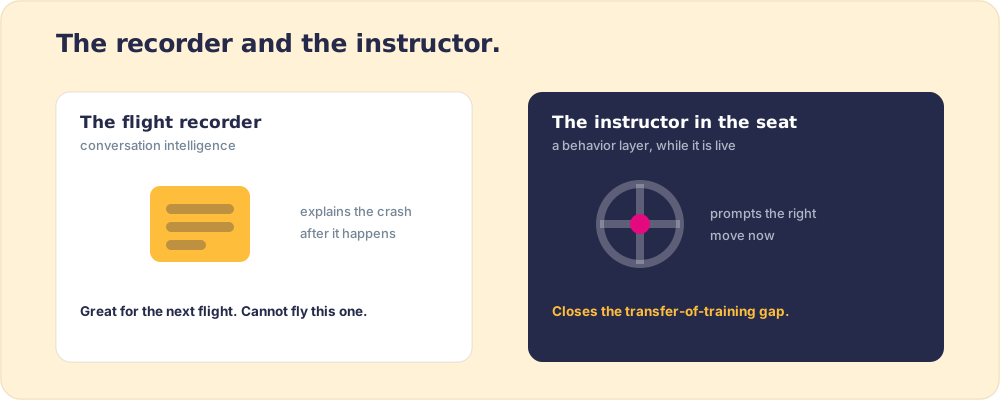
Because they all do their work after the call, and you cannot edit a recording of a deal that already went sideways. Conversation intelligence is a flight recorder. After a crash it tells you, with precision, what went wrong, and that is real value for the next flight. What it cannot do is fly the current plane. By the time the recorder has the data, the call is over and the outcome is set. The recorder is innocent of this. It was built to explain, and it explains beautifully. We keep asking it to do a second job, change the next call, that no recording can do.
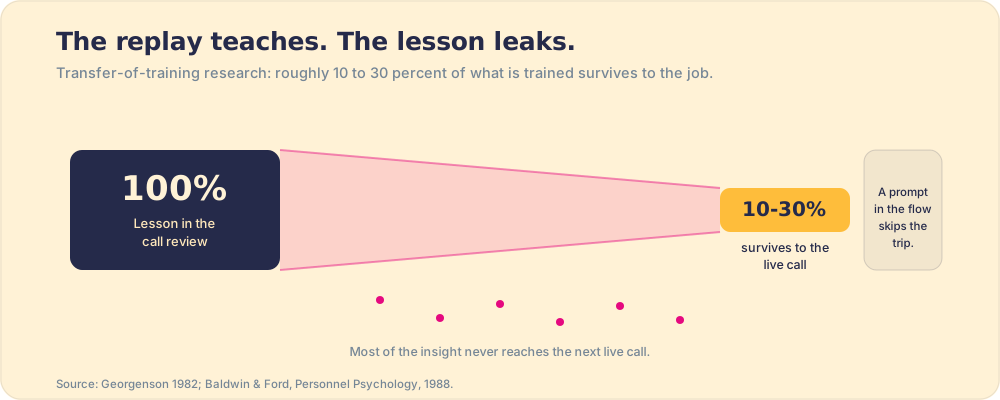
There is a learning-theory reason this matters more than it looks, and it is older than any of these products. Researchers have studied “transfer of training” (whether a skill learned in one setting shows up where the work happens) for forty years, and the recurring, uncomfortable finding is that most of it does not transfer. The figure that has echoed through the literature since Georgenson floated it in 1982, and that Baldwin and Ford carried into their landmark 1988 review, is that perhaps only ten percent of what is trained ever changes behavior on the job; later, more careful estimates put the band at roughly ten to thirty percent, still a leak of most of the value (Baldwin & Ford, “Transfer of Training,” Personnel Psychology, 1988). Reviewing a recorded call is a training event: the rep watches what went wrong and learns what to do differently. The transfer research says that lesson will usually not survive the trip to next week’s live call, because the insight is filed in memory under “things I learned in a review,” and the decision arrives somewhere else entirely, under pressure, with no recorder in the seat to prompt the better move. The lesson is in last Thursday’s replay; the moment is now. That gap is not a flaw in Gong or Chorus or any one product. It is structural to the whole category, because the category’s job ends when the call does.
This is also why “more coaching off the recordings” disappoints so reliably. The recordings make the coaching better informed, which is real, but the coaching still lands in the review room and has to travel, unaided, to the next live conversation, exactly the trip the transfer data says most lessons do not complete. To close a behavior gap you have to deliver the prompt where the behavior happens, not where it gets graded afterward.
What we recommend
If your goal is better call analysis, choose on the merits. Gong for the deepest standalone conversation intelligence, Fireflies or Avoma for lighter and cheaper transcription and notes, or stay on ZoomInfo Chorus if consolidation on ZoomInfo is the priority. All are credible, and the ownership fact should weigh heaviest if you are not a ZoomInfo customer, because it tells you whose roadmap Chorus now serves.
But if you keep returning to Chorus alternatives because reps are not running calls well, recognize that no recorder fixes that. The transfer-of-training problem is the reason: a lesson from last week’s replay rarely survives to next week’s live call, because it is absent at the moment of action. The fix is not a sharper recording; it is a behavior layer that puts the right step in front of the rep in the flow of work, before the call, so the call goes the way you would otherwise only see in the replay.
From here: the category in full in conversation intelligence, the leader-versus-suite question in Gong vs Chorus, the engagement side in Gong vs Salesloft, and the data on the execution gap in the sales execution gap.
Frequently asked questions
What are the best Chorus alternatives in 2026?+
Is Chorus still a standalone product?+
What is the difference between Chorus and Gong?+
What do all Chorus alternatives have in common?+
Your process, running itself.