Gong vs Chorus: Same Job, and Why It Is Not Your Job
Gong and Chorus are the two big conversation intelligence platforms.
Here is the honest 2026 comparison, what each is best for, and why the deal-moving problem sits outside what either one was built to do.
Gong vs Chorus is a choice between the two leading conversation intelligence platforms, both of which record and analyze sales calls after they happen, with Gong the standalone leader and Chorus now embedded inside ZoomInfo's go-to-market suite.
Gong vs Chorus is the comparison most revenue teams reach for when they decide they need conversation intelligence, and it is a fair fight between two capable products. It is also, for a lot of teams, the wrong fight, because the two options are more alike than the comparison implies, and the thing they have in common is the thing that limits what either can do for your number. So here is the honest version: what each is genuinely best at, how ZoomInfo changed the math on Chorus, and where the deal-moving problem lives.
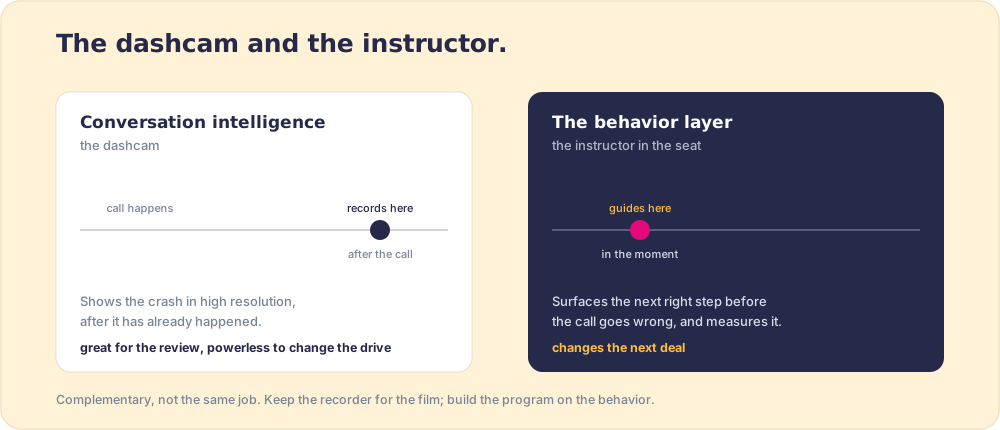
Gong vs Chorus is a choice between the two leading conversation intelligence platforms, both of which record and analyze sales calls after they happen, with Gong the standalone leader and Chorus now embedded inside ZoomInfo’s go-to-market suite. Hold onto the phrase after they happen. It is the whole argument.
What do Gong and Chorus do?
The same job, with different polish. Conversation intelligence records sales calls, transcribes them, and runs analysis on top: which topics moved deals, where reps talked past objections, how much the customer spoke, which deals show risk in the language. It turns the call, previously a black box that lived only in the rep’s memory, into searchable, coachable data. That is a different job from conversational AI for sales, which talks to the buyer in real time at the front door; conversation intelligence listens to the rep after the call. That is real value, and we say so plainly: a team flying blind on what happens inside calls gains a great deal from either tool.
Gong is the standalone leader, and in 2026 it is repositioning fast. The company hit a $500 million annual revenue run rate, acquired RightBound to add contact and account signal, and launched “Mission Andromeda,” an initiative that adds an AI coaching chatbot and open Model Context Protocol integrations under the frame of a Revenue AI OS (Ctech, Gong $500M ARR). The G2 review base remains among the largest in the category. If you want best-of-breed conversation intelligence as its own platform, Gong is still the default, but the platform it is building in 2026 is expanding well past call recording.
Chorus is now ZoomInfo Chorus, and the trajectory since the 2021 acquisition is telling. As of 2025 and into 2026, Chorus is sold as an add-on module within the ZoomInfo platform rather than a standalone product, meaning you cannot buy Chorus independently from ZoomInfo’s broader data and sequencing suite. Development has continued, including new engagement filters and plain-English call search added in 2026, but the strategic logic is bundle, not standalone excellence. Read against that, Chorus is less a standalone choice than a reason to consolidate on ZoomInfo. It does core conversation intelligence competently; its strategic appeal is being part of one go-to-market stack rather than winning a head-to-head on analytics depth.
How do you choose between Gong and Chorus?
If you have decided you want conversation intelligence, the choice (gong vs chorus, or chorus vs gong, the same question reversed) is less about features and more about stack philosophy.
| Gong | Chorus (ZoomInfo) | |
|---|---|---|
| Position | Standalone category leader | Component of ZoomInfo’s suite |
| Strength | Deepest deal and forecast analytics | Bundled with ZoomInfo data and sequencing |
| Best when | You want best-of-breed, willing to pay for it | You already run ZoomInfo and want one contract |
| Independence | Independent roadmap | Tied to the ZoomInfo platform roadmap |
Choose Gong if conversation intelligence is a priority in its own right and you want the deepest analysis, the broadest integrations, and a roadmap that is not subordinate to a larger suite. Choose ZoomInfo Chorus if you are already a ZoomInfo shop, or about to be, and the value of one consolidated contract, with calls analyzed against the same data that powers your prospecting, outweighs squeezing the last increment of analytics depth. That is the real Gong vs Chorus decision, and for most teams it resolves on stack, not on a feature shoot-out.
Why did Chorus stop being standalone? The economics behind the choice
The reason this resolves on stack and not features is not an accident of strategy; it is an economic law, and naming it tells you what you are deciding. Clayton Christensen called it the law of conservation of attractive profits: when one stage in a value chain becomes modular and good enough, it commoditizes, and the attractive profits migrate to an adjacent stage that is still scarce and integrated (Christensen, on conservation of attractive profits). Conversation intelligence, the call-analysis component, got good enough to commoditize, so the profit drained out of owning a standalone analyzer and pooled in the integrated suite next door, the data, the intent, the sequencing. That is why ZoomInfo bought Chorus and folded it in, and why Gong, to stay independent and premium, has had to keep widening into deal and forecast analytics. Neither move is about transcription quality. Both are about where in the chain the scarce value sits.
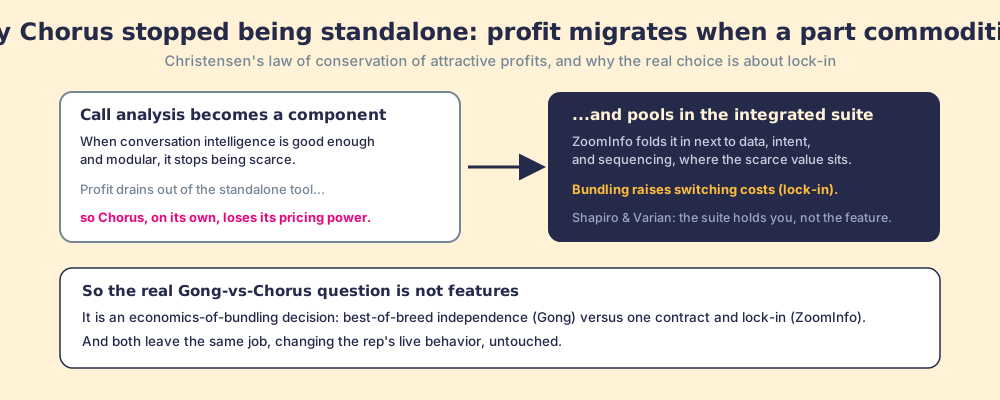
This reframes the decision honestly. What you choose between is not two transcription engines but two economic positions: best-of-breed independence, where you keep the freedom to switch, versus a bundle, where Carl Shapiro and Hal Varian’s Information Rules warns that the consolidated contract is the thing that raises your switching costs and hands the vendor lock-in. Bundling is not a convenience feature; it is a lock-in strategy with real future costs, the same dynamic now playing out in the Highspot and Seismic merger on the content side. That is the challenge to every “Gong vs Chorus” feature table: it scores the commoditizing component and ignores the two variables that will matter to you in three years, lock-in and the job neither tool does.
The thing both of them share, and why it caps the upside
They both look backward. This is not a knock; it is a category fact. Conversation intelligence is, by design, retrospective. It records the call, then analyzes it, then a manager reviews the analysis, then, days later, a coaching conversation happens. The signal is real, but it arrives after the moment it describes is gone. The deal where the rep should have run discovery differently has already moved on. You are watching the dashcam footage after the drive.
This matters because of where deals are won or lost, which is not in the review afterward but in the rep’s decision in the live moment: what to ask now, which objection to handle now, what the next step is now. Our research found that teams whose enablement reached reps in the flow of work hit quota at 49 percent versus 15 percent for those whose tools sat in separate destinations (The State of Sales Enablement). Conversation intelligence is, almost by definition, a separate destination you visit after the fact. It is a superb rear-view mirror. It is not a hand on the wheel.
What is the alternative to Gong and Chorus?
It depends on which problem you are solving. If you genuinely need to analyze calls and coach from them, other conversation intelligence tools (Fireflies, Avoma) compete on price and simplicity, and a Gong alternative chosen on cost is a reasonable move for a smaller team. But scan the reasons teams go shopping and a lot of them are not “we cannot see our calls.” They are “our reps are not running the process, and watching the calls afterward has not fixed it.” That is a behavior problem, and conversation intelligence diagnoses it without treating it.
This is the category we build in. A business logic layer like Supered runs inside HubSpot and Salesforce, surfaces the next right step and the right play in the moment of the deal, and measures whether reps run the process, deal by deal. It acts while the deal is happening rather than analyzing the deal that already happened. The two are complementary more than competitive: conversation intelligence tells you what went wrong on the call, and a business logic layer changes what the rep does on the next live one. If you only buy one and your real problem is adherence, buy the one that acts in the moment.
The verdict
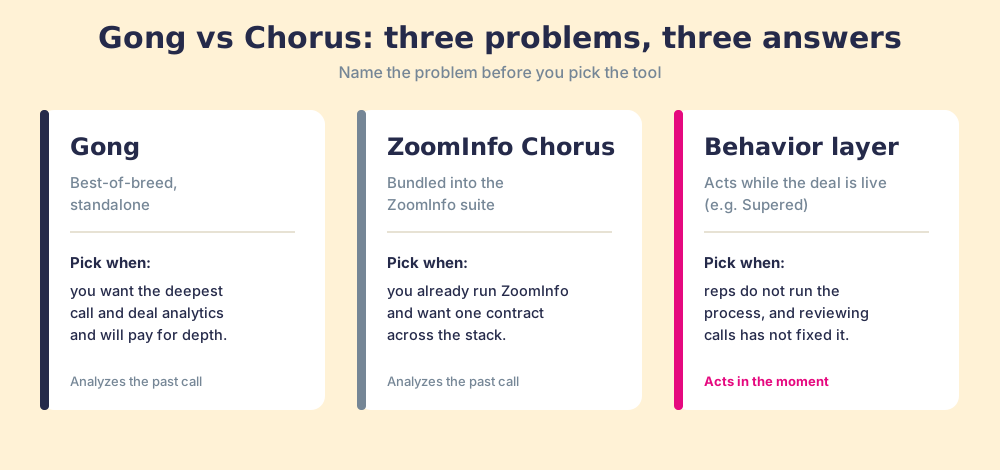
Gong vs Chorus comes down to three branches, and naming the job decides which.
- Best-of-breed independence. Choose Gong when conversation intelligence is a priority in its own right, you want the deepest analytics, and you value keeping the freedom to switch over a consolidated contract.
- A consolidated stack. Choose ZoomInfo Chorus when you already run ZoomInfo and one contract is worth more to you than best-of-breed depth, with eyes open to the lock-in that bundling buys.
- The unsolved job. Choose a business logic layer when the problem is that reps do not run the process in the moments that decide deals, because both Gong and Chorus analyze the call after it ends, and that job is changing the deal while it is still live.
Both leaders are good at the job they share. Name the job first: if you cannot see what happens on calls, either tool helps and Gong helps most; if reps will not run the process, neither was built for it, and the right answer is a different category. If Gong is the direction you are leaning, our breakdown of Gong pricing and the 2026 AI credit model covers what the contract holds beyond the seat count.
From here: the full category in best conversation intelligence software, the wider field in the best sales enablement tools, the engagement layer in sales engagement platform, and the behavior problem underneath in sales process adoption.
Frequently asked questions
What is the difference between Gong and Chorus?+
Is Gong better than Chorus?+
Is Chorus still a standalone product?+
What is the alternative to Gong and Chorus?+
Everything we have written on Chorus
More on Chorus
Your process, running itself.