Predictive Sales Analytics: The Forecast Is the Easy Part, the Action Is the Whole Job
Predictive sales analytics promises to see the slip and the churn before they happen. But a prediction changes nothing on its own, and a model that cries wolf trains the team to ignore it. Two traps, and the fix.
Predictive sales analytics uses historical data and machine learning to forecast outcomes like deal slip and churn, and its value depends entirely on the behavior it triggers, because a prediction no one acts on, or one that cries wolf until reps tune it out, changes no outcome.
Predictive sales analytics sells foresight: a model that tells you which deals will slip and which accounts will churn before it happens. It is a genuinely impressive capability, and on its own it is worth almost nothing. A prediction is not an outcome. Knowing a deal will slip changes nothing unless a rep does something different because of it, and most predictive analytics dies exactly there, in the gap between a correct forecast and an action no one takes. There is a second, subtler trap underneath the first: a model that predicts rare events will cry wolf so often that reps stop listening, which means even the true warnings go unheard. Foresight is the easy part. Getting a human to act on it, and trusting the model enough to bother, is the whole job.
Predictive sales analytics uses historical data and machine learning to forecast outcomes like deal slip and churn, and its value depends entirely on the behavior it triggers, because a prediction no one acts on, or one that cries wolf until reps tune it out, changes no outcome. Solve for action and trust, not accuracy alone, and the analytics start paying.
Why does an accurate prediction change nothing on its own?
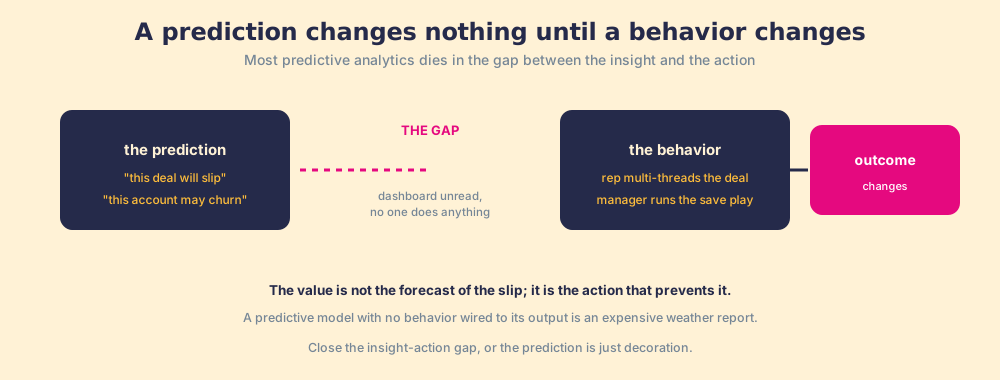
Because the value is in the action, and the action is a separate problem from the prediction. This is the knowing-doing gap that Jeffrey Pfeffer and Robert Sutton documented across organizations: the distance between what an organization knows and what it does is vast, and knowledge that does not change behavior produces no result (Pfeffer and Sutton, on the knowing-doing gap). A predictive model is a knowledge machine. It tells you a deal is at risk with impressive precision. But the deal is only saved if a rep multi-threads the account, a manager runs the save play, someone does the thing the prediction implies. Bolt a brilliant model onto a team that does not change its behavior, and you have bought a precise description of deals you will still lose.
This is why so many predictive analytics deployments end as unread dashboards. The model is correct. The forecast is good. And nothing happens, because no behavior was wired to the output. The prediction sits in a report, the slip happens on schedule, and the analytics team wonders why an accurate model produced no lift. The answer is that prediction and action are different jobs, and only the second one moves the number.
Predictive analytics in sales inherited this blind spot from the discipline that birthed it. Business intelligence spent two decades getting good at describing what happened and almost no time on what to do about it, which is why most BI dashboards are read once and forgotten. Sales forecasting analytics is the same trap one rung higher: the model now describes what will happen, but the structural problem is unchanged. A description, however precise and however far into the future it reaches, is inert until it is connected to a hand that does something. The forecast is information. A deal saved is behavior. Between them sits the most reliable failure point in the entire field, the place where a sharp chart goes to die because no rep ever changed a single move in response to it.
Why does a predictive model end up crying wolf?
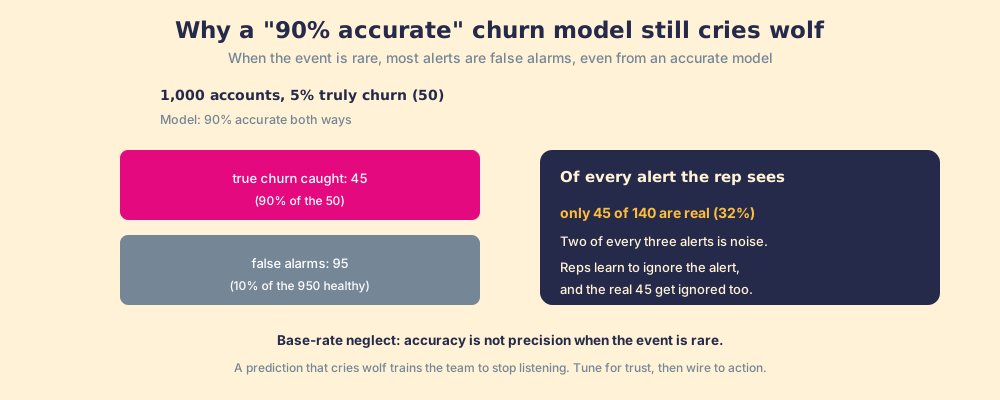
Because of base rates, a statistical trap that makes accurate models flag mostly false alarms when the event they predict is rare. Daniel Kahneman called the underlying error base-rate neglect: we judge a model by its accuracy and forget how rare the thing it predicts is (Kahneman, on base-rate neglect). Work the arithmetic. Suppose 5 percent of your 1,000 accounts truly churn, and your model is 90 percent accurate in both directions. It catches 45 of the 50 real churners, which sounds excellent. But it also wrongly flags 10 percent of the 950 healthy accounts, which is 95 false alarms. So of the 140 alerts a rep sees, only 45 are real. Two out of every three warnings is noise.
A rep who gets three alerts and finds two are wrong does the rational thing: they stop trusting the alert. And once they tune it out, the 45 real warnings get ignored alongside the 95 false ones. This is the cruel mechanics of signal detection: a model tuned for high recall on a rare event drowns its true signals in false ones, and the human response to a crying-wolf system is to stop listening. Accuracy is not precision, and precision is what earns a rep’s attention.
How do you make predictive sales analytics pay?
Wire every prediction to an action, and tune every model for trust. The two traps have two fixes, and you need both. First, close the insight-action gap: a prediction should not land in a dashboard but in the flow of work as a specific next move, a slip signal that triggers a defined save play, an at-risk account that routes to a manager with the play attached. The prediction is the trigger; the behavior is the product, which is the same logic running through sales process adoption and conversation intelligence. Second, tune for precision over raw recall, so the alerts reps see are mostly real, because a model that cries wolf is worse than no model at all.
- Wire prediction to action. Every signal triggers a defined play in the flow of work, not a row in a report. No action, no value.
- Trust is the tuning target. Favor precision over raw recall so reps can believe the alert. One ignored model poisons trust in every model after it.
- Measure the behavior, not the forecast. Track whether the triggered play ran, because the prediction is only as good as the action it produced.
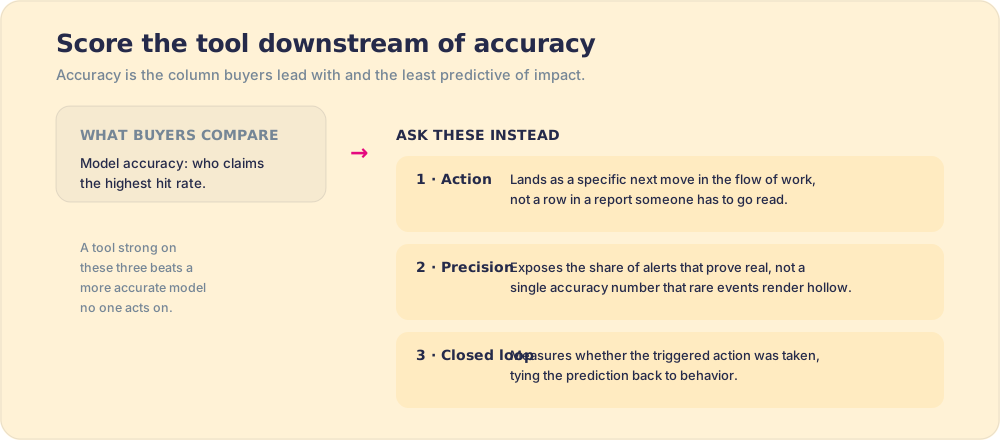
There is a useful way to evaluate predictive sales analytics tools that falls out of this. Most buyers compare them on model accuracy: which vendor claims the highest hit rate on churn or slip. That is the wrong column to lead with, because two of the failures above are downstream of accuracy entirely. A more honest scorecard asks three questions of any tool. Does it land its prediction as a specific next action in the flow of work, or as a row in a report someone has to go read? Does it expose precision, the share of its alerts that prove real, rather than hiding behind a single accuracy figure that base rates make meaningless on rare events? And can it measure whether the triggered action was taken, closing the loop back to behavior? A tool that scores well on those three will outperform a more accurate model that scores poorly on them, because the accurate model that no one acts on produces nothing and the accurate model that cries wolf gets switched off. The job of forecasting analytics was never to be right. It was to change what a rep does when the signal arrives, and only a tool wired to behavior can claim that.
What we recommend
Treat predictive sales analytics as two jobs, not one, and respect that the model is the easy half. The forecast, deal slip, churn risk, conversion likelihood, can be genuinely accurate, and still produce zero lift if no behavior is wired to it and if it cries wolf until reps tune it out. So spend your effort where the value truly is: close the insight-action gap by turning every prediction into a specific play that lands in the flow of work, and tune the model for precision so the alerts reps see are mostly real and worth their trust. An accurate prediction nobody acts on is an expensive weather report, and a model that cries wolf is worse than none. The forecast is cheap. The behavior it drives is the whole return.
From here: the forecasting fundamentals in sales forecasting, the signal-to-behavior pattern in conversation intelligence, the adherence that makes the action happen in sales process adoption, and the wider frame in AI sales enablement.
Frequently asked questions
What is predictive sales analytics?+
Does predictive sales analytics deliver real results?+
Why do reps ignore predictive analytics alerts?+
How do you get value from predictive sales analytics?+
Your process, running itself.