Sales Training Courses: A Course Library Buys Knowledge, Not Skill
Sales training courses transfer knowledge well and build skill not at all. Buying a bigger course library raises completion, not competence. A course needs practice and reinforcement beside it to change behavior.
Sales training courses are structured, often self-paced lessons that teach selling concepts, and they transfer knowledge well but build skill not at all, so a course library raises completion without raising competence unless practice and reinforcement sit beside it.
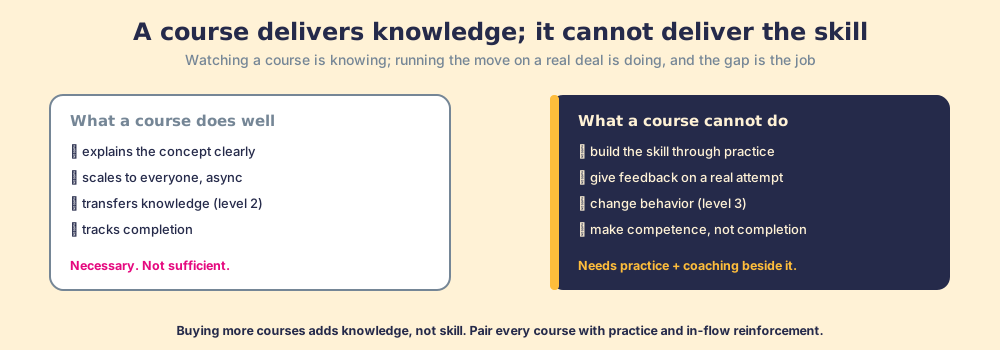
The modern sales org buys courses the way it buys software: by the library. A learning platform, a catalog of lessons, a completion dashboard, and the comforting sense that training is handled. It is not, because a course does one thing well and the thing teams hoped for not at all. A course transfers knowledge: it explains a concept clearly, scales to everyone, and leaves reps knowing the material. It does not build skill, because skill comes from practicing the move with feedback, which a video lesson cannot give. So a bigger course library raises completion, the count of lessons finished, while leaving competence, whether reps do something differently on a real deal, exactly where it was. The course is necessary. It is nowhere near sufficient, and buying more of it does not change that.
Sales training courses are structured, often self-paced lessons that teach selling concepts, and they transfer knowledge well but build skill not at all, so a course library raises completion without raising competence unless practice and reinforcement sit beside it. Use the course for what it does, and add what it cannot.
Why does a sales training course not build skill?
Because a course operates at the knowledge level and skill lives at the behavior level, and the two are built differently. A course is excellent at the first: it explains, demonstrates, and scales, moving a rep from not knowing a concept to knowing it. But knowing a concept and being able to perform it under real conditions are different abilities, the difference between watching a course on negotiation and holding a price with a real buyer pushing back. Skill is built by deliberate practice with feedback, as the research on expertise consistently shows, and a course provides no practice and no feedback on a real attempt (on transfer of training). So the course delivers the knowledge and stops at exactly the point where skill would have to be built, which is why a rep can complete a course perfectly and still not run what it taught.
This is the knowing-doing gap again, and it is why measuring courses by completion is so misleading. Completion is a knowledge-level metric: it tells you the rep finished the lesson, nothing more. The behavior-level question, does the rep now do it on a real deal, is the one that matters, and a course cannot answer it because a course cannot produce the behavior. A library of courses with a 100 percent completion rate is a library of knowledge delivered, not a team of reps who changed.
The psychologist Anders Ericsson, who spent his career studying how expertise is built, drew the sharp line here. He distinguished deliberate practice, which he defined as “individualized training activities specially designed by a coach or teacher to improve specific aspects of an individual’s performance through repetition and successive refinement,” from what he called naive practice: “essentially just doing something repeatedly, and expecting that the repetition alone will improve one’s performance” (Ericsson & Pool, Peak, 2016). A course is not even naive practice. It is watching a description of the activity. The thing Ericsson found indispensable, a coach observing a real attempt and feeding back what to fix, is precisely the thing a video lesson is structurally incapable of providing. You can watch a hundred hours of footage on holding a price and never once have a buyer push on your number while someone who has done it tells you where you flinched.
Why does the knowledge from a course fade so fast?
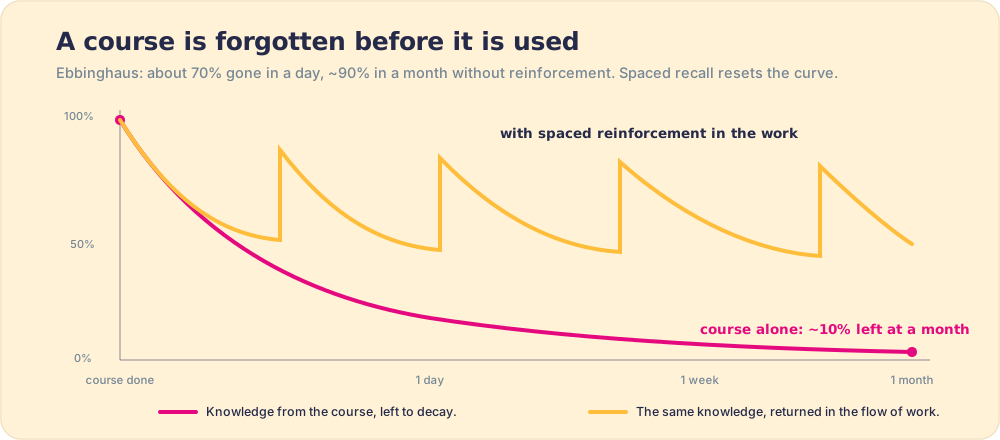
There is a second problem, and it is worse than the first. Even the knowledge a course does deliver does not stay. In the 1880s the German psychologist Hermann Ebbinghaus ran the first experiments on memory, learning lists of nonsense syllables and charting how fast he lost them, and produced the forgetting curve: memory decays sharply and soon after learning unless something interrupts the decay. Applied to training, the modern estimates are blunt. People forget roughly 70 percent of new information within a day, and without reinforcement up to about 90 percent within a month (on the forgetting curve).
Sit with that against a course library. A rep completes a course, the dashboard turns green, and within a month nine tenths of what the course taught is gone. The completion record is permanent; the learning is not. So the team has paid for knowledge transfer, logged it as done, and lost most of the cargo within weeks, while the report still shows a finished course. This is why the only thing that fights the curve is the thing a course cannot do on its own: spaced reinforcement, the material returning in the work, at intervals, until it sticks. Ebbinghaus found the same fix Ericsson did, from the other direction. Repetition timed into real use is what converts a fading lesson into a durable one.
What does a sales training course need beside it?
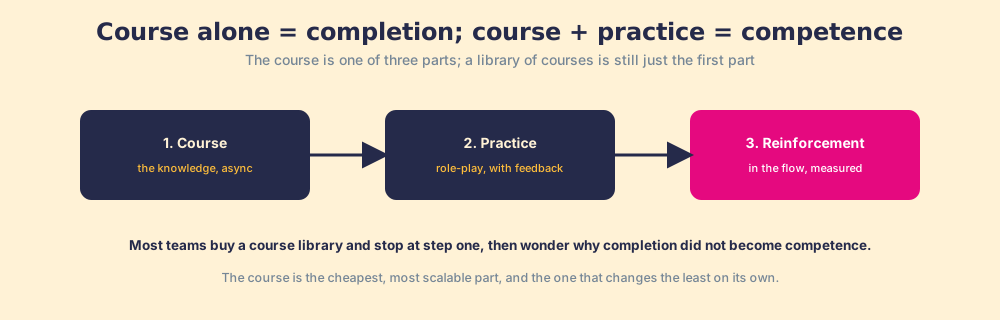
Practice and reinforcement, the two parts a course cannot supply. A course is the first of three components, and most teams buy only the first. The course delivers the knowledge efficiently and at scale. Deliberate practice, role-play with feedback, builds the skill the course described, which we cover in sales role play. And in-flow reinforcement on real deals makes the behavior stick and lets you measure whether reps run it, the sales process adoption layer. The course is the cheapest and most scalable of the three, and the one that changes behavior least on its own. A team that buys the course and skips practice and reinforcement has bought the part that matters least and called it training.
This is not a fringe view; it is roughly the consensus the learning field already holds and most sales teams ignore. The 70-20-10 model, popularized from research at the Center for Creative Leadership, estimates that about 70 percent of what people learn at work comes from doing the job, 20 percent from others such as coaching and feedback, and only 10 percent from formal courses (on the 70-20-10 model). The exact split is a heuristic and has been debated, but the shape is the point: the formal course is the smallest lever, and the doing-and-coaching is where the change lives. A team that buys a catalog of the best sales training courses it can find and skips the other ninety percent has invested almost entirely in the smallest of the three buckets. The model does not say courses are useless. It says they are the ten, and most budgets spend like they are the seventy.
- Course: the knowledge. Async, scalable, efficient at transferring the concept. Necessary, and the smallest part of the job.
- Practice: the skill. Role-play with feedback, where the rep builds the ability the course described. Knowledge becomes capability here.
- Reinforcement: the behavior. In the flow of work, on real deals, measured, so the skill becomes a durable habit.
- Measure competence, not completion. Completion says reps watched. Behavior change says they can do it. Judge on the second.
How should you buy and use sales training courses?
Buy courses for the knowledge layer, deliberately and cheaply, and put your real effort into the practice and reinforcement around them. A good course is worth having: online sales training courses transfer a concept faster and more consistently than a live session, and they scale to the whole team at near-zero marginal cost. So use courses for exactly that, and resist the instinct to treat a bigger library as a bigger training investment, because more courses add knowledge that was rarely the constraint. Pair every course that matters with practice that builds the skill and reinforcement that makes the behavior stick, and measure the result at the behavior level, the sales training metrics that show whether reps changed, not the completion rate that shows they watched. A sales course is a knowledge library of one; a course library is a bigger knowledge library. Turning either into capability takes the two things a course cannot do.
What we recommend
Treat sales training courses as the knowledge layer of training, valuable and limited, and stop mistaking a fuller course library for better training. A course transfers a concept well and builds skill not at all, so buying more courses raises completion without raising competence, and a team that answers flat performance with a bigger catalog is adding knowledge reps already mostly have. The course is one of three parts: pair it with deliberate practice that builds the skill and in-flow reinforcement that makes the behavior stick, and measure whether reps changed rather than whether they finished. Used this way, courses do real work as the efficient, scalable way to transfer knowledge. Used as the whole of training, they produce a green completion dashboard and no change in how anyone sells. The course is necessary. The skill is built beside it.
From here: the practice that builds the skill in sales role play, the system the course belongs to in sales training programs, the metrics that judge it in sales training metrics, and the adoption underneath in sales process adoption.
Frequently asked questions
Do sales training courses work?+
Why does a bigger course library not improve sales?+
What do sales training courses need to work?+
How should you use sales training courses?+
Your process, running itself.