Sales Training Topics: Train the Few Places Your Deals Break, Not the Whole Menu
Most sales training topic lists are generic syllabi that cover everything thinly. The topics that matter are the two or three places your deals break, found in your loss data, not a vendor's catalog.
Sales training topics are the subjects a team trains on, and the ones worth training are the two or three places where your deals break, drawn from your win-loss data, rather than a generic syllabus that covers everything thinly and changes little.
Most sales training topic lists are catalogs: prospecting, discovery, qualification, objection handling, negotiation, closing, the standard menu, covered in turn. It looks thorough, and it changes almost nothing, because spreading training attention across every topic means going deep into none. The topics that matter are not a menu; they are the two or three specific places where your deals break, and those are unique to your team. If you lose deals in discovery, no amount of closing training helps; if you lose them at the close, a deeper discovery module is wasted effort. A topic list chosen from a generic syllabus trains things you may already be good at and misses the gaps that are costing you revenue. The right topics come from your loss data, not a vendor’s catalog.
Sales training topics are the subjects a team trains on, and the ones worth training are the two or three places where your deals break, drawn from your win-loss data, rather than a generic syllabus that covers everything thinly and changes little. Pick the vital few, and training starts moving the number.
Why does covering every sales training topic fail?
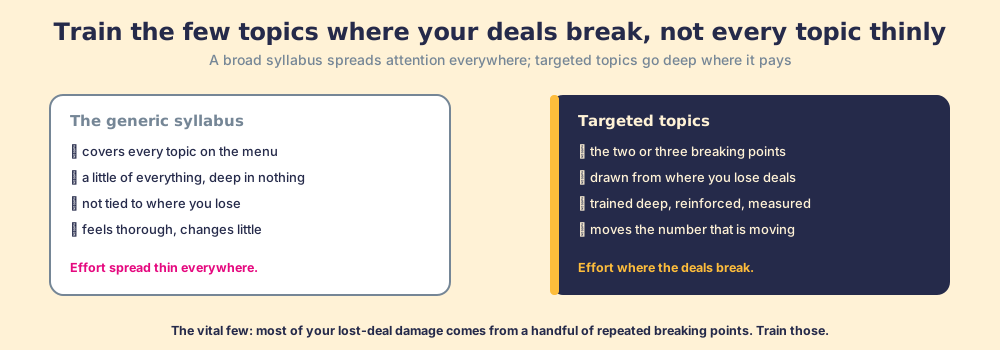
Because effort spread across everything goes deep into nothing, and depth is what changes a behavior. The Pareto principle holds in training as it does everywhere: a small number of causes produce most of the effect, so most of your lost-deal damage comes from a handful of repeated breaking points, not from a uniform weakness across all topics (on the Pareto principle). A curriculum that touches every topic in the menu gives each one a shallow pass, enough to feel thorough and not enough to build skill in any of them. So the broad syllabus produces the appearance of thorough training and the reality of unchanged behavior, because no topic got the depth, practice, and reinforcement that moves a skill. You cannot train ten topics deeply at once, and training them shallowly trains none of them.
The deeper error is choosing topics by coverage rather than impact. A menu-driven syllabus trains discovery because discovery is on the menu, rather than because you lose deals in discovery. Often it trains the topics you are already good at, because those are the standard ones, while the specific gap losing you deals, a weak point unique to your team, never appears on the generic list at all. Coverage is the wrong objective. Impact is the right one, and impact lives at your specific breaking points.
There is a second reason the broad syllabus fails, and it is older than any sales course. Hermann Ebbinghaus, mapping memory in the 1880s, found that people forget the majority of new information within days unless it is reinforced, a decay so reliable it is now called the forgetting curve (Ebbinghaus forgetting curve). A one-pass survey of ten topics is the forgetting curve’s perfect victim: each topic gets a single exposure, no spacing, no reinforcement, and most of it is gone by the following week. This is why “we covered objection handling in onboarding” so rarely shows up as better objection handling on live calls. Coverage and retention are not the same event, and a syllabus optimized for coverage is optimized for forgetting. Depth, spacing, and reinforcement on a few topics beat a single shallow pass over many, not as a matter of preference but as a matter of how memory works.
How do you choose the right sales training topics?
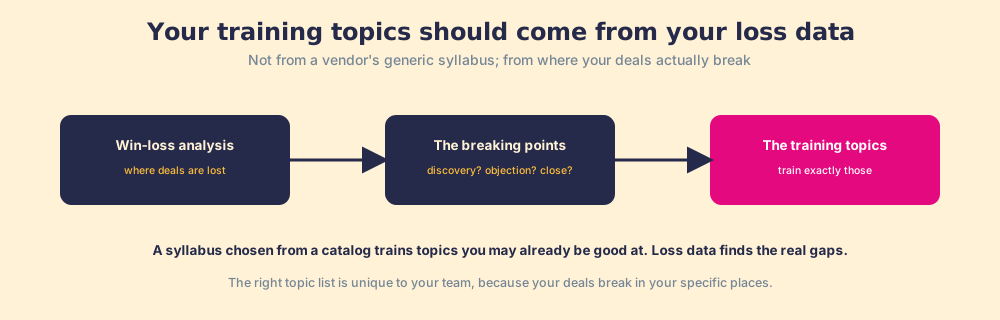
Derive them from your loss data, so the topics are your real gaps rather than a catalog’s defaults. The method is direct: run win-loss analysis to find where your deals consistently break, the specific stage or behavior that repeatedly costs you, and make those the topics. If win-loss shows deals dying in discovery, discovery is your topic; if they die when a competitor reframes the decision, competitive positioning is your topic. The list that results is unique to your team, because your deals break in your specific places, and it will rarely match a vendor’s standard syllabus, which is the point. The generic list trains the average team’s gaps; your loss data trains yours.
- Start from loss data. Win-loss analysis shows where deals break. That is your topic list, not a catalog.
- Pick the vital few. Two or three breaking points, not ten topics. Depth where it matters beats breadth everywhere.
- Ignore what you already do well. A standard topic you are strong at is not a training priority, however common it is on a syllabus.
- Prioritize by impact. The breaking point that costs the most deals gets trained first and deepest. Sequence by revenue at stake.
What sales training subjects belong on the shortlist?
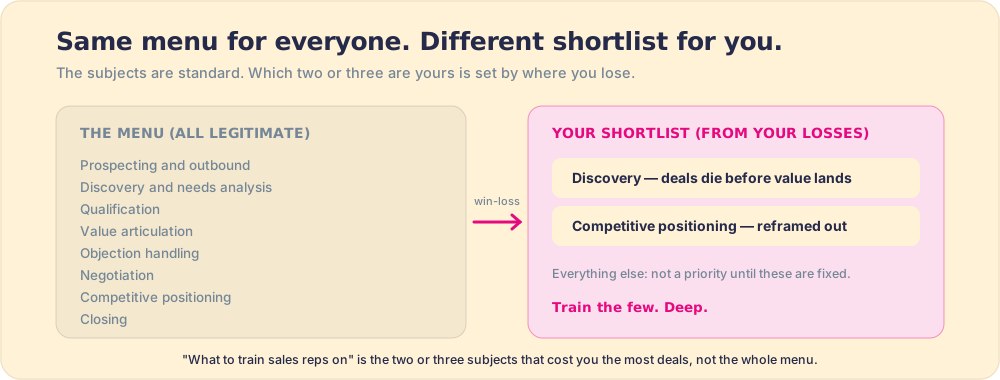
This is where most searches start, with a request for sales training topic ideas, and where the framing goes wrong. The honest answer is that there is no universal list, because the right sales training subjects are the ones tied to your loss data, and your losses are not the average team’s losses. Still, it helps to know the menu you are choosing from, so you can spot which two or three are yours.
The standard subjects fall into a handful of families: prospecting and outbound, discovery and needs analysis, qualification, product and value articulation, objection handling, negotiation, competitive positioning, and closing. Each is legitimate, and any could be the topic that decides your number. The point is not that these are wrong; the point is that “what to train sales reps on” is not answered by listing all of them. It is answered by asking which one, run badly, costs you the most deals. If your win-loss data says deals die when a competitor reframes the decision, competitive positioning is your topic and negotiation is noise. If they die because reps never surface the economic buyer, qualification is your topic and prospecting is a distraction. The menu is the same for everyone; the shortlist drawn from it is yours alone.
So when a colleague asks for sales training topic ideas, the better gift is not a longer list. It is the method that turns the list into a shortlist: look at where you lose, pick the two or three subjects that map to it, and ignore the rest until those are fixed.
How do you train the topics you choose so they stick?
Take the few topics from your loss data and train them as a system, deep and reinforced, not as a one-time pass. Choosing the right topics is half the job; the other half is training them the way any skill is built, with practice and reinforcement rather than a single session. The forgetting curve is the reason: a single session decays, but spaced reinforcement flattens the curve, which is why deliberate practice (the model Anders Ericsson built from studying experts across fields) rests on repeated, feedback-rich repetition rather than one-time exposure (Ericsson, on deliberate practice). So for each breaking point, go deep: teach it, have reps practice it with feedback, reinforce it in the flow of work on real deals, and measure whether the behavior changed, the sales training programs system applied to the few topics that matter.
And this is where the two halves meet. Picking the right two topics is wasted if you train them in one shallow pass, and training deeply is wasted if you go deep on the wrong topics. The win is the intersection: the vital few, trained as a system. A short, sharp topic list trained deeply this way changes behavior at the exact points where you lose, which is the whole purpose, while a broad syllabus trained shallowly changes nothing anywhere. Fewer topics, trained deeper, reinforced longer, aimed at your real gaps.
What we recommend
Choose your sales training topics by impact, not coverage, because a syllabus that covers everything thinly changes nothing and a short list aimed at your real gaps changes the number. Most of your lost deals trace to a handful of repeated breaking points, so the topics worth training are the two or three specific places your deals break, found in your win-loss data rather than a vendor’s standard menu. Resist the urge to train the full curriculum, which spreads effort across topics you may already be good at and goes deep into none, and resist training a topic only because it is standard. Pick the vital few, prioritize by the revenue they cost you, and train each one deeply, with practice and reinforcement, until the behavior changes at that breaking point. The best sales training topics are not the most complete list. They are the shortest list that fixes where you lose.
From here: the loss data that picks them in win-loss analysis, the system that trains them in sales training programs, the skills they build in sales skills, and the adoption underneath in sales process adoption.
Frequently asked questions
What are the best sales training topics?+
How do you choose sales training topics?+
Why does covering every sales training topic fail?+
What sales training topics should you prioritize?+
Your process, running itself.