The Sandler Pain Funnel: Let the Buyer Say It
The Sandler pain funnel is structured self-persuasion: a question ladder that takes a surface complaint down to its real, costed, emotional pain, said in the buyer's own words. Why the sequence works, the questions in order, and why a memorized script backfires.
The Sandler pain funnel is a structured sequence of pain funnel questions inside the Sandler Selling System that takes a buyer from a vague surface complaint down to the real, quantified, emotional cost of their problem, so the buyer says the pain out loud and self-persuades.
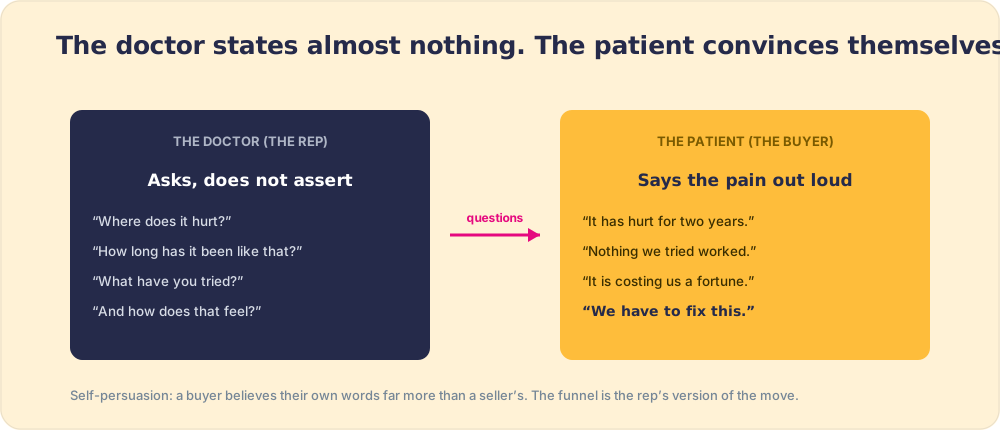
A good doctor almost never tells you how much it hurts. She asks. Where is the pain, when did it start, what makes it worse, what have you already tried, and what happens if you leave it. By the time she names the problem you are nodding along, because every fact in the diagnosis came out of your own mouth. You walk in with a vague ache and walk out convinced you need the procedure, and she barely made a claim the whole visit. That is not bedside manner. That is a method.
The Sandler pain funnel is that method written down for sellers. It is a structured sequence of questions that takes a buyer from a vague surface complaint down to the real, quantified, emotional cost of their problem, so the buyer says the pain out loud and persuades themselves. The questions are not the asset; they are printed on a thousand blogs, including, in part, this one. The asset is structured self-persuasion: a buyer who states the cost of their problem in their own words believes it in a way no rep assertion will ever match. This post goes deep on just the funnel. For the whole seven-step system it sits inside, the upfront contract, the submarine, post-sell, read the Sandler sales methodology.
What is the Sandler pain funnel?
The Sandler pain funnel is the pain step of the Sandler Selling System, drawn as a funnel because the questions narrow as they go: wide and open at the top, where the buyer names a surface complaint, tapering down rung by rung to the one thing at the bottom that actually moves a deal, the personal cost of doing nothing. David Sandler built it on a contrarian premise he reached by instinct in 1967, that the harder a rep pushes a problem, the more the buyer waves it off, so the rep’s job is not to assert the pain but to ask until the buyer feels it.
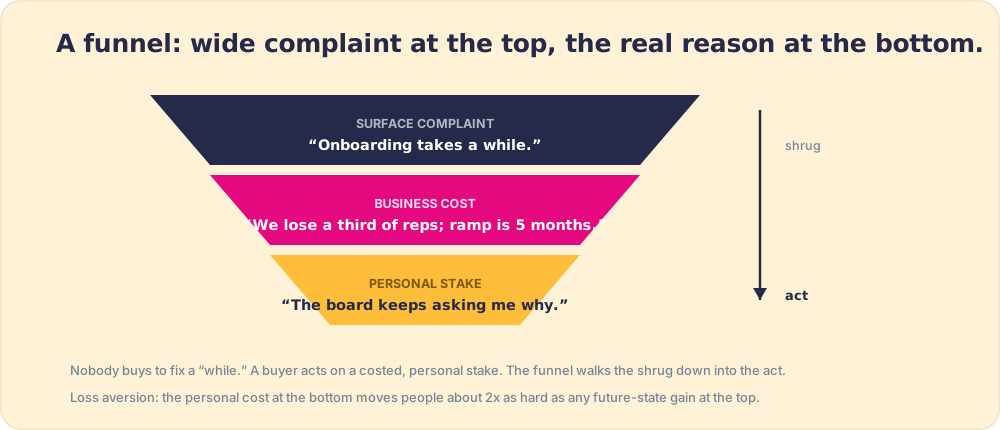
Pain in the Sandler sense is a term of art, so define it plainly. Sandler selling pain is not “a problem.” It is the gap between where the buyer is and where they need to be, felt strongly enough that staying put has become more expensive than changing. A buyer with a problem shrugs. A buyer in pain acts. The funnel exists to walk a shrug down into an act, and the descent has three stretches.
- The surface complaint. What the buyer says first, usually a symptom and usually understated. “Our onboarding takes a while.” Real, but inert. Nobody buys to fix a “while.”
- The business cost. What the surface complaint actually costs, in the buyer’s own numbers. “We lose about a third of new reps before they ramp, and ramp runs five months.” Now there is a figure, and a figure is a reason.
- The personal stake. What the cost means to this person across the table, the part that turns a line item into urgency. “It is the reason my board keeps asking me why ramp is so slow, and I do not have a good answer.” That is the bottom of the funnel, and it is where deals are decided.
What are the Sandler pain funnel questions, in order?
Eight rungs, more or less, depending on which Sandler trainer you ask, but the canonical ladder is stable and the order carries the method. Each question assumes the answer to the one before it, which is why you cannot shuffle them. You do not ask what something costs before you have established that it is a real, recurring, unsolved problem, or the number means nothing. Here is the sequence as Sandler teaches it (Sandler, the pain funnel), with what each rung is doing underneath the words.
- The widener. “Tell me more about that.” It does nothing but keep the buyer talking, which is the entire job of the first rung. The rep who fills this silence with a feature has already lost the funnel.
- The specific. “Can you be more specific? Give me an example.” A vague problem cannot be costed. This rung drags a generality (“onboarding is slow”) down to an instance the buyer can put numbers around.
- The history. “How long has that been a problem?” Time turns a one-off into a pattern. A problem that has run for two years is a problem the buyer has already paid for twice over, and saying so out loud makes it heavier.
- The prior attempts. “What have you tried to do about it?” This establishes that the easy fixes are spent, which is what makes the buyer open to a real change instead of another patch.
- The result. “And did that work?” The buyer answers no, in their own voice, and in doing so admits the problem is still live. The rep did not have to claim it.
- The business cost. “How much do you think that has cost you?” The hinge of the entire funnel. A problem with no quantified cost has no gap attached, and a gap with no number is a conversation, not a deal.
- The personal stake. “How do you feel about that personally?” The rung most reps skip and the one that matters most. A board’s pressure, a missed promotion, a Friday spent explaining the same miss again: the cost stops being the company’s and starts being the buyer’s.
- The reckoning. “Have you given up trying to solve it?” A gentle dare that surfaces whether the buyer is resigned or ready, and almost always provokes a “no, we have to fix this,” which is the buyer closing themselves.
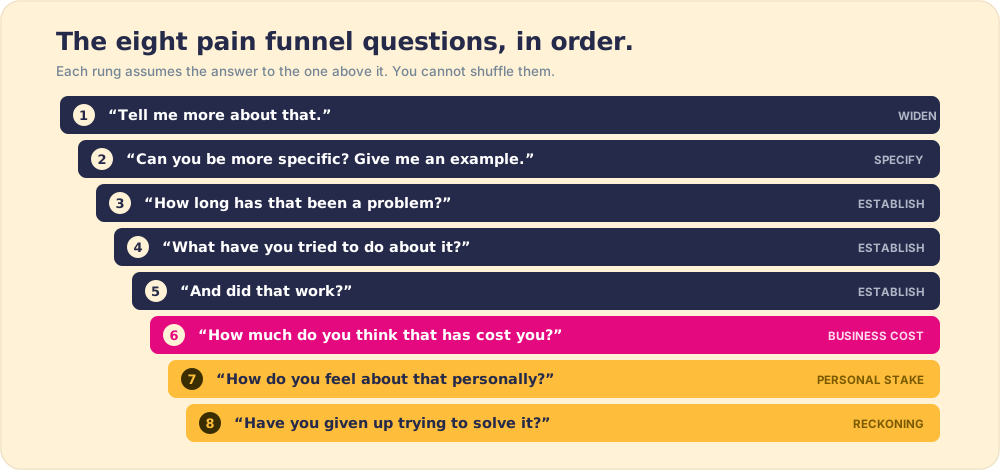
Notice that the rep made no claims. Eight questions, and the buyer built the case for change brick by brick, in their own words, which is the only way a case for change ever really holds. The discipline this shares with SPIN selling is the refusal to prescribe before the problem is fully developed; the difference is that the pain funnel keeps descending past the implication until it reaches the feeling. That descent is the heart of uncovering pain in sales: not noting that a problem exists, but developing it until the buyer owns its weight.
Why does the pain funnel work?
Because it runs on two findings from behavioral science that Sandler stumbled onto decades before the studies confirmed them: self-persuasion and reactance. They are worth naming, because once you see the mechanism you can run the funnel from understanding instead of from a card.
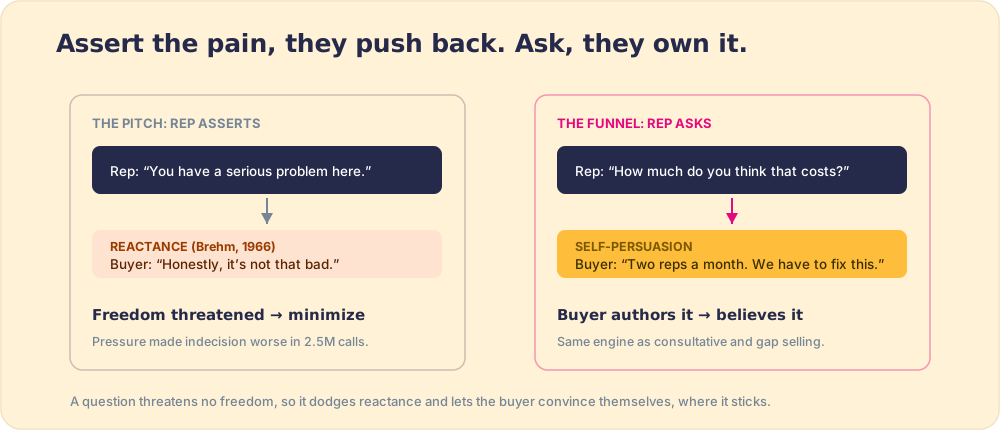
Self-persuasion first. People believe their own conclusions far more than a seller’s. When the buyer says “this is costing us about two reps a month,” that sentence carries a conviction that the identical sentence from the rep never could, because the buyer cannot dismiss themselves as biased. The funnel is a machine for getting the buyer to author the diagnosis. This is the same engine underneath consultative selling and gap selling: the rep diagnoses by asking, and lets the buyer’s own words do the convincing.
Then reactance, which is why the asking matters and the telling backfires. In 1966 the psychologist Jack Brehm laid out the theory of psychological reactance: when a person feels their freedom of choice is threatened, they push back to reassert it (reactance theory, The Decision Lab). A rep who pronounces “you have a serious problem here” threatens the buyer’s freedom to make up their own mind, so the buyer’s reflex is to minimize: “it is not that bad.” A question threatens nothing. It hands the buyer the floor. The funnel lowers pressure precisely where a hard pitch raises it, and lowering pressure is what the data says works.
That data is unusually clean. In The Jolt Effect, Matt Dixon and Ted McKenna analyzed over two and a half million sales conversations and found that pushing makes an indecisive buyer more likely to freeze, not buy, and that 40 to 60 percent of qualified buyers end up making no decision at all (The Jolt Effect). Read through the funnel’s lens, most of those are deals where the rep asserted urgency the buyer never owned. The funnel’s whole architecture, ask down to the cost and let the buyer name it, is the antidote to the single largest category of lost deals.
The deeper point hides in there. Loss aversion explains why the bottom of the funnel is where deals turn: Daniel Kahneman and Amos Tversky showed that people feel a loss about twice as intensely as an equivalent gain (Kahneman & Tversky, prospect theory). A future-state benefit (“you could ramp faster”) is a gain, and gains are weak fuel. The cost of the present, named by the buyer (“we are bleeding two reps a month”), is a loss, and losses move people roughly 2x as hard. The funnel is loss aversion, operationalized as a question sequence.
Why does the pain funnel backfire as a memorized script?
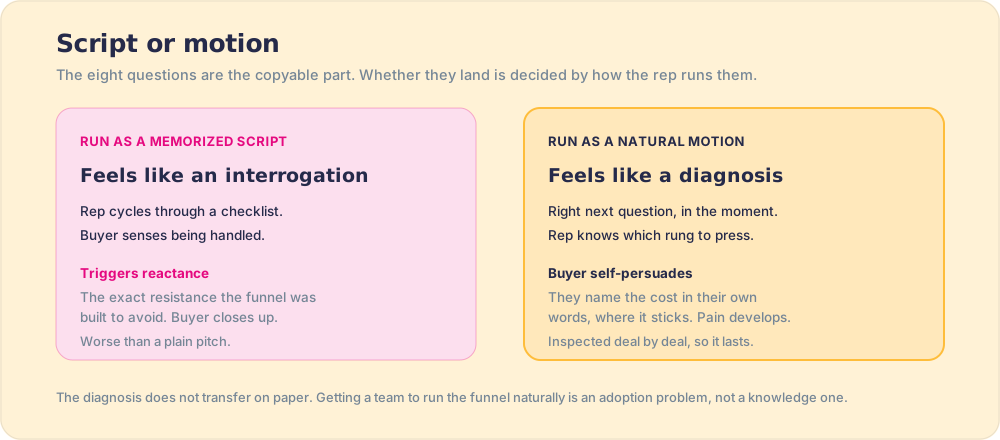
Because the moment a buyer hears a script, the funnel becomes an interrogation, and an interrogation triggers the exact reactance the funnel was built to avoid. The questions are the copyable, worthless part. You can read all eight in a minute, and a buyer who senses a rep cycling through them on a checklist will close up faster than they would have to a plain pitch, because now they feel handled. The skill that does the work is the part no handout contains: hearing which rung to press, knowing when a “how do you feel about that” is earned and when it is intrusive, sitting in the silence after the widener instead of rescuing it with a demo. That is diagnosis, and diagnosis does not transfer on paper.
This is the heart of our point of view, and where the funnel meets the problem we care about most. The pain-funnel questions are knowledge, and knowledge is solved: any rep can find the list, any AI can recite it. What a rep actually does on a live call is behavior, and behavior is the unsolved problem. The reps who run the funnel naturally are not the ones who memorized it best; they are the ones for whom it became a motion they perform without thinking, the way a doctor does not recite the intake form. Getting a team there is not a training problem. It is an adoption problem.
And adoption is where Sandler rollouts die. A team buys the class, the reps leave fired up, and within a week they are back to a Tuesday with eleven open deals and a manager asking about the number, and the careful posture from the workshop slips. They assert. They pitch. They skip to the cost question with no foundation under it and get a shrug. This is not a failure of will, and not a failure of the course; it is how memory works. In the 1880s Hermann Ebbinghaus measured how fast we shed what we learn, and the curve is steep: without reinforcement, most new material is gone within days (Ebbinghaus forgetting curve). A two-day pain-funnel class is a spike the calendar flattens by Thursday.
So the deciding question is never whether the funnel works. It works, and the science says why. The deciding question is whether the funnel gets run on the next real discovery call, by the rep who under quota pressure would rather skip to the demo. You can only expect what you inspect, and a method you cannot see being run is a method you are merely hoping for. The fix is the one behavioral science prescribes for any decaying skill: deliver the cue at the moment of the action, and inspect whether it happened. Not the funnel on a poster in the sales room. The right next question in front of the rep on this call, and a record of whether the pain was actually developed on this deal.
What we recommend
Two ways to put the pain funnel to work, and only one of them changes the number. You can teach it as content: run the class, hand out the eight questions, certify the team, and hope the motion survives contact with a busy week. Or you can treat the questions as the easy part and the running of them as the real work: deliver the right next question to the rep in the moment of the call, and inspect, deal by deal, whether the pain was actually developed before anyone advanced the stage.
We recommend the second, and the evidence is not subtle. Reactance research says asking beats asserting, so the funnel’s posture is right. Prospect theory says the costed, personal loss at the bottom of the funnel moves people about twice as hard as any future-state gain, so the descent is worth finishing. The Jolt data says most lost deals die of indecision the funnel is built to cure. And the forgetting curve says none of that pays off from a one-time class. Those point one way: the funnel is a behavior to be adopted and inspected, not a script to be memorized.
So hold the doctor’s posture from the top of this post. Ask down to the cost, let the buyer name it, and finish at the feeling. Then make sure it happens on the next call, and the one after that, because a funnel you cannot see being run is a funnel that, under pressure, will not be. For the full system the funnel sits inside, read the Sandler sales methodology; for the discovery questions that feed it, discovery call questions; for the cousin disciplines, SPIN selling and gap selling; for the behavioral science underneath why asking beats asserting, sales psychology; for how it compares to the rest, sales methodologies; and for the mechanics of making any method stick, sales process adoption.
Frequently asked questions
What is the Sandler pain funnel?+
What are the Sandler pain funnel questions, in order?+
Why does the Sandler pain funnel work?+
How is the pain funnel different from SPIN selling?+
Why does the pain funnel fail when reps run it as a script?+
Your process, running itself.