Sales Enablement Manager: The Job Is Inspection, Not Asset Production
Most sales enablement manager job descriptions read like a content-production role: build decks, run onboarding, manage the LMS. The real job is setting an expectation, inspecting adherence, and coaching off the signal. Here is the difference, and why it decides the number.
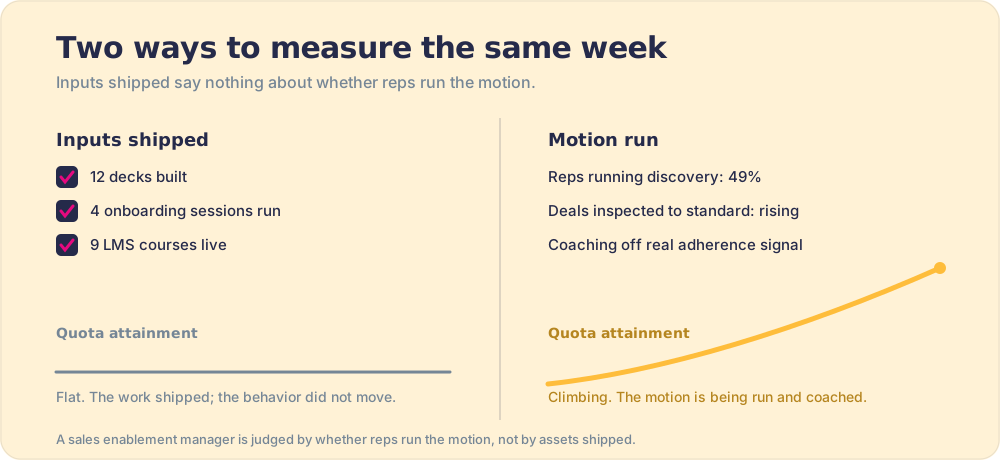
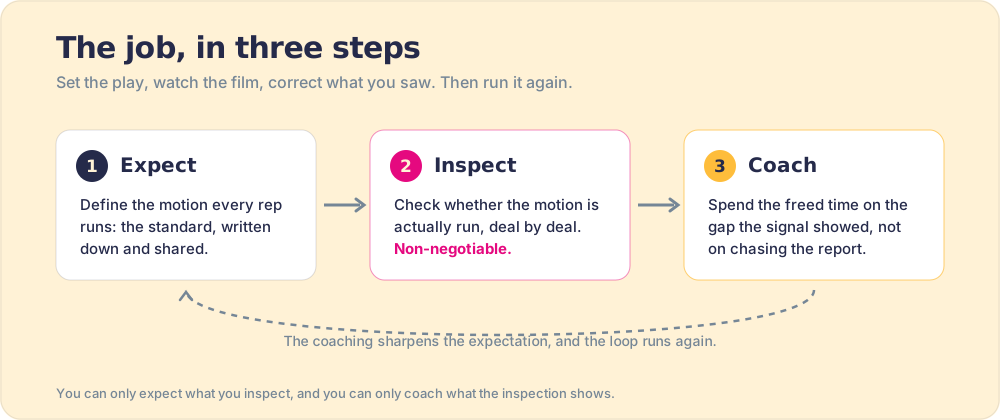
A sales enablement manager is the person who makes a sales team's process repeatable: they set the expectation for how reps sell, inspect whether reps actually run it, and coach off that signal, so the work is closer to a system architect than a content producer.
Read almost any sales enablement manager job description and you will find the same shape. Build the playbooks. Produce the decks. Run onboarding. Manage the LMS. Roll out the new tool. Report on content usage. It reads like a job in publishing, a steady output of artifacts, measured by how many you ship and how slick they look. A manager could do every line of that description well, all year, and the number would not move.
That is the contradiction at the center of the role, and it is worth naming plainly before we go further. The job description describes a content-production and training-logistics function. The job that actually changes revenue is a different one: set the expectation for how reps sell, inspect whether reps run it, and coach off what the inspection shows. A manager who measures their week in assets shipped and sessions run is counting inputs. The manager who moves the number is measuring whether reps run the motion. Knowing better is not doing better, so the lever was never the volume of material; it was the adherence to a standard, and adherence is the one thing the standard job description never mentions.
So here is the plain definition. A sales enablement manager is the person who makes a sales team’s process repeatable: they set the expectation for how reps sell, inspect whether reps actually run it, and coach off that signal. The role is closer to a system architect than a content producer. The decks are real work. They are also the least load-bearing part of the job.
What does a sales enablement manager actually do?
Strip the job description to its verbs and you get two stacks. The first stack is what the role is asked to produce: playbooks, training, content, tooling, reporting. The second stack is what decides whether revenue moves: a defined motion, a way to see if reps run it, and the coaching that closes the gap. The two overlap, but they are not the same, and confusing them is how a function stays busy and stays flat.
The producing stack is the easy half to staff and the easy half to evaluate, which is exactly why it dominates the job description. You can count decks. You can count training hours. You can put a number of courses on a board and call it a quarter. The trouble is that every one of those counts measures effort, not effect. A rep can sit through the onboarding, download the deck, and complete the course, and then, on a deal where it matters, do none of what they learned. The classic finding here is Ebbinghaus’s forgetting curve, the 1885 memory research that has held up for more than a century: without reinforcement, people forget the majority of new information within days. Front-load knowledge in a session and most of it is gone before the rep’s first real call. The artifact was delivered. The behavior never arrived.
The doing stack is harder, and it is the actual job:
- The expectation. The manager names the motion reps are supposed to run: the discovery questions, the qualification standard, the stage exit criteria, the way a deal moves. Not as a wish, but as a written standard specific enough that you could watch a call and say whether it happened.
- The inspection. The manager checks whether the motion is run, deal by deal, rather than assuming it from the fact that training was delivered. This is the part the job description omits and the part that predicts the number.
- The coaching. The manager spends the time the inspection frees on the gap it exposed, working with the rep who skips discovery on the specific behavior, instead of broadcasting another all-hands refresher nobody needed.
Notice the order. Most enablement runs the producing stack and hopes it produces the doing stack as a side effect. It rarely does, because a deck is information, and information does not change behavior on its own.
Why does the job get written as a content role?
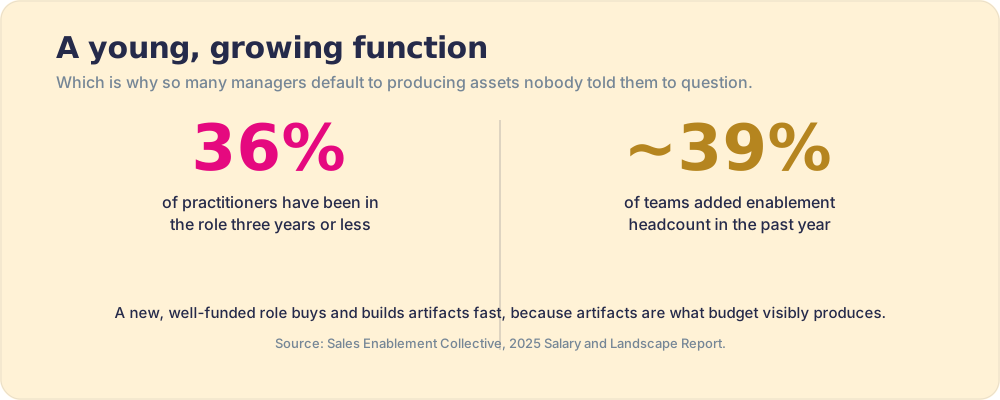
Because the function is young, well-funded, and judged on what budget visibly produces. The Sales Enablement Collective’s 2025 Salary and Landscape Report found that 36% of enablement practitioners have been in the role three years or less, and roughly 39% of teams added enablement headcount in the past year (SEC). The same report found 85% of companies kept or grew their enablement budgets, and 42% increased them. A new role, a growing headcount, a protected budget: that is a function under pressure to show output, and the output that is easiest to show is an artifact.
Think of a new gardener handed a big budget and a bare plot. The fastest way to look productive is to buy plants and put them in the ground, a lot of them, quickly, because a full bed photographs well. Whether anything takes root, whether the soil holds, whether the thing is alive in August, that is slower and harder to show in the first season. Enablement under budget pressure does the same thing. It fills the bed with content because content is the visible proof of spend, and the question of whether reps use any of it on a deal is one nobody is forced to answer until much later, if at all.
This is the trap the role is born into, and it is not a people failure on the manager’s part. It is a structural one: the job is defined by what is countable, and what is countable is inputs. The fix is not to work harder at producing. It is to change what the manager measures.
How is a sales enablement manager measured?
In most orgs, by activity and by satisfaction. Assets produced, sessions delivered, courses live, plus a smiley-face survey after training. These are input metrics, and they share a flaw: a manager can max every one of them while reps run their deals exactly as they did before. Tracking what the enablement team produced is necessary and good, it tells you the work is happening, but a function cannot advance on its own activity alone any more than a deal can advance on the rep’s activity alone. The output is whether reps run the standard, and whether that shows up in win rate, ramp, and quota.
The output measure has a name, and it is the most predictive thing the role can track: adherence. Are deals being run against the defined process? In the State of Sales Enablement 2026, teams that consistently inspect deals against a defined process hit quota at 6.3 times the rate of teams that rarely do, the largest single effect in the survey (State of Sales Enablement 2026). Not the teams with the most content. The teams that check.
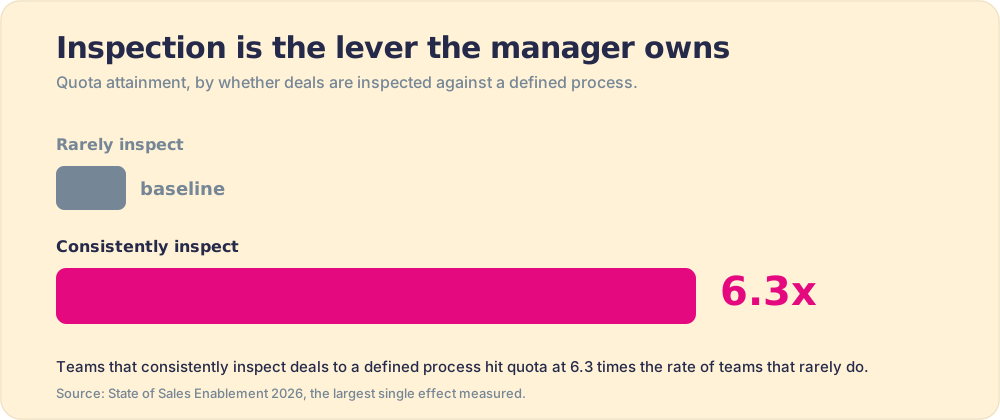
This is the tenet the role turns on: you can only expect what you inspect. A documented process that nobody checks is a wish, not a standard. The manager who writes the world’s clearest playbook and never looks at whether it is followed has produced an artifact, not a process, and the team will run on intuition the moment quota pressure hits. Inspection is what converts a document into a motion the team actually runs.
There is an honest objection here, and it deserves its full force. You might say inspection is a euphemism for surveillance, that watching every deal turns the manager into a hall monitor and the reps into people gaming a checklist. That is a real failure mode, and plenty of enablement programs have lived it. The answer is in how the inspection is done and what it is for. Inspection is not policing; it is the prerequisite to coaching. You cannot help a rep with discovery until you can see that they skip discovery. The point of looking is not to catch the rep, it is to find the specific gap so the coaching has a target. When a rep does not follow the process, that is almost never laziness; it is friction, late delivery, or a standard that was never actually inspected. The fix is to the system, not to the rep.
What skills does a sales enablement manager need?
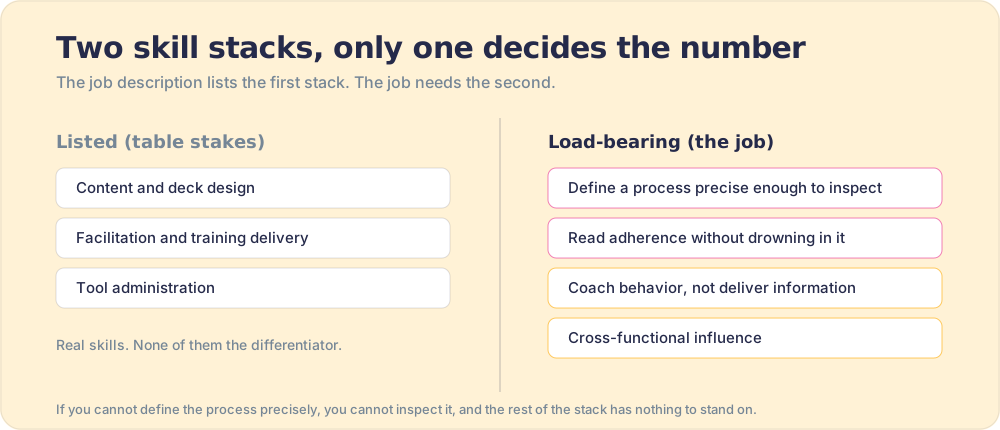
A sales enablement manager job description usually lists content design, facilitation, and tool administration. Real skills, all of them, and none of them the differentiator. The sales enablement manager skills that carry the role sit underneath:
- Defining a process clearly enough to inspect it. A vague standard (“do good discovery”) cannot be checked, and a standard that cannot be checked cannot be enforced or coached. The skill is writing the motion in terms specific enough that you could watch a call and score it.
- Reading adherence without drowning in it. The data exists; the skill is pulling the one signal that matters (is the motion being run?) out of the noise of dashboards, without turning inspection into a second full-time job.
- Coaching behavior, not delivering information. Anyone can present a refresher. The skill is sitting with the rep who skips the qualification step and changing what they do next time, which is a different muscle from building the slide that explains qualification.
- Cross-functional influence. The motion touches sales, marketing, product, and RevOps, and the manager owns none of those teams. Getting a standard adopted across functions you do not control is the political core of the job, and no deck-building course teaches it.
The first item carries the rest. If you cannot define the process precisely, you cannot inspect it; if you cannot inspect it, you have no signal to coach from, and you are back to producing artifacts and hoping. The skills the market lists describe a content producer. The skills the job needs describe someone who builds a measurable system and improves it from the evidence.
How is the role changing as AI commoditizes content?
Fast, and in the direction the rest of this argument points. For two decades the enablement manager’s scarcest output was content: the deck, the battlecard, the objection guide, the certification. AI has collapsed the cost of producing all of it. A model drafts a battlecard in seconds and answers a rep’s product question instantly. The part of the job that was hardest to staff, content volume, is now nearly free.
That does not shrink the role. It relocates its value. When information is instant and commoditized, the moat is no longer what a rep can know; it is what a rep actually does. Knowledge is solved. Behavior is the unsolved problem, and behavior is precisely the half of the job the standard description left out. The manager whose value was producing content is the one AI threatens. The manager whose value is setting an expectation, inspecting adherence, and coaching the gap is the one AI makes more valuable, because the inspection burden is exactly what AI can lift.
That last point is where the role wins back its time. The historical reason managers do not inspect is that manual inspection eats the time they should spend coaching, so they skip it and fall back on the survey. Automate the inspection, and the trade reverses. The payoff of pairing the two is documented outside our own data: Korn Ferry’s 5th Annual Sales Enablement Study found that companies with consistent sales coaching and impact measurement see 32% higher win rates and 28% higher quota attainment than peers (Korn Ferry). Coaching and the measurement that feeds it are one motion, not two. The State of Sales Enablement 2026 found that teams whose guidance reaches reps in the flow of the work hit quota at 49%, against 15% for teams whose guidance lives in docs and a separate tool, and that live, data-backed coaching lifts win rates by roughly 28% (State of Sales Enablement 2026). Same content, different moment of delivery, triple the result. The lever was never the asset. It was whether the standard reached the rep when it mattered and whether someone coached the gap.
This is where the modern version of the role gets its tooling. The work of putting the standard in front of the rep at the moment of the work, and measuring whether they follow it, is what the Behavior Layer does: it surfaces the process and the next right action inside HubSpot, Salesforce, Salesloft, Gong, and Gmail, then reports adherence back, so the manager’s time goes to coaching instead of chasing. Supered exists to lift the inspection burden off the manager and turn it into a coaching signal. The product is one instance of the principle; the principle stands without it. A sales enablement manager who inspects and coaches beats one who produces and hopes, with or without any particular tool in the room.
The way forward for the role
There are two versions of the sales enablement manager role, and a manager gets to choose which one they hold. The first is the one the description hands you: produce the content, run the training, manage the tools, report on usage, and measure success by how much you shipped. It is the safer-looking version, because the output is countable and the budget is protected, and it is the version AI is busy making cheap.
The second is the one the data points to: define the motion, inspect whether reps run it, and coach off the signal. Measure success by adherence and by the numbers adherence drives, ramp time, win rate, quota attainment, not by assets produced. It is harder, because behavior is harder than content, and it is the version that survives the next five years, because it owns the problem that did not get solved.
The recommendation is the second one, without hedging, and the evidence is the reason. A function judged on inputs will keep filling the bed with content while the soil washes out. A function judged on adherence has a lever, the 6.3x one, that no volume of decks can match. Build the standard, inspect it, coach the gap. The content is the easy part, and increasingly the free part. The behavior is the job.
If you want the system view of where this role sits, the sales enablement maturity model maps the climb from artifact-counting to behavior measurement; if you are still defining the function itself, start with what sales enablement is and then the sales enablement strategy that frames the whole motion. And if the question is which software lifts the inspection burden, the sales enablement software guide is the place to start.
Frequently asked questions
What is a sales enablement manager?+
What does a sales enablement manager do day to day?+
What is the difference between a sales enablement manager and a sales manager?+
What skills does a sales enablement manager need?+
How is a sales enablement manager measured?+
Your process, running itself.