Sales Enablement Strategy: the Order Is the Strategy
Most sales enablement strategy is a list of activities. The activities are not the strategy; the order is. Do them in the wrong sequence and you amplify failure. Here is the sequence that compounds.
A sales enablement strategy is the plan for turning your sales process into behavior reps run, and in what order: define the behavior, deliver it in the flow of work, measure adherence, then layer content and AI, because the sequence is what makes enablement compound.
The textbooks define sales enablement as a thing you produce. SiriusDecisions, the model most teams inherited, calls it “a strategic, ongoing process that equips all client-facing employees with the ability to consistently and systematically have a valuable conversation,” delivered through “integrated content, training, and coaching services” (Forrester). Tamara Schenk, who ran the enablement research at CSO Insights and co-wrote the field’s master framework, defines it as “a collaborative, strategic discipline… designed to increase sales results by providing consistent and effective enablement services” (Matthews and Schenk, Sales Enablement: A Master Framework, Wiley, 2018). Read those carefully. The strategy in both is a list of inputs you create: content, training, coaching, services. Produce more, enable more.
That model built the category, and it is right about the materials. It is wrong about what a strategy is. A sales enablement strategy is not the pile of inputs you produce. It is the order you put them in. And the order most teams use multiplies the one thing it is meant to fix.
Search for a strategy and you will find a hundred checklists: audit your content, build a portal, map the buyer journey, train the team, pick a platform, measure engagement. The lists are not wrong. They are not a strategy, any more than a pile of bricks, lumber, and shingles is a house. The materials are the same on every site. What separates the house that stands from the one that does not is the order you assemble them in, foundation, then frame, then roof. Put the roof on first and you have an expensive pile.
Sales enablement is the same. The activities are commodities; every team has access to the same content tools, the same training platforms, the same AI. The strategy is the sequence. And most teams run it in exactly the wrong order, which is why most enablement spend produces tools instead of results.

What is a sales enablement strategy?
A sales enablement strategy is the plan for turning your sales process into behavior reps run, and the order you do it in. Stripped to its spine, the sequence is four steps:
- Define the behavior. Decide the process and the plays reps should run, drawn from what your best reps already do. This is the foundation, covered in the sales playbook guide.
- Deliver it in the flow of work. Get the play and the next step to the rep in the moment, inside the CRM, not in a document they must remember.
- Measure adherence. Track whether reps run it, deal by deal, so you can see the truth instead of guessing.
- Then layer content and AI. Add the assets and the automation last, on top of a motion that already runs.
The order is not arbitrary. Each step depends on the one before it. You cannot deliver a play you have not defined, cannot measure adherence to a behavior you have not delivered, and cannot trust AI on a process nobody follows. Run the steps in sequence and they compound. Run them out of order and each one undercuts the next.
Why do most sales enablement strategies stall?
Because they start at the end. The exciting purchases are content and AI, so teams buy those first and assume behavior will follow. It does not, because content and AI are multipliers, and a multiplier applied to a broken motion makes the brokenness bigger.
Our research put a number on it. Across 198 sales leaders, average AI impact landed at a modest 3.2 out of 5, but the average hid a split: among teams with strong process adherence, 40 percent rated AI’s impact high; among teams with weak adherence, only 21 percent (The State of Sales Enablement). Same tools, nearly double the impact, decided entirely by whether an adopted process was already in place. One of the leaders we interviewed put it plainly: AI without process only amplifies failure, so the process has to be adopted first before AI adds any real value. The sequence is the finding.
There is older organizational evidence underneath this. Stanford’s Pfeffer and Sutton documented the knowing-doing gap: companies that buy knowledge (and now tools) without changing behavior, and see no result, because knowing is not doing (Pfeffer and Sutton, The Knowing-Doing Gap, 2000). A strategy that front-loads content and AI is buying knowing. Worse, knowing decays: Ebbinghaus’s forgetting curve, replicated for more than a century, shows most new information is lost within days without reinforcement (forgetting curve), so training poured in ahead of an adopted process is mostly gone by the first real deal. The doing has to come first, and the doing is behavior reps run on real deals.
Is the content-and-training model wrong?
It is not wrong. It is incomplete, in a way that matters more now than it did when it was written. So let me be fair to it first, because it earned its place.
The SiriusDecisions and CSO Insights models gave the field its spine. They named the discipline, they tied it to the buyer’s journey, and they were right that reps need content, training, and coaching to sell well. Schenk in particular did the field a service: she insisted on measurement when most teams were still counting decks produced, and CSO Insights showed that enablement only pays when reps adopt it, finding that adoption above 75 percent is where quota attainment and win rates climb (CSO Insights via Highspot). On adoption, they and we agree completely.
The gap is in the verbs. Read the definitions again and notice what the strategy is made of: you provide content, you deliver training, you equip sellers. Those are all inputs, things you produce and hand over. It is an input-based model. And an input-based model carries a hidden assumption, the same one Stanford’s Pfeffer and Sutton spent a whole book dismantling: that if you give people the knowledge, the doing will follow. It does not. They called the space between the two the knowing-doing gap, and their conclusion was blunt, that improving performance “depends largely on implementing what is already known,” not on producing more to know (Pfeffer and Sutton, The Knowing-Doing Gap, Harvard Business School Press, 2000). The input model produces more knowing. The gap is in the doing.
This is why the order matters so much, and it is the one place we part company with the inherited model. Content and AI are not the strategy; they are multipliers laid on top of a process. A multiplier does to a process what an amplifier does to a recording. Turn the amplifier up on a clean track and you get a stronger version of a good thing. Turn it up on a track full of skips and hiss and every skip and every hiss arrives bigger, at higher volume, at higher cost. The amplifier never improves the recording. It only commits to whatever is already on the tape.

So the input-based strategy, produce content and train reps and add AI, has the order backwards. It pours inputs into a process before anyone has checked that the process runs, and then wonders why a fuller content library and a smarter AI did not move the number. They did move it. They amplified a motion nobody had adopted. The fix is to sequence the inputs behind the behavior: get the process adopted and measured first, then turn up the content and the AI, so the multiplier lands on something worth multiplying.
What is the right sequence for a sales enablement strategy?
Build it like the house: foundation up.
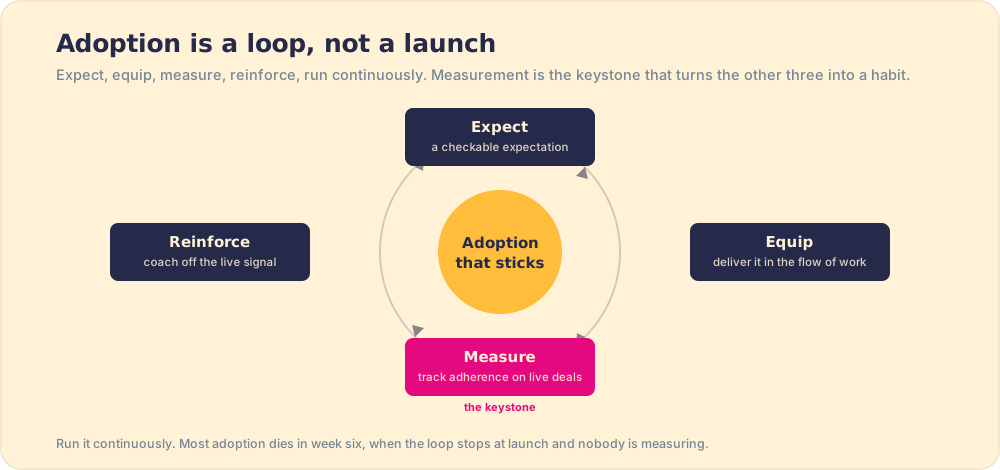
First, the foundation: define the behavior and get it adopted. Decide the process and plays, deliver them in the flow of work, and drive adoption until reps run the motion on real deals. Nothing else you do will hold without this, and it is the step teams are most tempted to skip because it is the least shiny. Adoption is the load-bearing wall, and the mechanics of it are in sales process adoption.
Second, the frame: equip the adopted motion with content and plays, delivered in the moment. Now that reps run the process, give them the right asset and the right play at each stage, surfaced on the live deal. The timing pressure is real: Gartner finds B2B buyers spend only about 17 percent of the journey with all suppliers combined (Gartner), so the few moments a rep gets have to land. Content matters here, on top of behavior, where it gets used. This is where sales content management software and sales playbook software earn their keep.
Third, the roof: layer AI. With an adopted, measured process carrying real signal, AI has something true to amplify, call analysis that maps to a known motion, next-best-actions grounded in plays reps run. Put the roof on a finished frame and it protects everything under it.
How do you measure a sales enablement strategy?
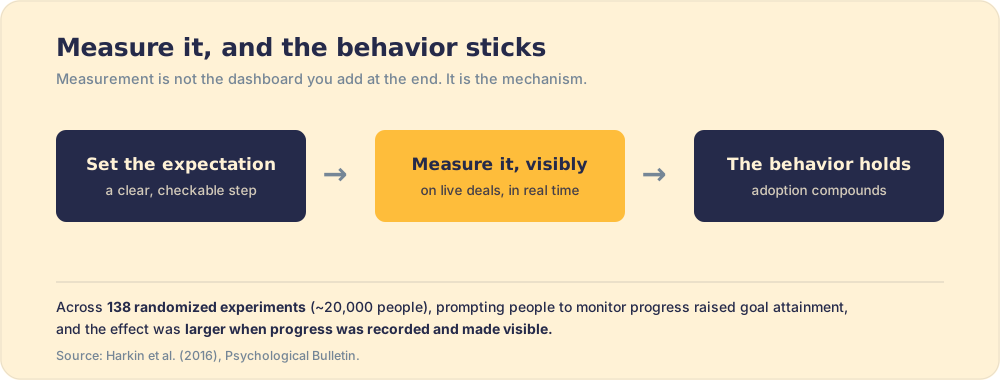
By adoption, not output. The trap is to measure the activities, because they are easy to count: pieces of content produced, courses completed, tools rolled out, portal logins. All of those can rise while nothing changes on a deal. The metric that tells the truth is whether reps run the defined process and plays on real deals, tracked deal by deal and rep by rep, over time.
This is the same discipline that separates a real process from a decorative one: you can only expect what you inspect. A strategy measured on output produces busy enablement and flat results. A strategy measured on adoption produces the 49 percent, because the thing being counted is the thing that moves the number. Teams that delivered process and guidance in the CRM and measured adherence hit quota at 49 percent versus 15 percent for those whose enablement sat in separate tools and docs.
What to do first
There are two ways to set a sales enablement strategy, and the choice is one of order. Call the document a sales enablement plan if you like; what makes it work is the sequence inside it.
The first is the input-based plan the textbooks hand you: produce the content, deliver the training, buy the AI, deploy them, and hope behavior follows. It feels like progress because the invoices are large and the demos are good, and it produces the modal outcome, a full stack and a flat quota, because the roof went on before the foundation. SiriusDecisions and Schenk were right that reps need these inputs. They left out that the inputs only pay once the behavior is adopted, which is the whole order question.
The second is to build in sequence: define the behavior, deliver it in the flow, measure adherence, and only then layer content and AI as multipliers. It is slower to look impressive and it is the order the evidence supports, from the 40-versus-21 AI split to the knowing-doing gap.
We would build foundation-first every time, because a multiplier on a broken motion amplifies the break, and an adopted process is the only thing that makes the rest compound. That is also the order Supered is built to support, behavior delivered and measured in the flow of work inside HubSpot and Salesforce, with content and AI on top, but the sequence holds whatever tools you choose. Get the order right and ordinary tools compound. Get it wrong and the best tools on the market still produce a pile.
Start at the foundation: the sales playbook guide to define the behavior, sales process adoption to make it stick, and the wider category in sales enablement software. The materials are everywhere. The order is the strategy.
Frequently asked questions
What is a sales enablement strategy?+
Why do most sales enablement strategies fail?+
What should a sales enablement strategy include?+
How do you measure a sales enablement strategy?+
Your process, running itself.