Pendo Pricing in 2026: What the MAU Model Costs, and What It Doesn't Buy
Pendo pricing in 2026: the MAU-based plans, what buyers pay by MAU band, the first-year costs beyond the license, how to negotiate, and when a per-user alternative fits better.
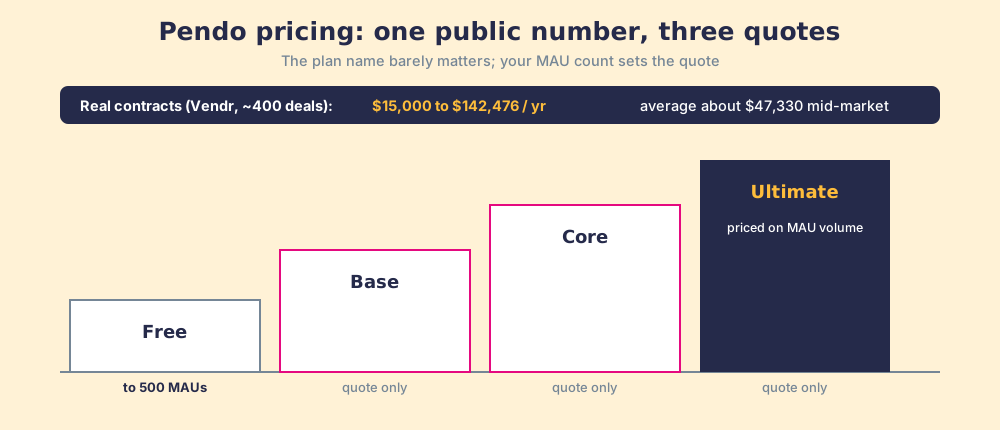
Pendo pricing is built around monthly active users rather than seats: a free plan up to 500 MAUs, then quote-only Base, Core, and Ultimate plans, with a Vendr median contract of $48,500 a year across 585 purchases and a range from $18,500 to $151,135.
A price tag is an answer to a question, and the question behind “what does Pendo cost” is rarely the one buyers think they are asking. They want a number. What they need is to know what the number buys, and what it leaves on the table after the contract is signed.
Pendo pricing is built around monthly active users rather than seats: a free plan up to 500 MAUs, then quote-only Base, Core, and Ultimate plans, with a Vendr median contract of $48,500 a year across 585 purchases and a range from $18,500 to $151,135 (Vendr, February 2026). If you are pricing Pendo, the short answer by who it fits:
- Pendo. Product teams that live in product analytics and want guides on the same platform. Free to 500 MAUs, median $48,500 a year after that.
- UserGuiding or Appcues. Teams that mainly need onboarding flows inside their product. UserGuiding publishes $174 a month billed yearly; Appcues’ Vendr median is $15,000.
- Supered. Teams guiding their own people inside HubSpot or Salesforce who need to see whether the process was followed. A published $13.50 or $40 per user per month.
How does Pendo’s price compare with the alternatives?
Prices were read from each vendor’s pricing page or Vendr on October 1, 2026.
| Tool | Best fit | CRM integration | Setup effort | Pricing (plan with the feature) | Reason to switch |
|---|---|---|---|---|---|
| Pendo | Product analytics plus in-app guides | Integrations; Pendo for Salesforce guides employees | Tagging and guide building | Free to 500 MAUs; paid quote-only, Vendr median $48,500/yr | Stay if analytics depth is the job |
| Supered | Internal teams running a process in HubSpot or Salesforce | Native in HubSpot and Salesforce; Chrome extension on any cloud URL | Live in under a week | Digital Adoption $13.50/user/mo, Process Compliance $40/user/mo (5-user minimum), paid yearly | Per-user price, and adherence measured by rep and rule |
| Userpilot | Product-led onboarding with analytics | Integrations; premium CRM integrations on Enterprise | Self-serve | Starter $299/mo billed annually to 2,000 MAUs; Growth from $849/mo | A published entry price |
| Appcues | No-code onboarding flows | Integrations | Self-serve | Quote only; Vendr median $15,000/yr | Lower median contract |
| UserGuiding | Early-stage SaaS on a budget | Integrations | Self-serve | Starter $174/mo, Growth $349/mo, billed yearly | Published, low price; no overage charge |
| WalkMe (SAP) | Employee adoption on SAP estates | SAP-native | An implementation project | Quote only | One vendor inside SAP |
Why trust this breakdown?
I started RevPartners, a HubSpot Elite-tier partner, and then co-founded Supered, which competes with Pendo when the users are a company’s own team inside the CRM, so read this page knowing we sell one of the options. Every Pendo figure on this page comes from Pendo’s pricing page or Vendr’s transaction data, with dates, so you can check it against your own quote. Supered holds 4.9 out of 5 from 81 reviews on G2, and Pendo holds 4.4 out of 5 from 1,819 reviews on G2 (both read October 1, 2026).
How much does Pendo cost in 2026?
Pendo’s pricing page lists four plans and one beta, and only the free plan carries a public number (Pendo pricing).
- Free. Up to 500 MAUs, with product analytics, in-app guides, Pendo-branded roadmaps and NPS surveys, and unlimited web and mobile app keys. No credit card.
- Base, Core, and Ultimate. Quote-only, priced on “custom MAU volume,” and sold on annual contracts. Paid plans include Leo, Pendo’s natural-language query assistant, and retroactive analytics.
- Novus. A new free beta for continuous product monitoring that opens AI-generated pull requests to keep instrumentation current.
- Add-ons. Session Replay, Product Discovery, Sentiment, Orchestrate, Listen, Data Sync, Predict, and Agent Analytics for monitoring AI agents. Vendr puts add-on modules at $10,000 to $50,000+ a year.
Because the paid plans are quote-only, the useful data is what buyers paid. Vendr’s bands still use Pendo’s older plan names, so read them by MAU band rather than plan name.
| MAU band (Vendr’s plan name) | Typical annual price | What drives it |
|---|---|---|
| Up to 500 MAUs (Free) | $0 | Pendo branding, limited segmentation and integrations |
| 500 to 2,000 MAUs (Starter) | $7,000 to $12,000 | MAU count and term |
| 2,000 to 10,000 MAUs (Growth) | $20,000 to $60,000+ | MAU volume and modules |
| Large or multi-product (Portfolio) | $75,000 to $200,000+ | Products covered, modules, support |
| All Vendr purchases | Median $48,500; range $18,500 to $151,135 | 585 purchases, 12% average savings |
Why does Pendo price by monthly active users?
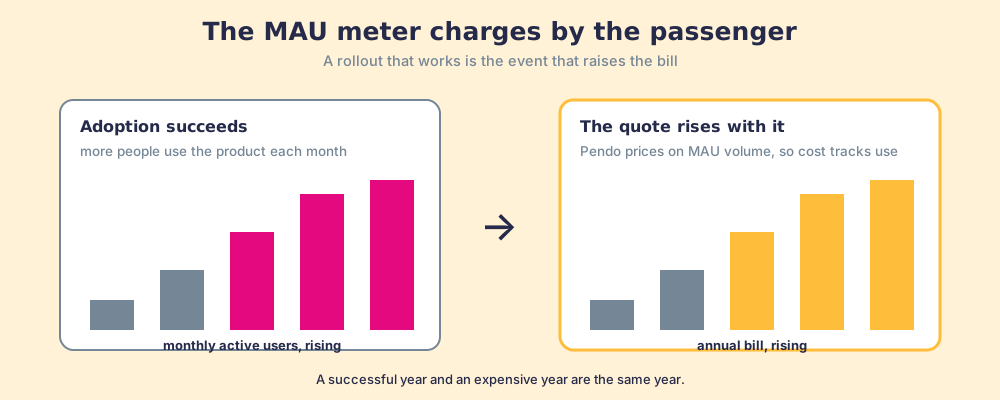
A monthly active user is any unique person who touches your product in a calendar month, and Pendo MAU pricing counts every one of them because it instruments the whole application, beyond the admins who author guides. Vendr notes that anonymous users, internal employees, and test accounts can be excluded through configuration, and that MAUs are typically calculated as a rolling average over the contract. That is a defensible way to price an analytics platform. It also produces a strange incentive.
Think of the MAU meter as a taxi that charges by the passenger rather than the trip. The better the night goes and the more people pile in, the higher the fare climbs, though the driver does the same driving. A rollout that works, more people in the product more often, is the event that raises your Pendo bill. Contracts carry a MAU cap, and crossing it “can trigger overage charges or require mid-term contract amendments at higher rates,” in Vendr’s words. A successful year and an expensive year are the same year. Employee-side platforms such as WalkMe and Whatfix avoid this meter by pricing on annual contracts, and the digital adoption platform cost comparison sets the two units side by side.
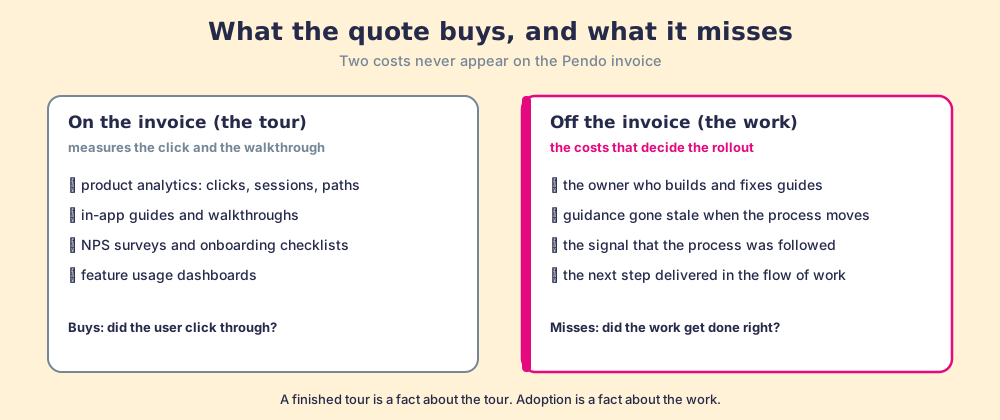
There is a deeper trap underneath the pricing one. When the thing you care about is hard to measure and a proxy is easy, you drift toward managing the proxy. Whether the work got done the right way is hard to instrument. Tour completion and feature clicks are trivial. So the dashboard fills with the easy number, the team optimizes it, and a finished walkthrough becomes the goal. The economist Charles Goodhart gave us the law for it: a measure that becomes a target stops being a good measure.
What hidden costs does Pendo pricing leave out?
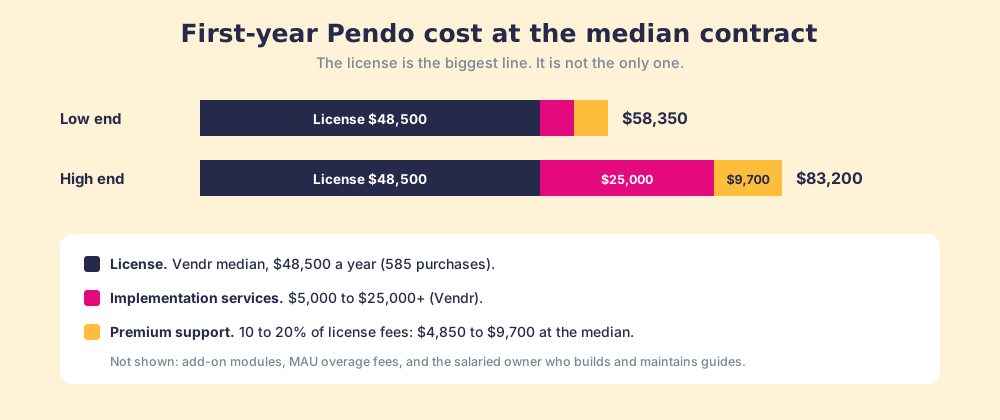
The license is the visible cost. Vendr lists the rest, and at the median contract they add a fifth to almost three quarters again in year one.
- Implementation services. Setup, training, and custom integrations, $5,000 to $25,000+.
- Premium support. Standard support is included; premium or dedicated support adds 10 to 20% of license fees, $4,850 to $9,700 at the median.
- Add-on modules. $10,000 to $50,000+ a year for modules priced outside the plan.
- MAU overage. Charges or a mid-term amendment when usage crosses the cap.
- Renewal increases. Pendo renewal contracts often include 5 to 10% annual price increases.
- The build-and-maintain owner. Guides need a person to author them and fix them when the process changes, a salaried cost the contract never shows.
| First-year line | Low end | High end |
|---|---|---|
| License (Vendr median) | $48,500 | $48,500 |
| Implementation | $5,000 | $25,000 |
| Premium support (10 to 20%) | $4,850 | $9,700 |
| Total before add-ons and overage | $58,350 | $83,200 |
How do you negotiate a lower Pendo price?
Vendr’s Pendo page carries the playbook, drawn from its transaction data.
- Term length. Pendo prefers two- and three-year contracts, and three-year terms often run 20 to 30% lower per year than one-year terms.
- Timing. Pendo’s sales team is more flexible when buyers engage 60 to 90 days before a decision deadline.
- A stated budget. Anchoring early to a number (“We have $30,000 allocated for this category” is Vendr’s example) frames the quote.
- MAU growth room. Write flexibility for MAU growth or scope changes into the contract, so success does not trigger a mid-term amendment.
- A renewal cap. Cap annual increases or lock flat pricing for the term.
Across all deals, Vendr reports buyers often achieve 15 to 30% off list, with 12% average savings on the median contract.
What changed at Pendo in 2026?
Pendo is independent and valued above $1 billion (The News & Observer). In April 2026 it cut about 90 roles, roughly 10% of its workforce. CEO Todd Olson said the company had been “refounding” Pendo over the previous six months “as the technology landscape has changed dramatically,” and that the cuts were “not any reflection of the strength of our business” (ABC11). The product moves since then show up on the pricing page: Novus, Agent Analytics for AI agents, and Predict. For a buyer, the practical read is a vendor repricing around AI, so ask what your plan includes today and what will move to an add-on at renewal.
Is Pendo worth the price for guiding employees inside Salesforce or HubSpot?
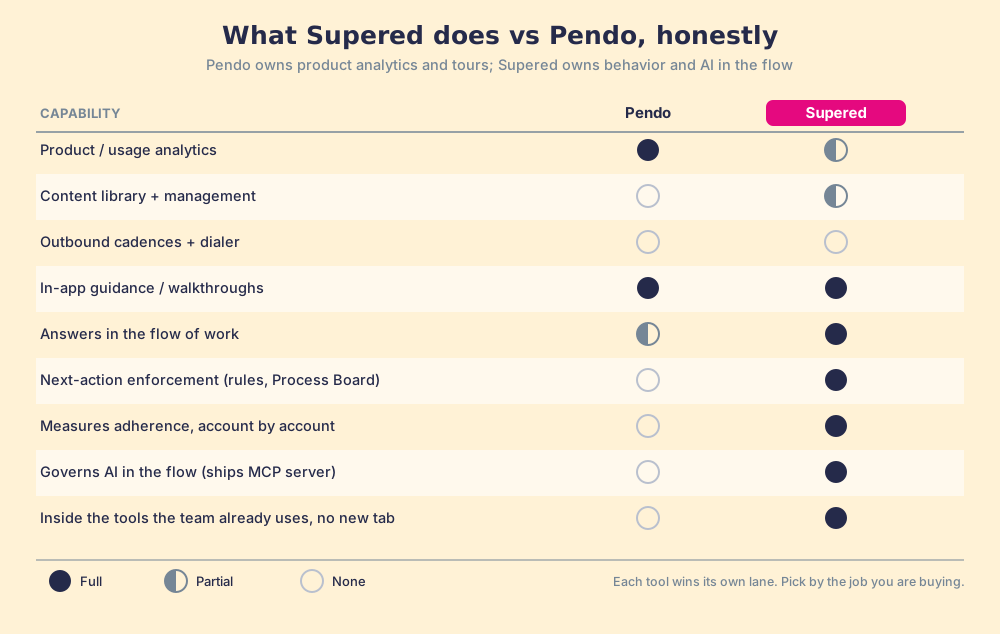
It depends on what you need to measure, and this is the case where Supered competes directly. Pendo for Salesforce deploys “no-code in-app walkthroughs and contextual tooltips” for employees and reports how they use Salesforce (Pendo), on Pendo’s MAU model. That measures the tour and the click.
The behavioral mechanism explains why the click is a weak proxy. Peter Gollwitzer’s work on implementation intentions, summarized in a meta-analysis of 94 studies by Gollwitzer and Sheeran, found that tying an action to a specific cue at the moment of the work produces a medium-to-large effect on follow-through, d = 0.65 (Gollwitzer and Sheeran). A tour fired at onboarding is the decision to act. The cue at the moment the work happens is what turns the decision into the deed.
Supered is the Business Logic Layer for teams working in HubSpot and Salesforce, priced per user on a published list:
- Digital Adoption. Cards, step-by-step guides, Action Plans, and Updates in the flow of work, $13.50 per user per month paid yearly ($15 monthly). A 50-person team pays $8,100 a year.
- Process Compliance. Adds Process Rules that fire when a record breaks the standard and the Process Board, which reports compliance by rep, by rule, and by region. $40 per user per month paid yearly ($45 monthly), 5-user minimum, implementation included. A 50-person team pays $24,000 a year.
- AI in the flow. The Supered AI Assistant drafts rules and guides from a plain-language description, and an MCP server lets Claude or another agent read the same process rules.
In our survey of 198 sales leaders, 89% had a defined process and 36% said reps followed it, and teams whose guidance sat in the workflow hit quota at 49% against 15% for teams whose process lived in docs (The State of Sales Enablement). Usage analytics does not see that gap; a rule checked on each record does.
Choose something else if:
- Customers inside your product. If the users are your customers, Pendo, Userpilot, or Appcues is built for the job and Supered is not.
- Analytics first. If feature usage, retention curves, and session replay are what you need, Pendo’s depth is real.
- A small internal team testing guides. A 50-person team sits under Pendo Free’s 500-MAU ceiling, so you can try Pendo-branded guides before paying anyone.
What we recommend
Price Pendo by forecasting your MAU count with care, since that, more than the plan name, is what the quote reads, and budget year one at $58,350 to $83,200 if you land at the median. Negotiate a three-year term, MAU growth room, and a renewal cap. Then ask the question the invoice cannot answer: after you pay, will you know whether the work got done the right way? If the users are your customers and analytics is the job, Pendo is worth the money. If the users are your own team inside the CRM and adherence is the job, a per-user tool that checks the process on each record costs less and measures the right thing.
For the next step, weigh the field in best digital adoption platforms, compare the options by use case in Pendo alternatives, and read why rollouts decay even with good tooling in user adoption.
Frequently asked questions
How much does Pendo cost in 2026?+
What does each Pendo tier cost?+
Does Pendo have a free plan?+
Why does Pendo charge by monthly active users instead of seats?+
What hidden costs come with Pendo?+
How do you negotiate a lower Pendo price?+
Is Pendo worth the price for guiding employees inside Salesforce or HubSpot?+
Your process, running itself.