Knowledge Management Strategy: Sequence Behavior First
Most knowledge management strategy work obsesses over capture and search. The strategy that moves the number runs the other way: decide the behavior first, then let the archive serve it.
A knowledge management strategy is the plan a team uses to capture, organize, deliver, and govern its know-how, and the version that moves results sequences delivery and adherence ahead of capture and search.
A new manager walks the office on her first week and finds the knowledge in good order. The pricing sheet is current. The onboarding deck is tidy. The objection responses someone wrote after a hard quarter sit in a folder, well named, easy to find. She nods. The library is built, the search works, the audit comes back clean. Then she listens to three calls and hears reps answering from memory, guessing, repeating the thing the last manager said.
The knowledge was there. The behavior did not follow.
Knowledge management strategies tend to lose exactly this way. The capture got done. The taxonomy is neat. By any inventory the content is complete, and adoption stays flat anyway, because the plan put all its effort into the two problems that were already solved and none into the one that was not.
Our position, and the throughline here: a knowledge management strategy is judged by what people do with the knowledge in the moment, not by how much of it you stored or how cleanly you can find it. So the order is the strategy. Decide the behavior first, then build the library to serve it.
What is a knowledge management strategy, and why does sequence decide it?
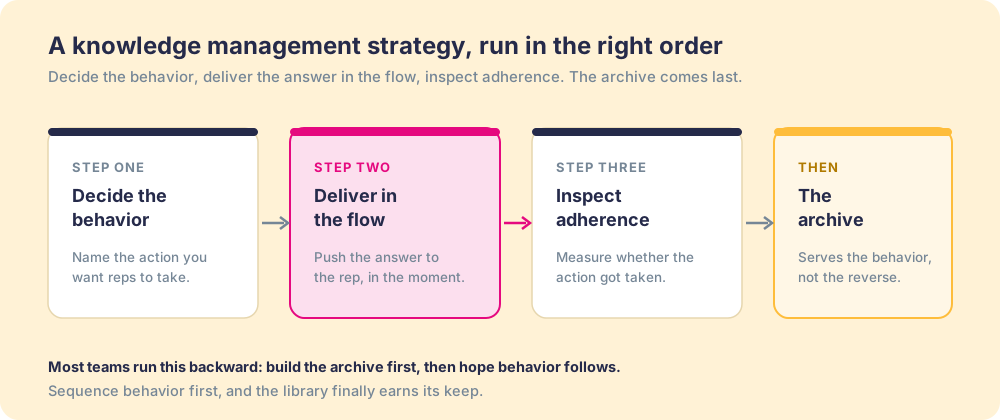
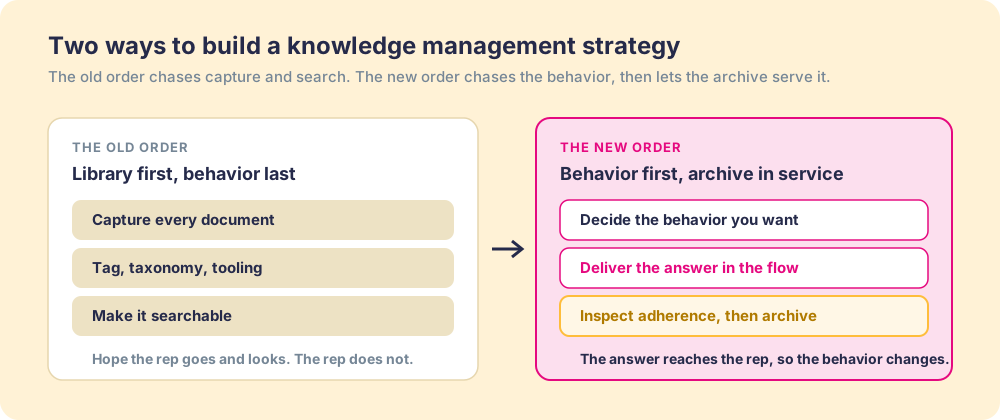
A knowledge management strategy is the plan a team uses to capture, organize, deliver, and govern its know-how, and the version that moves results sequences delivery and adherence ahead of capture and search. Most strategy work runs in the opposite order. It opens with an audit of every document, then a tagging scheme, then a tooling decision, then a long project to make the whole pile searchable, and only at the end, if at all, a vague hope that people will go and look.
Building the library before deciding what anyone will read is the error. You can spend a year on the shelving and the catalogue and still have no answer to the only question that pays: when a rep hits the moment a piece of that knowledge would help, does it reach them, and do they act on it?
Capture and search were genuine pains, and in 2026 both are close to solved. Notion and Confluence made authoring cheap. Guru, Glean, and the AI search layer made finding cheap; ask a question, get a cited answer in seconds. If storing and finding were the whole job, the work would be over.
They are not the whole job. There is a third step almost no plan builds for: use. A person can have the perfect answer surfaced and still not act on it, because acting means stopping the work, reading, deciding, and changing course while a buyer waits on the line. The knowledge was available. The behavior did not change. That distance, between the answer existing and the person acting on it, is where the value leaks, and no amount of better tagging closes it.
What are the components of a knowledge management strategy?
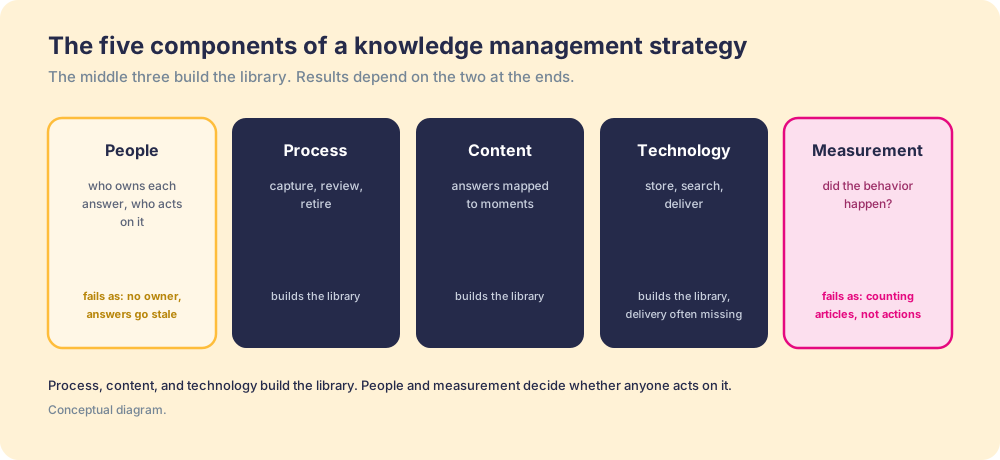
A knowledge management strategy has five components: people, process, content, technology, and measurement. Each answers a different question, and each fails in a recognizable way:
| Component | The question it answers | How it fails |
|---|---|---|
| People | Who owns each answer, and who acts on it? | No owner, so answers go stale the day the process changes |
| Process | How do answers get captured, reviewed, and retired? | Capture with no retirement, so the library fills with contradictions |
| Content | Which answers does each moment of work need? | Written for the archive, not for the moment |
| Technology | Where are answers stored, searched, and delivered? | Storage and search bought, delivery skipped |
| Measurement | Did the intended behavior happen? | Counting articles and views instead of actions |
Process, content, and technology build the library. People and measurement decide whether anyone acts on it. Gartner’s survey of 4,861 digital workers found 47% struggle to find the information they need to do their jobs, while juggling an average of 11 applications (Gartner, May 2023). The failure sits in the library components, where answers split into knowledge silos, and a twelfth application to store more answers does not fix it.
Why do most knowledge management strategies stall at capture and search?
Because using the knowledge costs more, in the only currency that matters mid-task, than not using it. That currency is attention in the moment. The answer lives in another tab. Getting it means breaking off the conversation, searching, scanning, and returning. The rep who guesses keeps the momentum. The plan is asking them to trade momentum for accuracy, and under pressure momentum wins.
The numbers say the tax is real. The McKinsey Global Institute estimated that knowledge workers spend close to a fifth of the workweek, on the order of 1.8 hours a day, searching and gathering information rather than doing the work itself (McKinsey Global Institute, 2012). A fifth of the week spent looking for things is a fifth of the week not spent doing them.
A knowledge management strategy built only on storing and finding aims its whole budget at making that search faster. Worthwhile, and still the wrong target, because the searcher who never searches gets no benefit from a faster search. The strategy treats non-use as a discipline problem, a matter of reminding people to go look. It is not. As we lay out in the sales execution gap, non-adherence is caused by friction and timing, not by lazy people, which is why a sterner email never moves the number.
There is older science underneath this. Ikujiro Nonaka’s SECI model of knowledge drew the line decades ago between tacit knowledge, the kind that lives in your best people’s hands, and the explicit kind you can write down. Most knowledge management strategy work obsesses over the explicit half, the part you can file, because it is the part you can see. The tacit half, the motion your best rep runs without thinking (what we call tribal knowledge, and at company scale institutional knowledge), is the part that wins deals, and a folder never captures it. Spreading that motion, not shelving more documents, is the job.
How do you build a knowledge management process that changes behavior?
Stop asking the person to visit the knowledge, and bring the knowledge to the person. The principle is the one that fixes adoption everywhere: the right action has to be the easy one, delivered the second it is needed, without taking anyone off the work.
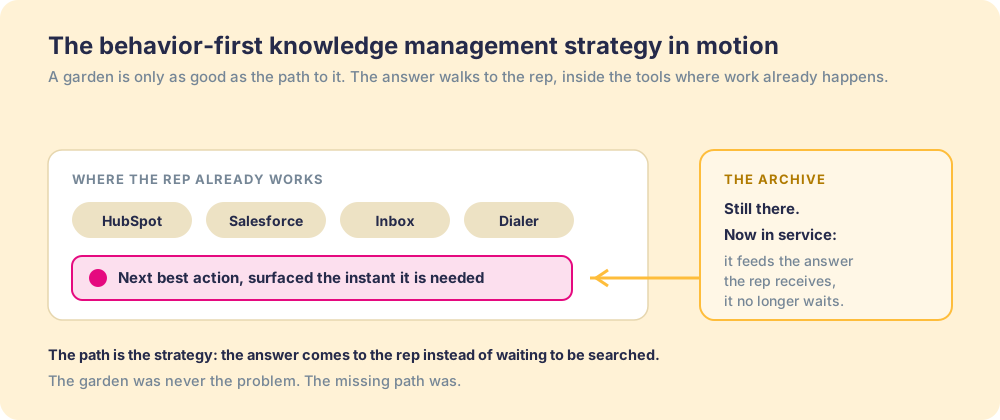
Think of a garden planted with no path to it. The beds are full, the labels are right, the soil is good, and no one walks there, because reaching it means crossing wet grass and a fence. The garden was never the problem. The missing path was. A knowledge management process is the same shape: the content can be perfect and still go unvisited if getting to it costs a detour.
The moves that lay the path are structural, and they are the heart of a knowledge management strategy worth running:
- Behavior decided first. Name the action you want before you organize a single document. The library exists to produce that action, so the action is the spec, not an afterthought.
- Delivery in the flow. The next step, the answer, the rule should surface inside HubSpot, Salesforce, the inbox, the dialer, wherever the person already is, so consulting it costs no detour.
- Triggers by context. A good knowledge management system detects what the person is doing, a renewal, a security review, and offers the answer unasked, rather than waiting to be remembered and queried.
- Adherence inspected. Measure whether the answer changed what the person did, not whether the article exists or got a click. A published-article count flatters the team and tells you nothing.
Teams skip the last move, and it decides the rest. You can only improve what you inspect. A knowledge management strategy measured on article counts and search volume is measuring its own existence. One measured on whether the guidance changed the next action is measuring the only thing the business cares about. The same discipline runs through sales process adoption and the broader case for knowledge sharing that reaches people where they stand: the plan only counts once the behavior moves.
When the answer arrives in the moment, surfaced by context and curated to the next step, the library stops being a destination and becomes a behavior system. The shift runs from a document-heavy plan, which goes stale the day the process changes, to one that reaches people while the work is in motion. We call it the Business Logic Layer, and it is what an internal knowledge base becomes once you stop counting its shelves and start measuring its effect.
How do you develop a knowledge management strategy, step by step?
You develop a knowledge management strategy by starting from the behavior you want and working back to the content, not the other way round. Seven steps, in order:
- The outcome. Name one business result the strategy exists to move: faster ramp, fewer deals stalled at security review, fewer escalations at handoff. One outcome per pilot.
- The behavior. Name the action that drives it, in a form you could check: “the rep sends the security packet within one business day of the request.”
- The moments of need. Map where in the work someone needs knowledge to take that action: the stage change, the objection, the pricing request, the handoff. These moments are the spec for everything after.
- The content audit, scoped. Audit only the answers those moments need. Mark each as current, stale, or missing, and give each one owner and a review trigger, such as any change to pricing.
- The delivery surface. Decide where the answer appears, inside the CRM, inbox, or dialer where the work happens, before choosing a storage tool from the knowledge management tools on the market. Atlassian’s State of Teams 2025 found leaders and teams waste 25% of their time searching for answers (Atlassian); a strategy that ends at a better place to search only trims that number.
- The measure. Track whether the behavior happened, deal by deal, then the outcome. Article views and search counts measure the library, not the strategy.
- The pilot. Run one team and one moment for 30 days, check the measure, then add the next moment.
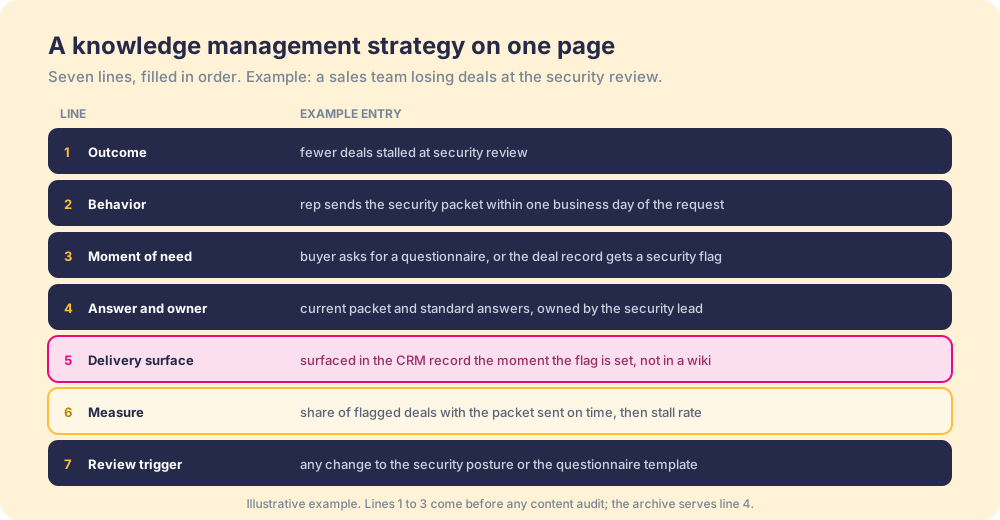
The example in the figure shows why the order matters. A team that starts with the audit would have catalogued every security document it owns. A team that starts with the behavior needed one packet, one owner, one trigger in the CRM, and one number to watch. The audit shrinks from the whole library to the answers a moment requires, and the strategy fits on one page.
The convergence is the strongest part of the case. Our own State of Sales Enablement found that teams whose guidance lives in the flow of the work hit quota at 49 percent against 15 percent for teams whose knowledge sits in a separate destination (The State of Sales Enablement). Same people, same content; the difference is whether the answer reached them where they were standing. When field data and decades of knowledge theory agree that delivery in the moment is the deciding variable, the question is close to settled.
What we recommend
Pouring more effort into capture and search, writing more, tagging better, bolting on smarter retrieval, improves the library and leaves adoption flat. Inverting the order changes what gets built: decide the behavior first, deliver the answer in the flow, inspect whether the behavior changed, and let the archive serve that loop.
Run it inverted, starting with one outcome and one moment. The evidence points one way. People lose close to a fifth of the week to search. Tacit knowledge, the kind that wins, never fit in a folder to begin with. And guidance delivered in the flow more than triples quota attainment over guidance parked in a separate tool. Storing it was solved. Finding it was solved years ago. Use, and holding the work to it, is the part that remains, and it is the part that moves the number.
So build the library if you must, then go further. Decide the behavior, lay the path, and the knowledge finally does the job you built it for. Start with the broader pattern in the sales execution gap, then see what it looks like as a daily discipline in sales process adoption.
Frequently asked questions
What is a knowledge management strategy?+
Why do most knowledge management strategies fail?+
What are the steps to develop a knowledge management strategy?+
What are the components of a knowledge management strategy?+
What is an example of a knowledge management strategy?+
How is a knowledge management strategy different from a knowledge management system?+
What should a knowledge management process measure?+
Where should the answer live in a knowledge management strategy?+
Your process, running itself.