What Is Sales Coaching? The Most Confused High-Impact Act a Manager Has
What is sales coaching, precisely?
It is not training and not managing, and the blur between the three is why the highest-impact thing a manager does is the first one cut. A clear definition, with the science.
Sales coaching is the ongoing work of a manager observing how a rep sells against a defined standard and developing their behavior deal by deal; it is distinct from training, which transfers knowledge once, and from managing, which tracks outcomes already decided.
Ask ten sales leaders what sales coaching is and you get ten answers, several of which are not coaching at all. One describes a pipeline review. One describes a training program. One describes a motivational one-on-one. The word is treated as sacred and used as a catch-all, and that confusion is not harmless trivia. It is the reason the single highest-impact thing a manager does is also the first thing that slips, because an act a manager cannot define cleanly is an act they cannot protect, measure, or get better at.
Sales coaching is the ongoing work of a manager observing how a rep sells against a defined standard and developing their behavior deal by deal; it is distinct from training, which transfers knowledge once, and from managing, which tracks outcomes already decided. Hold those three apart, because telling them apart is most of understanding what coaching is.
What is sales coaching, and what is it not?
It is the development of selling behavior, and it is neither of the two things it gets confused with. Training is the delivery of knowledge: the playbook, the certification, the product deck. It happens once, in a room, and it is an input you can schedule. Managing is the tracking of results: the number, the forecast, the quota. It happens after the fact, on outcomes that are already set. Coaching sits between them and does what neither can: it develops the behavior that turns knowledge into the result, while the deal is still live enough to change.
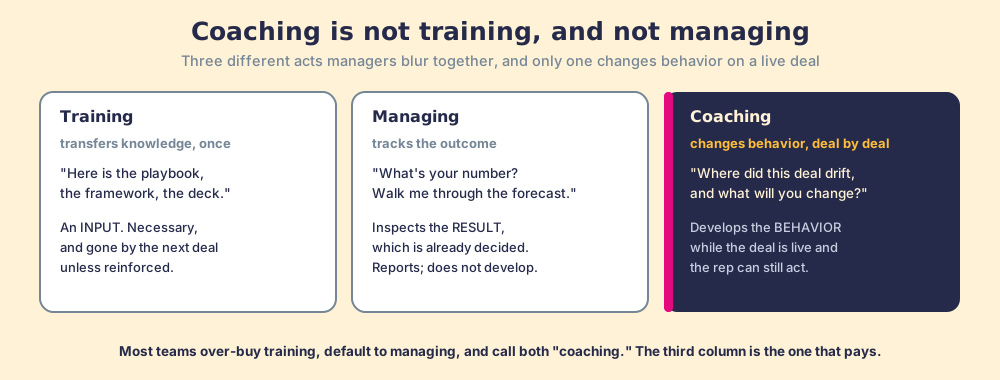
The distinction is not academic, because the three acts decay differently. Knowledge transferred in training is mostly gone within days unless reinforced. Hermann Ebbinghaus measured this in the 1880s and the curve named after him still holds: without reinforcement, recall of new material drops by more than half within a day and keeps falling (on the Ebbinghaus forgetting curve). Results tracked in managing cannot be changed at all, because they have already happened; the score is final the moment you read it. Only coaching operates in the window where intervention still matters: while the deal is live, on observable behavior, in time to change the outcome. A team that treats training as coaching keeps teaching reps things they forget; a team that treats managing as coaching keeps reviewing numbers it can no longer move. Both feel like coaching and neither develops anyone.
Timing is why these three cannot substitute for each other, and a kitchen makes the picture plain. Training is buying the ingredients and reading the recipe before service. Managing is tasting the dish after it leaves the pass, when nothing can be changed and all you can do is record whether it was good. Coaching is the expediter standing at the line while the plate is being built, catching the under-seasoned sauce before it goes out. Only one of the three happens while the cook can still fix the plate, and that one is coaching. A restaurant that inspected only the empty plates coming back would learn a great deal and improve nothing, which is exactly what a team does when it calls the quarterly review its coaching.
Why is sales coaching the highest-impact act a manager has?
Because behavior is the unsolved problem in selling, and coaching is the only one of the three acts that touches it. In 2011 the surgeon and writer Atul Gawande, already one of the best in his field, asked a retired senior surgeon to watch him operate, and within twenty minutes had a page of notes on flaws he could no longer see in himself; his complication rate, long flat, started falling again (Gawande, “Personal Best,” The New Yorker, 2011). His conclusion is the case for coaching in one line: even an expert plateaus without an outside eye, because no one perceives their own blind spots. A sales rep is no different, and the manager is the outside eye.
The numbers match the surgeon. Korn Ferry’s CSO Insights research found teams running formal, dynamic coaching attain quota at 91.2 percent against 84.7 percent for informal approaches, with roughly 28 percent higher win rates (Korn Ferry). That lift does not come from knowing more or watching the number harder. It comes from the one act that develops what a rep does on the next deal they work. The full case, the dose, and the loop are in the sales coaching guide.
A leader can carry that sales coaching meaning into a budget conversation: the act with the steepest return is the one with no line item, because it is a manager’s time spent developing a rep rather than a tool you buy.
Does coaching have a right dose?
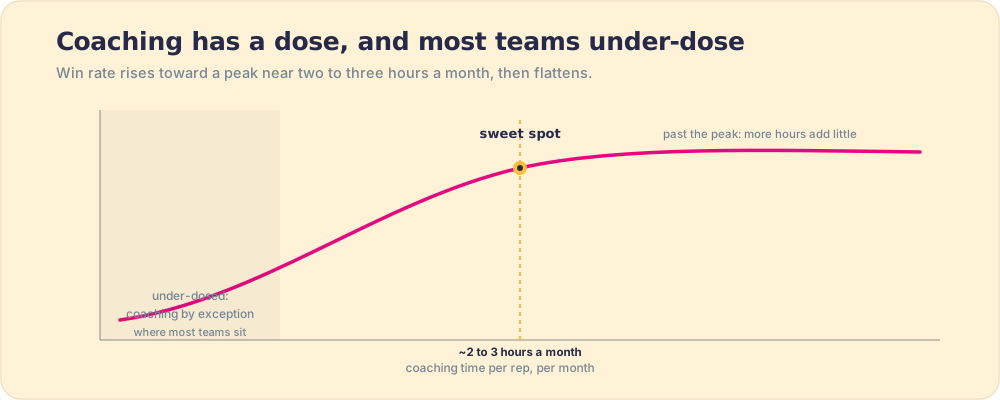
It does, and teams that believe in coaching still get the dose wrong. CSO Insights, studying coaching across thousands of sellers, found the return is not linear: as coaching time per rep climbed toward roughly two to three hours a month, win rates rose, and the curve had a peak rather than running up forever (CSO Insights via Korn Ferry). Too little and the behavior never changes, the way a single gym visit changes nothing. Past the peak, more hours add little, because the binding constraint stops being coaching time and becomes something else. There is a sweet spot, and a team that coaches by exception, only when a deal is on fire, sits far below it.
Why a rhythm, and not a long annual intensive, comes back to Anders Ericsson’s work on how expertise gets built. His decades of research on elite performers, across music, chess, and medicine, found that skill comes from deliberate practice: focused, repeated effort on a specific weakness, with immediate feedback, spread over time (Ericsson on deliberate practice). The operative word is repeated. A skill is built by short, frequent reps with correction, the way a muscle is, not by one heroic session. A quarterly coaching marathon is a single workout; the weekly loop is training. So the cadence of coaching matters as much as its content: the development happens in the repetition, and a manager who coaches once a quarter has not coached lightly, they have skipped the mechanism entirely.
What does sales coaching look like when it is done right?
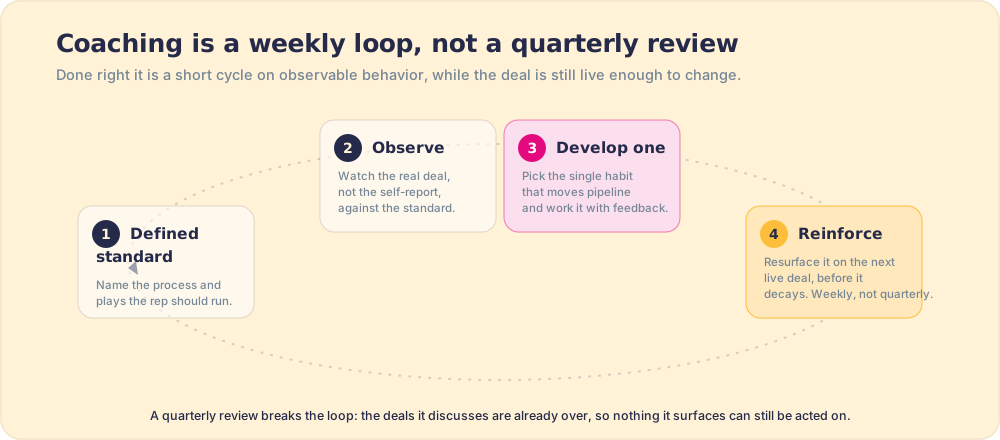
A short, weekly loop on observable behavior, not a quarterly review of outcomes. Sorting the act into its moves makes the sales coaching definition concrete.
- A defined standard. You cannot coach a gap you have not named, so coaching rests on the process and plays a rep is expected to run.
- Observation against the standard. Watch the real call or the real deal, not the rep’s self-report, so the coaching is grounded in what happened.
- One behavior, developed with feedback. Pick the single habit that moves the most pipeline and work it, the way deliberate practice builds skill, rather than reviewing a dozen things and changing none.
- Reinforcement on the next live deal. The lesson has to resurface while the rep is working a real deal, before it decays, which a weekly cadence provides and a quarterly review cannot.
What we recommend
Define sales coaching narrowly, because the narrow definition is the useful one. Your training program and your forecast review sit outside it. Coaching is the weekly, behavior-based development of how reps sell, against a standard, on real deals. Keep training for the knowledge and managing for the results, and protect coaching as the distinct, highest-impact act it is, the only one that changes what a rep does next. The reason it gets cut is that it gets confused with the other two and demoted; the reason to defend it is that Gawande’s surgeon and Korn Ferry’s data agree it is where performance is made. Name it clearly, and you can start to protect it.
From here: the full method in the sales coaching guide, the cadence in sales coaching, the techniques in sales coaching techniques, and the standard underneath in sales process adoption.
Frequently asked questions
What is sales coaching?+
What is the difference between sales coaching and sales training?+
What is the difference between coaching and managing?+
Why is sales coaching so valuable?+
Your process, running itself.