Types of Sales: The Motion Changes, the Discipline Does Not
B2B and B2C, inside and outside, transactional and complex.
Here is a clear map of the main types of sales, how they differ, and the one thing every type needs no matter the motion.
Types of sales are the main categories of selling (B2B and B2C, inside and outside, transactional and complex, and models like SaaS and channel), which differ in motion and cycle but share one requirement: a consistent process the team actually runs.
“Types of sales” sounds like a taxonomy question, and it is, but the useful version is not a list of labels. It is understanding how the motion changes across types of selling, and then noticing the thing that does not change at all. Because for all the real differences between selling software to an enterprise and selling mattresses to a walk-in, the teams that win in every category share one trait, and it is not the motion. It is the discipline underneath it.
Types of sales are the main categories of selling, B2B and B2C, inside and outside, transactional and complex, and models like SaaS and channel, which differ in motion and cycle but share one requirement: a consistent process the team runs every time. Hold that last part. We will come back to it after the map.
What are the main types of sales?
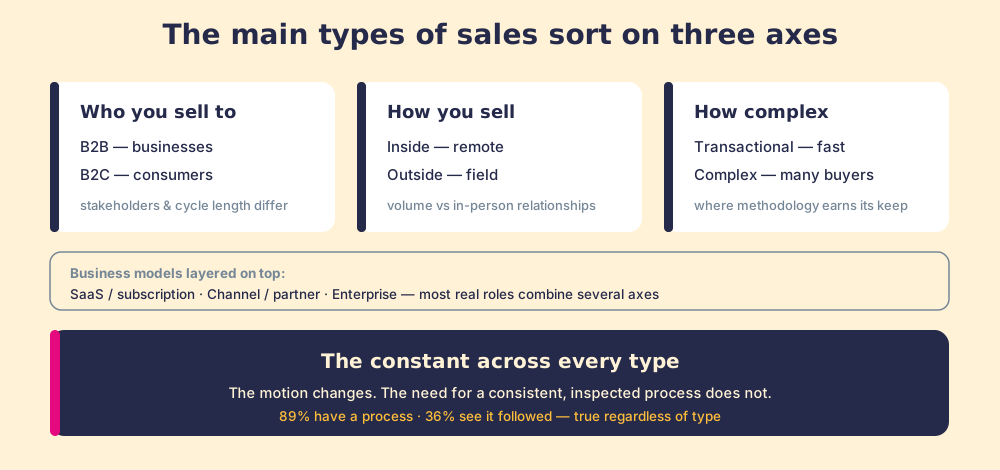
They sort along a few axes, and most real jobs blend several kinds of sales.
- B2B vs B2C. Selling to businesses means multiple stakeholders, longer cycles, and larger deals. Selling to consumers means shorter cycles, smaller deals, and faster, more emotional decisions.
- Inside vs outside. Inside sales runs remotely, by phone, email, and video, and scales on volume and efficiency. Outside or field sales happens in person, with fewer, larger relationships.
- Transactional vs complex. Transactional sales are fast and simple, often one decision-maker and a short cycle. Complex or solution sales involve many stakeholders, long evaluations, and high stakes.
Layered on those are business models: SaaS and subscription sales (where the close is the start, not the end, of the revenue), channel or partner sales (selling through others), and enterprise sales (the most complex end of B2B). A single role often combines them, an inside SaaS rep running a complex B2B motion, for instance.
Why are there types of sales at all?
Here is the question the listicles never ask, and it turns the taxonomy into something you can reason from instead of memorize. These categories are not arbitrary; they are different answers to one underlying variable, and economics named that variable decades ago. Oliver Williamson won the 2009 Nobel for transaction-cost economics, which holds that the way an exchange is structured depends on three things: how specific the assets are, how much uncertainty surrounds the deal, and how often the two parties transact (on transaction-cost economics). When stakes are low, uncertainty is small, and a buyer can judge the product and walk away cheaply, a plain market exchange is efficient, and that is the transactional sale: fast, price-driven, low-trust-required. When stakes are high, the future is uncertain, and the two sides will be bound together for years, the exchange needs relational governance, trust, consensus, a real relationship, and that is the complex enterprise sale. The “types” are only where a given exchange sits on that one axis.
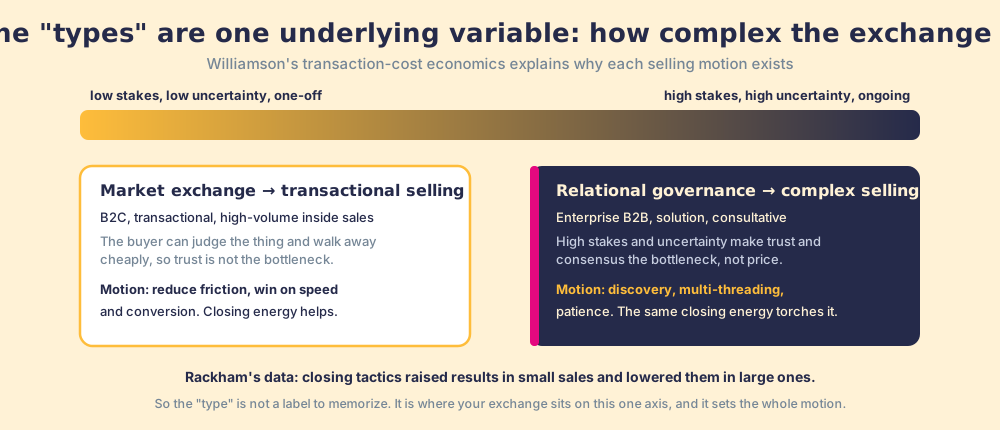
This is not an academic flourish, because it predicts a concrete, counterintuitive fact about selling, and the data confirms it. Neil Rackham’s research on thousands of calls found that classic closing techniques, the pressure tactics that raised results in small, transactional sales, actively lowered them in large, complex ones (Rackham, SPIN Selling). That is exactly what transaction-cost economics predicts: a tactic suited to a low-trust market exchange becomes poison in a high-trust relational one. The skill that wins one type is not merely useless in another; it can be actively destructive, because the two sit at opposite ends of the same axis. Name where your exchange sits, and the right motion follows from the structure rather than from a list.
What does the subscription model change?
One business model deserves its own paragraph, because it bends every axis above. In a one-time sale, the signature is the finish line. In SaaS and subscription sales, the signature is the starting gun: the revenue is recognized over months and years, and most of it arrives after the deal everyone celebrated. That single structural fact rewrites the motion. The cost of acquiring a customer is no longer recovered at the close; it is recovered over the lifetime, which means a sale that lands the wrong-fit customer is worse than no sale, because it carries acquisition cost and then churns. The discipline shifts from closing to qualifying, because a subscription business is punished for the deals a transactional business would happily take.
This is why subscription sellers obsess over fit and over the early signals of whether the customer will stay, and why the same process discipline that helps a complex B2B sale helps a SaaS one even more. A subscription is a relational exchange wearing a transactional cycle, fast to sign, long to pay off, and the process has to protect the long part during the fast part. Run discovery loosely to close quicker and you have only moved the loss from the deal to the renewal. The motion looks transactional; the economics are relational; the process is what reconciles the two.
How do the types of sales differ?
They differ most in cycle length, stakeholder count, and where the value is created. A transactional B2C sale rewards conversion and experience: make the decision easy, reduce friction, win on volume. A complex B2B sale rewards orchestration: manage a buying group (the problem Miller Heiman strategic selling was built for), which Gartner puts at six to ten decision-makers for a typical complex purchase (Gartner), qualify hard, and run a multi-stage process over months. The skills that win in one can actively lose in the other; the relentless closing energy that works on a short transactional cycle can torch a complex enterprise deal that needs patience and consensus-building.
This is why methodology fit depends on type. SPIN Selling and Challenger earn their keep in complex sales where insight and discovery move the deal. Solution selling and consultative selling suit considered purchases with real needs to uncover. A purely transactional motion needs less of this machinery and more speed. Choosing a methodology without naming your type is how teams end up running an enterprise playbook on a transactional motion, or the reverse.
What does every type of sales share?
Here is the part the taxonomy hides: across every type, the teams that win run a consistent process, and the teams that lose depend on individual heroics. The motion differs, but the requirement for a defined, repeatable, inspected motion does not. A transactional team needs a tight, fast process run the same way every time. A complex enterprise team needs a multi-stage process with real exit criteria. Both fail the same way, by leaving the motion to each rep’s instinct and hoping it works out.
The evidence is the same regardless of type. Our research found 89 percent of teams have a defined sales process and only 36 percent see it consistently followed (The State of Sales Enablement), and teams that consistently inspect deals against the process hit quota at 6.3 times the rate of those that rarely do. That gap between having a process and running it does not care whether you sell SaaS or services, inside or outside, to a business or a consumer. The type sets the motion. Adherence to the motion sets the results.
What we recommend
Use the types to choose your motion, but reason from the structure, not the labels. Locate your exchange on Williamson’s axis, how high the stakes, how much uncertainty, how ongoing the relationship, and the right motion follows: a market-exchange sale wants speed, friction reduction, and conversion, while a relational sale wants discovery, multi-threading, and patience, and the tactics do not transfer between them. That is a real and useful decision, and getting it wrong is how teams run an enterprise playbook on a transactional motion, or take a closer’s energy into a deal that needed consensus and lose it.
But do not mistake choosing the motion for the thing that determines results. The different types of sales change what good selling looks like; they do not change the fact that good selling has to be run consistently to matter, which is why the same 89-versus-36 adherence gap shows up at every point on the axis. Map your type from its transaction structure, build the process that fits it, and then do the unglamorous work every type rewards: get the team to run it consistently, deal after deal.
From here: the process every type needs in sales process steps, the methodologies that fit complex sales in sales methodologies, the consultative approach in what is consultative selling, and the adherence that decides results in sales process adoption.
Frequently asked questions
What are the main types of sales?+
What is the difference between B2B and B2C sales?+
What is the difference between transactional and complex sales?+
Which type of sales is hardest?+
Your process, running itself.