SPIN Selling: the Rep Who Asks, Not Tells
SPIN selling is a four-question framework from research on 35,000 sales calls. What the four questions are, why the Implication question is the engine, and why asking beats telling.
SPIN selling is a sales methodology, developed by Neil Rackham from research on 35,000 sales calls, built on four kinds of question asked in sequence (Situation, Problem, Implication, Need-payoff) that lead the buyer to articulate their own need rather than being pitched to.
Socrates claimed he taught no one anything. He said he was a midwife, and that all he did was ask questions until the person in front of him gave birth to a conclusion they had been carrying all along. It is a strange claim for the most famous teacher in history, and it contains the secret of persuasion: a thing you work out for yourself is believed in a way that a thing you are told never is.
That is the engine inside SPIN selling, though Neil Rackham arrived at it not through philosophy but through the largest study of selling ever run. The SPIN selling methodology is question-led, built on the same midwife’s insight: the rep who asks the right questions in the right order leads the buyer to state their own need, and a need the buyer says out loud is worth more than any claim the rep could make. The best reps, it turns out, do not pitch. They ask, and then they get out of the way.
What is SPIN selling?
SPIN selling is a sales methodology developed by Neil Rackham and the Huthwaite research team, who observed roughly 35,000 sales calls across twenty-three countries over more than a decade before publishing the findings in 1988 (Neil Rackham, SPIN Selling). That scale is the reason the method carries weight, and the reason SPIN Selling still tops most lists of the best sales books. It is not one trainer’s opinion about what works; it is a pattern pulled from tens of thousands of real conversations, sorted into the ones that closed and the ones that did not.
The headline finding overturned the sales wisdom of its day. In small, transactional sales, the old advice (talk a lot, present features, close hard) worked fine. In large, considered sales, the same behaviors actively hurt. What separated the winners was not presentation skill. It was the quality and sequence of the questions they asked, and SPIN is the name for that sequence.
What are the four SPIN questions?
Four kinds of question, asked in an order that builds, each one earning the right to the next. The sequence is the method, so the order is not decoration.
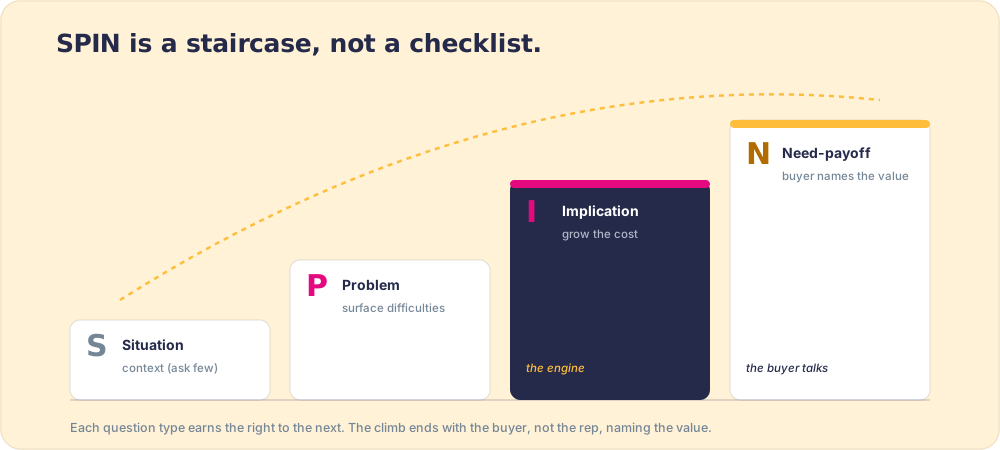
- Situation questions. They gather the facts of the buyer’s current setup. Necessary, but cheap, and the classic rookie error is to ask too many, interrogating the buyer about context the rep could have researched. Do the homework, ask few.
- Problem questions. They surface the difficulties and dissatisfactions in that setup. This is where the real conversation starts, because a problem named is the seed of a deal.
- Implication questions. They explore the consequences of those problems, what the difficulty costs in time, money, morale, missed growth. This is the engine, and most reps skip it.
- Need-payoff questions. They get the buyer to articulate the value of solving the problem (“so if you could cut that ramp time in half, what would that be worth?”). The buyer, not the rep, says the benefit out loud.
Why is the Implication question the engine?
Because it is the one that makes the problem grow, and a problem has to feel large before anyone pays to solve it. A Problem question establishes that a difficulty exists. An Implication question makes the buyer feel the full weight of it, and Rackham’s data singled this out: in successful large sales, reps asked markedly more Implication questions than in unsuccessful ones. The winners were not better presenters. They were better at making the buyer sit with the cost of the status quo.
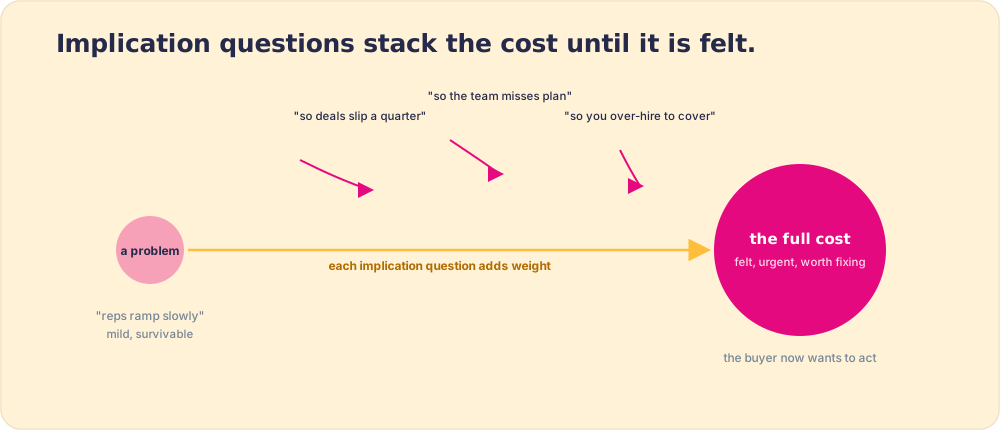
The behavioral reason is the same one that makes loss aversion such a strong force. Daniel Kahneman and Amos Tversky showed that people weigh a loss roughly twice as heavily as an equivalent gain (Kahneman & Tversky, prospect theory). A Need-payoff is a gain (“imagine the upside”); an Implication is a loss (“this is bleeding you now”). By making the buyer enumerate the cost of their current state before any solution appears, Implication questions turn a mild, survivable problem into a loss the buyer is now motivated to stop. This is the same mechanism that powers gap selling, arrived at from a different direction: the cost of the gap is what moves the deal.
Why does asking beat telling?
Because of the midwife’s secret, and the data now proves what Socrates only asserted. People are persuaded far more by conclusions they reach themselves than by claims handed to them, a principle behavioral scientists call self-generated validity. When the buyer says “we are losing about two deals a month to this,” that sentence has a force no rep assertion of the same fact could carry, because the buyer cannot dismiss their own words as a sales pitch. The Sandler sales methodology is built on the same conviction, leading the buyer to surface their own pain rather than having the rep name it for them.
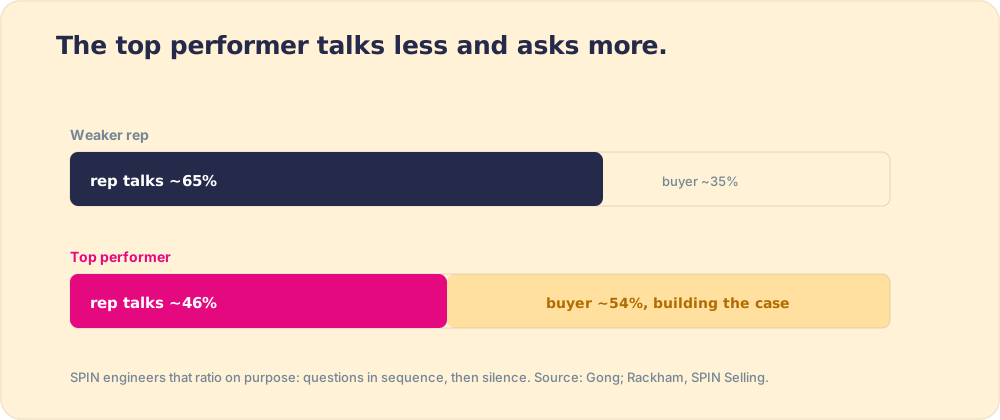
Modern conversation analytics confirm the shape of it. Gong’s analysis of sales calls finds that top performers listen more than they talk, landing nearer a 46:54 talk-to-listen ratio while weaker reps dominate the conversation (Gong). The rep who talks least, within reason, wins most, because the deal is being built in the buyer’s mouth, not the seller’s. SPIN is the discipline of engineering that: a sequence of questions designed to make the buyer do the talking that matters, and it is why the sharpest cold-calling tips push a rep to open with a question rather than a pitch.
This is the deeper kinship between SPIN and consultative selling: both work by self-persuasion. SPIN is the most rigorously researched way to run the questioning that consultative selling calls for, which is why the two belong in the same playbook rather than competing for the same slot.
How do you make SPIN selling stick?
Treat the questions as a defined, inspected step in the process, not as a talent you hope reps were born with. This is where most SPIN rollouts fail, the same way most sales methodologies fail: the team runs the training, everyone is energized for two weeks, and then under quota pressure the reps revert to feature-dumping, because telling is faster than asking and old habits are strong.
The fix is structural, not motivational. The State of Sales Enablement 2026 found that teams who consistently inspect deals against a defined process hit quota at 6.3 times the rate of teams that rarely do, the largest single lever we measured. For SPIN that means the discovery questions should be part of the deal’s required motion, surfaced to the rep at the moment of the call rather than recalled from a class months ago, and inspected so a manager can see whether the questions were asked. A methodology that is not reached for in the moment of the work is a methodology that is not run, which is the real subject of sales process adoption.
What we recommend
Two ways to run a discovery call sit underneath this, and only one of them ages well. You can present: learn the product cold, lead with its strengths, and talk the buyer into seeing the fit. Or you can ask: run the SPIN sequence, spend your effort on Problem and especially Implication questions, and let the buyer talk themselves into the need.
We recommend asking, and the evidence spans forty years and two disciplines. Rackham’s 35,000 calls say that in considered sales the question-led rep wins and the presenter loses. Kahneman’s prospect theory says the cost of the current state, which Implication questions surface, moves people about twice as hard as the upside. Gong’s modern call data says the top performers listen more than they talk. And our own data says a method only changes the number when it is inspected and run in the moment, not when it is merely taught. Those converge on one instruction: ask better questions in a better order, lean hardest on Implication, and make the asking a visible step rather than a private gift.
So be the midwife, not the lecturer. If you want the broader philosophy SPIN serves, read consultative selling; for the problem-first cousin, gap selling; for the qualification that follows good discovery, the MEDDPICC checklist; and for how it all becomes one runnable system, the sales playbook guide.
Frequently asked questions
What is SPIN selling?+
What are the four SPIN questions?+
Why is the Implication question the most important in SPIN selling?+
Is SPIN selling still relevant today?+
How is SPIN selling different from consultative selling?+
Your process, running itself.