MEDDPICC: the Two Letters Where Deals Actually Die
MEDDPICC adds two letters to MEDDIC, and they are the two reps skip. Here is what all eight mean, why a checklist beats a smarter rep, and where late-stage deals fall apart.
MEDDPICC is an eight-part sales qualification checklist (Metrics, Economic buyer, Decision criteria, Decision process, Paper process, Identify pain, Competition, Champion) that scores a deal on verifiable buyer facts, so forecasts rest on evidence, not optimism.
A pilot with ten thousand hours in the air still reads the checklist aloud before takeoff. Flaps set. Trim set. Fuel pumps on. He has done it a thousand times and could likely recite it asleep, and that is precisely why the airline does not trust him to. The list is not there to teach an expert his job. It is there for the one departure in a thousand when he is tired, or rushed, or sure he already did the thing he did not do. The checklist catches the step a confident professional skips under pressure, and in a cockpit the skipped step is the one that kills everyone aboard.
MEDDPICC is that checklist for a sales deal. Most reps treat it as a longer acronym to memorize, two more letters than MEDDIC to recite in a forecast call. That misses what a checklist is for. The point was never to teach a good rep what qualification means. The point is to force the verification of the two or three facts a busy rep, sure the deal is real, will otherwise sail right past, straight into the rocks at the end of the quarter.
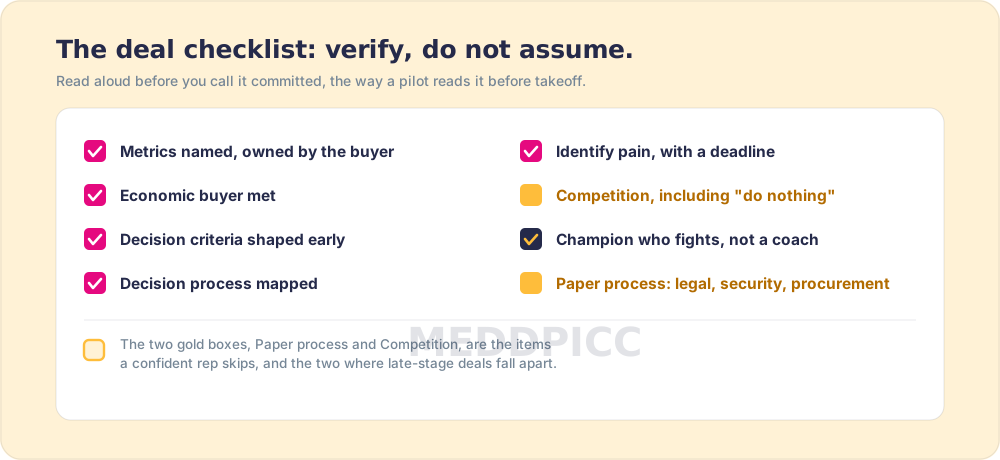
What is MEDDPICC?
MEDDPICC is an eight-part B2B sales qualification checklist that forces a rep to replace their optimism about a deal with facts they can prove. The MEDDPICC sales methodology is unusual in that it scores rather than scripts: the MEDDPICC framework does not tell a rep what to say, it tells them what they must be able to verify. It is MEDDIC, the six-letter framework built at Parametric Technology Corporation in the 1990s, with two letters added for the parts of a modern deal that the original six left uncovered: a P for the Paper process and a second C for Competition.
Strip away the long acronym and it is one idea repeated eight times: stop telling yourself a story about the deal, and go find out what is true. A rep who “feels good” about a deal has a story. A rep who can name the number the buyer will move, the person who controls the budget, the rival in the room, and the procurement gauntlet still to come, has evidence. The distance between those two reps is the distance between a forecast you can bank and one you cross your fingers over.
What does MEDDPICC stand for?
Eight letters, each a fact about the buyer rather than a thing you did. The first six are MEDDIC; the two in bold below are what MEDDPICC adds, and they are the two that earn the longer name.
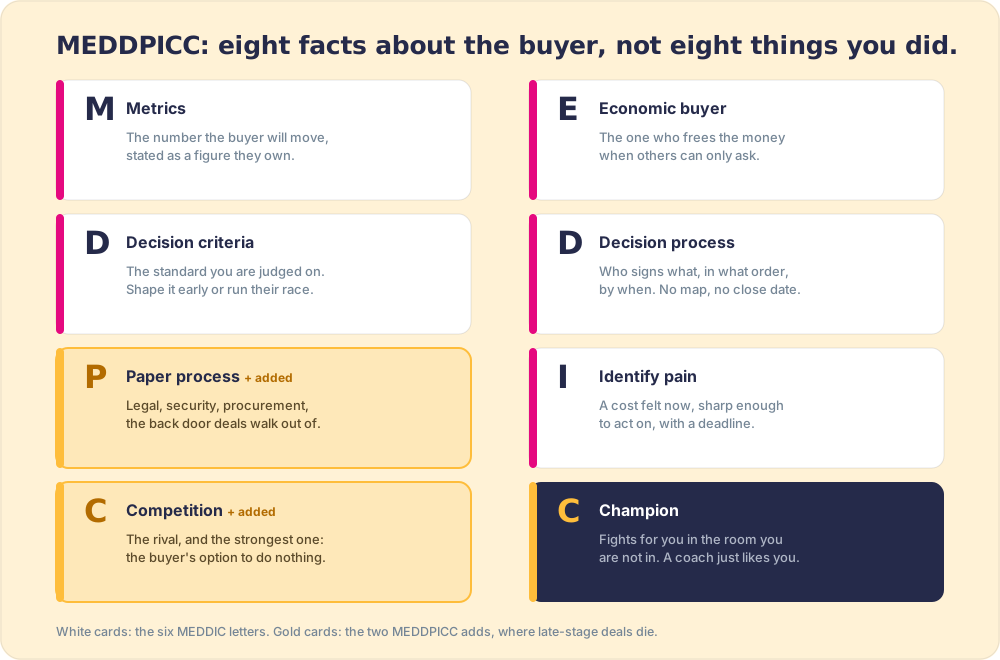
- Metrics. The economic result the buyer will move, stated as a number they own. Not “improve efficiency,” but “cut ramp from nine months to five.” No figure on the prize means no one has decided it is worth chasing.
- Economic buyer. The one person who can free the money when everyone else can only ask for it. A deal that has never met one was sold to people who can say no but never yes.
- Decision criteria. The standard you will be judged against, technical, commercial, and political. Shape it early or spend the deal running someone else’s race.
- Decision process. The literal sequence of who signs what, in what order, by when, ideally written down as a mutual action plan the buyer has agreed to. No decision process named means the close date was invented.
- Paper process. The legal, procurement, and security review the signed deal must still clear. This is the added P, and it is the back door deals walk out of after you thought they were won.
- Identify pain. The cost the buyer feels now, sharp enough to act on this year, with a deadline they supplied. Mild pain produces pleasant calls and no purchase orders.
- Competition. The rival you are measured against, named and understood, including the buyer’s strongest option, which is usually to do nothing at all. This is the added second C.
- Champion. The insider with power and a personal stake in your win, who argues for you in the room you are not in. A coach likes you; a champion spends their own credibility on you. Most “champions” are coaches.
How is MEDDPICC different from MEDDIC and MEDDICC?
Same spine, more vertebrae for deals that need them. The framework grew one letter at a time, and each addition was a scar from a specific kind of lost deal.
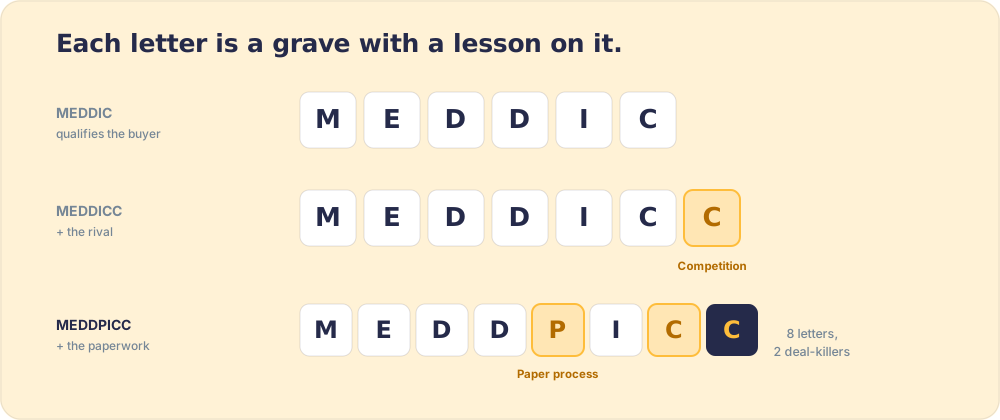
MEDDIC, the original, qualified the buyer in isolation: their pain, their money, their decision. It worked beautifully right up until a deal you were winning on the merits vanished to a competitor you never asked about, so MEDDICC added the second C for Competition. Then teams noticed a second pattern, a deal fully qualified, the champion strong, the economic buyer sold, that still died in month nine inside a security questionnaire or a procurement queue nobody had mapped. So MEDDPICC added the P for Paper process. The framework did not get more complicated for its own sake. It grew to cover the two places deals kept dying after MEDDIC said they were safe. (For the original six in depth, and why the letters are the easy part, the MEDDIC field guide is the companion to this post.)
When should you use MEDDPICC instead of a lighter framework?
More qualification is not a free good. Each letter is a question the rep has to earn an answer to, and earning eight answers takes calls, time, and a buyer’s patience. For the right deal that weight buys you safety. For the wrong one it is a tax. The honest answer to “should we run MEDDPICC?” is “it depends on which deal you are holding,” and what it depends on is how much can go wrong.
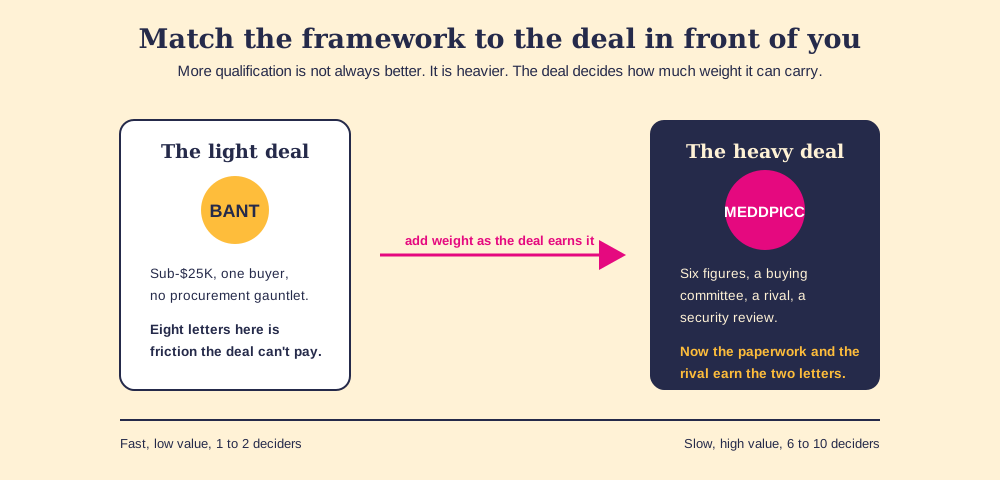
Picture two deals on a Tuesday. The first is a $12,000 renewal-adjacent purchase with one buyer who has already used the product at a past job; they want a number and a contract, and it closes in two calls. Run all eight letters on that deal and you have spent more on qualification than the deal is worth, and likely annoyed a buyer who was ready to sign. For that motion a faster framework earns its place: BANT, the four-question budget-authority-need-timing triage built for speed, qualifies it in a single call and gets out of the way. The second deal is $400,000, with a buying committee, a procurement department, a security questionnaire, and an incumbent vendor defending its turf. Here BANT is a flashlight in a cave. The Paper process and Competition letters are the difference between a clean close and a deal that dies in month nine, and the eight-letter weight is exactly what the deal can carry.
The rule of thumb most revenue teams settle on: below roughly $25,000 with one or two deciders and no procurement gauntlet, a light framework is the right tool, and dragging MEDDPICC across it is over-engineering. Above six figures, with a real committee (Gartner puts the deciding group at six to ten people) and a formal buying machine, the heavier framework is the only honest one. The skill is not loyalty to one acronym. It is matching the weight of the check to the weight of the deal, which is a judgment a manager has to coach, not a policy a CRM can enforce.
Why do the two added letters matter most?
Because the front of a deal is where the excitement is, and the back of a deal is where the money is lost. Reps love the early letters. Pain and Metrics are discovery, the part of selling that feels like selling. Paper process and Competition are the unglamorous back rooms, the redline and the rival, and they get skipped for exactly that reason, which is why they deserve the picture.
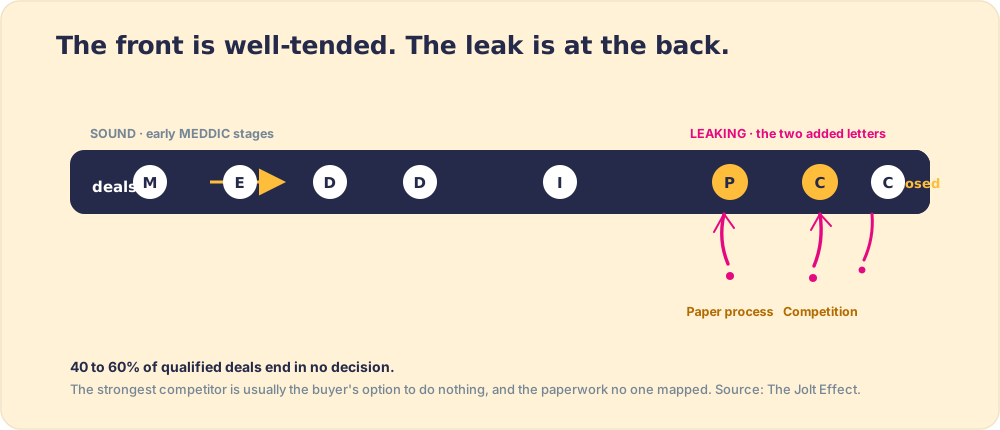
The data says the leak is real and large. In The Jolt Effect, Matt Dixon and Ted McKenna analyzed more than two and a half million recorded sales conversations and found that between 40 and 60 percent of qualified, interested buyers end in no decision, not lost to a rival but lost to their own inability to move (The Jolt Effect). That is the Competition letter doing its damage in plain sight: the strongest competitor in most deals is the status quo, the buyer’s option to keep their money and do nothing, and a rep who only ever asks about other vendors never qualifies against it. Meanwhile the Paper process accounts for a different graveyard, the deals that were genuinely won and then stalled out in legal and security because no one asked, in month two, what the buyer’s signing machine required.
Name them early and the late stage stops ambushing you. A deal that has qualified its Paper process knows in week three that security review takes six weeks, so the close date is honest. A deal that has qualified its Competition knows it is fighting inertia rather than a rival logo, so the rep builds a cost-of-inaction case instead of a feature bake-off. The two letters reps skip are the two that decide whether the back door is bolted.
Why does a checklist beat a smarter rep?
Here is the deeper reason MEDDPICC works, and it has nothing to do with sales. It is about how experts fail. A skilled professional under load does not fail by forgetting how to do the hard thing; they fail by skipping the simple thing they were certain they had handled. The fix is not more skill. It is a list that makes the certainty get checked.
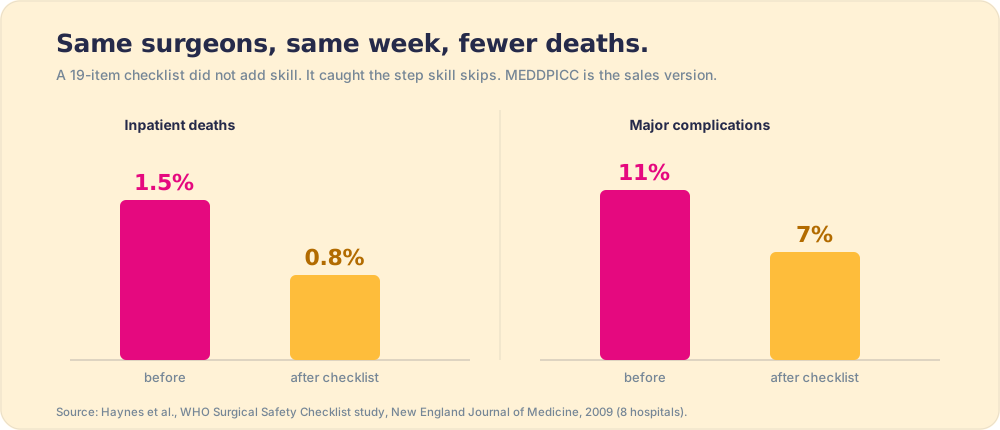
The cleanest proof comes from surgery. In 2009 a team led by Atul Gawande tested a nineteen-item surgical safety checklist across eight hospitals, the kind of list that asks a theater full of experts to confirm out loud the obvious things, the patient’s name, the site of the incision, the antibiotics given. Inpatient deaths fell from 1.5 percent to 0.8 percent, and major complications from 11 percent to 7 percent, after the checklist was introduced (Haynes et al., New England Journal of Medicine, 2009). The surgeons did not get better at surgery in the weeks between. A list made them verify what their confidence would otherwise have waved through.
This is why “our reps are experienced, they do not need a framework” is the argument that guarantees they do. Experience is exactly the condition under which the obvious step gets skipped, because the expert is sure. MEDDPICC works for the same reason the pre-flight list works: it converts a confident professional’s optimism into a verified fact, eight times, on every deal that matters, whether or not the rep felt like checking.
Is MEDDPICC a checklist or a set of behaviors?
Here a fair objection lands, and it comes from the person who did more than anyone to carry MEDDPICC into modern software. Andy Whyte, whose 2020 book MEDDICC made the eight-letter version the common tongue of enterprise sales, would push back on the cockpit picture we drew earlier. In the book he writes that “many qualification methodologies, including BANT and MEDDICC, get a bad name because junior salespeople feel they need to check off answers to every element during every engagement with a customer. Being on the other side of this process feels like an interrogation for the customer” (Whyte, MEDDICC, 2020). His prescription: sellers should “allow for a conversation that focuses on uncovering the qualification elements,” not march a buyer down a form.
He is right, and the cockpit analogy has an edge we should mark before it overreaches. A pilot reads his checklist to himself; a rep cannot read MEDDPICC at the buyer. The moment qualification becomes an interrogation, “Who is your economic buyer? What is your decision process? Walk me through your paper process,” the buyer feels processed, and a processed buyer closes their notebook. John Kaplan, who sold on the original PTC team where MEDDIC was born and now runs Force Management, puts the same caution in a sharper picture: “Think of MEDDICC as an x-ray. It tells you where you’re hurt, but it doesn’t tell you how to fix them” (Force Management). The x-ray reads the deal; it does not treat the patient. Whyte and Kaplan are making the same point from two directions: the letters are a diagnosis, and a diagnosis recited at a customer is not selling.
So grant the objection its full force. MEDDPICC is not a script to read, and a rep who turns it into one will lose the room. But notice where Whyte’s correction lands. He is not saying drop the eight facts. He is saying the eight facts are gathered through behavior, in a real conversation, not harvested by reading boxes off a screen. That is the whole move, and it is the one most rollouts miss. A qualification framework is not a set of fields. It is a set of behaviors: the call a rep makes to the person who controls the money, the question asked plainly enough that “improve efficiency” turns into “cut ramp from nine to five months,” the early, slightly awkward probe into a security review that nobody wants to think about in month two. The letters are the names of those behaviors. The CRM field is only the place the behavior leaves a footprint.
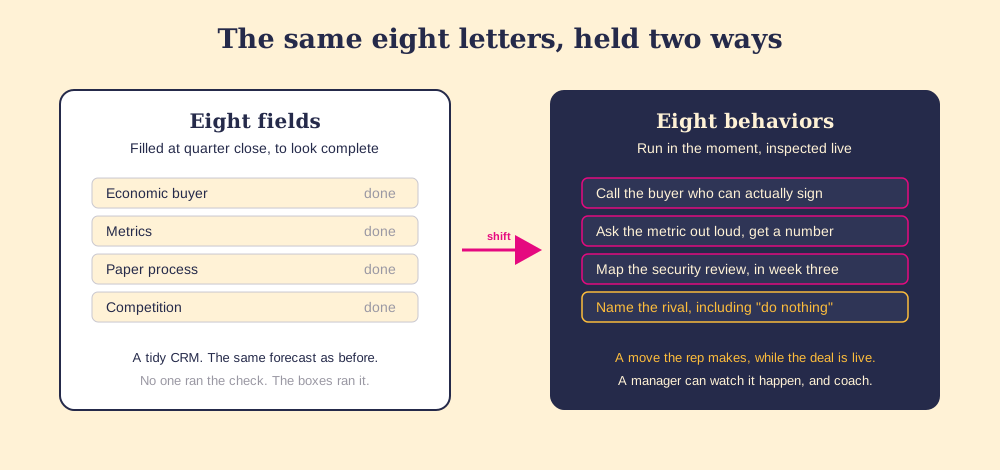
This is where Whyte’s point and Kaplan’s x-ray meet our own. Force Management, after years of installing MEDDICC, found that teams treating it “as a simple checklist” got less from it than teams that treated it “as a repeatable process, a single truth of how your sales team approaches and moves through the customer engagement process” (Force Management). Read that against our own conviction and they are the same sentence: a process is not a document, it is the motion your best reps already run, captured and made repeatable. The eight letters do not create good qualifying behavior. They name the behavior your strongest closers already have, so an average rep can run it too, and a manager can see whether they did.
How do you make MEDDPICC stick?
Installing the acronym is the easy part, and the part that does nothing. Any rep can recite eight letters by Friday; an AI can define them in a sentence. The hard part, the part that was always hard, is getting a busy rep to do the cold, slightly deflating work of MEDDPICC on a live deal on a Tuesday, to call the friendly contact and discover they cannot sign, to ask the Paper-process question whose honest answer pushes the close date out a month.
That work gets skipped because it is unpleasant and invisible, and the cost of skipping it is most of your slipped pipeline. When we asked 198 sales leaders, 89 percent had a defined sales process and only 36 percent saw their reps follow it (The State of Sales Enablement). A qualification framework adopted on paper and ignored in the field is not a methodology. It is a poster.
The lever that closes the gap is inspection, and the same survey shows how much it matters: teams that consistently inspect deals against a defined process hit quota at 6.3 times the rate of teams that rarely do, the largest single effect we measured. So the way to make MEDDPICC stick is not a better template. It is three habits.
- Score the deal, do not store the deal. The MEDDPICC checklist is a test, not eight new tabs. Each letter gets a defensible answer or it is marked unknown. “Unknown” is the most valuable word in the framework, because it names exactly where the deal is blind.
- Reach the rep in the moment, not in a quarterly review. The qualification question has to arrive while the rep is working the deal, the instant the question is live, not weeks later in a pipeline meeting where the honest answer comes too late to change the outcome. This is the real subject of sales process adoption and of the sales execution gap.
- Inspect the answers, not the activity. A logged call records how hard a rep worked. A confirmed economic buyer and a mapped paper process record that the deal moved. Inspect the second, and the forecast stops flattering you, which is the same reason thin qualification wrecks the sales forecast long before quarter close.
What we recommend
Two ways to use this framework sit in front of every team, and only one of them changes a number. You can adopt MEDDPICC as vocabulary, add eight fields, run a training, and let reps fill the boxes with the same hope they had before, which buys you a tidier CRM and the same forecast. Or you can adopt it as a checklist that gets run and inspected on real deals, where each letter is verified or flagged unknown, and the Paper process and Competition get qualified as early and as honestly as the Pain.
We recommend the second, and the evidence is why. Gawande’s surgeons cut deaths in half with nothing but a list that made experts verify the obvious, which is the entire mechanism MEDDPICC offers a sales floor. The Jolt data says the deals you are losing are mostly dying at the two letters reps skip. Andy Whyte and John Kaplan, the two people who carried this framework furthest, both warn that the letters are a diagnosis and not a script, useless until a rep runs the behavior behind them. And our own field data says a framework only moves the number when someone inspects whether that behavior happened. Those four point the same way: the value of MEDDPICC is not in the eight letters, which are common property, but in whether your reps run the check when the deal is live and the quarter is loud, and whether you can see that they did. Match the framework to the deal, run it as behavior rather than fields, and inspect it in the moment.
So treat it like the cockpit list. Read it aloud on every deal that matters, especially the ones you are sure about, because those are the ones the back door opens on. If you want the original six letters in depth, start with the MEDDIC field guide; for fast first-call triage that feeds it, BANT; for the discovery that turns “pain” into a number the buyer owns, consultative selling; and to see how all of it ladders into one runnable system, the sales playbook guide.
Frequently asked questions
What does MEDDPICC stand for?+
What is the difference between MEDDIC, MEDDICC, and MEDDPICC?+
Is MEDDPICC a sales process or a methodology?+
Who created MEDDPICC?+
Does MEDDPICC still work with self-directed modern buyers?+
Your process, running itself.