What Is the Sales Execution Gap? The 53-Point Problem
The sales execution gap is the distance between the process you design and the process reps run. How it is defined, measured, and why it is a known human pattern.
The sales execution gap is the distance between the sales process a leader designs and the process reps run on live deals, measured as the defined-process rate minus the followed-process rate.
Your reps are not skipping the sales process because they are lazy or undertrained. They are skipping it for the same reason you did not go to the gym this morning, and there are thirty years of behavioral science on exactly that. The standard prescription, more training and better content, treats the symptom and misses the mechanism. The reps who skip the step mostly agree with it.
The sales execution gap is the measurable distance between the process a leader designs and the process reps run on a live deal. For the average team it is wide enough to decide the year, and the reason it stays open has nothing to do with discipline. Give it a name and you can measure it; understand what it is and you can close it. Most teams do neither, which is why they keep paying for the same gap on a loop.
How is the sales execution gap measured?
The arithmetic is plain: the defined-process rate minus the followed-process rate.
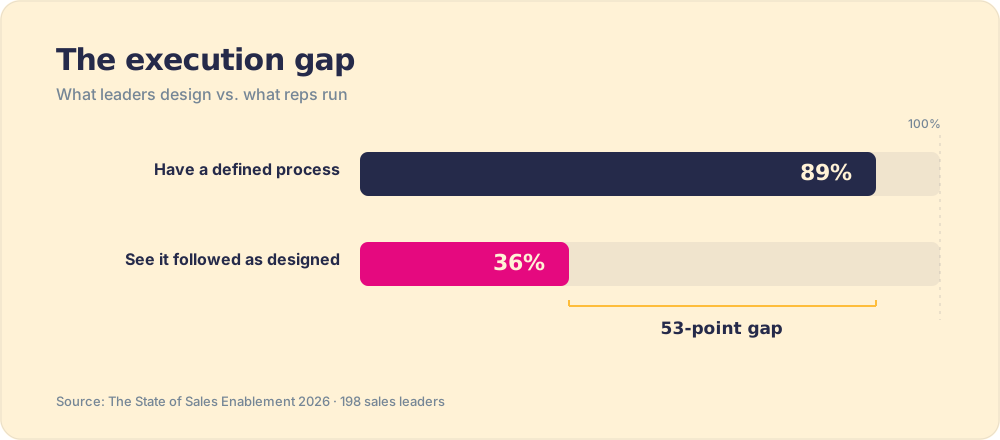
We put the question to 198 sales leaders in our 2026 research. Eighty-nine in every hundred said they had a defined sales process. Thirty-six said their reps followed it as designed. The distance between those two numbers is the gap.
One caution on measuring it well: a survey captures what leaders believe, which is the honest place to start, but the real gap shows up on live deals. The sharper version of the question is whether your open opportunities meet the stage criteria they are filed under. That is an audit you can run this week: take a sample of deals in your two or three most crowded stages and check, deal by deal, whether each one truly satisfies the entry criteria for the stage it sits in. A deal in “proposal” with no confirmed economic buyer, a deal in “negotiation” with no documented next step, a “commit” forecast resting on a single champion who has gone dark, each one is the execution gap made concrete. Run that audit once and most teams find the gap is, if anything, a little wider than the survey admitted, because beliefs about the process are themselves optimistic.
The gap is also expensive, which is why it earns the attention. A deal running an off-book version of the process is a deal your forecast is misreading, a coaching conversation aimed at the wrong problem, and a stage definition that means less than the dashboard implies. The cost does not show up as a line item. It shows up as forecast slippage, uneven ramp, and deals that die in late stages for reasons that were visible early to no one, because the process that would have surfaced them was never run.
Doesn’t more training and better content close it?
The people who study this for a living have already named the gap, and their prescription is more sensible than the strawman deserves. It is worth voicing fairly before we sharpen it.
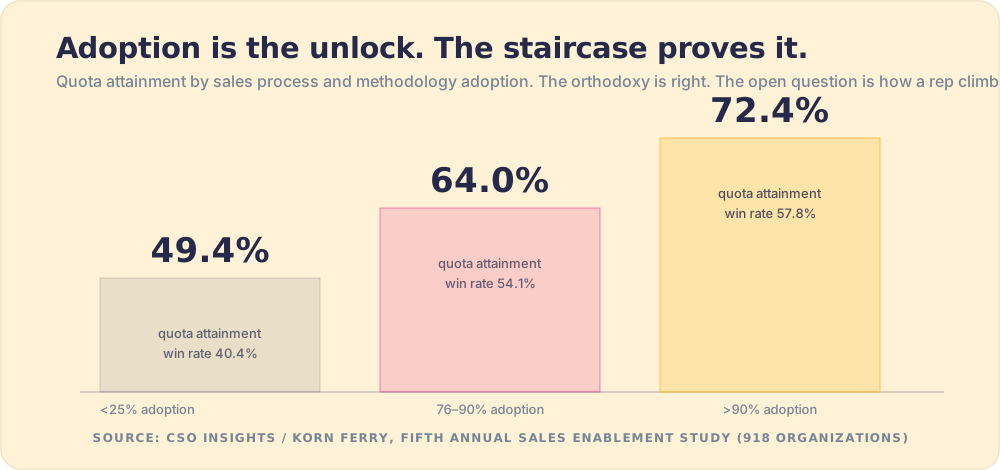
Mike Kunkle, who has spent thirty years inside sales enablement and wrote The Building Blocks of Sales Enablement, calls it the sales methodology execution gap and sizes it in dollars: a middle-market company, he argues in March 2026, leaves seven to eight sellers’ worth of quota on the table for want of a process reps truly run. His evidence is the CSO Insights Fifth Annual Sales Enablement Study, the research arm now folded into Korn Ferry, which surveyed 918 organizations and found a staircase nobody in sales should be allowed to ignore. At under 25 percent process and methodology adoption, teams hit 49.4 percent of quota. At 76 to 90 percent adoption, 64.0 percent. Above 90 percent, 72.4 percent, with win rates climbing from 40.4 to 57.8 percent across the same steps.
Grant all of it, because it is true. The orthodoxy is correct that a formal process is the floor, correct that adoption (not the document) is what moves the number, and correct, in Kunkle’s fifth step, that the process should be embedded in the workflow rather than left in a binder. That last point is the one we would underline twice. Where the prescription still leans, though, is on training and structured coaching as the primary levers that get a team up the staircase. Train the reps, train the managers, coach to the methodology, and adoption is supposed to follow.
Here is the friction. Training and content work on knowing. The execution gap is a doing problem, and the enablement execution gap opens precisely where knowing and doing come apart. A rep can ace the certification on Friday and skip discovery on Monday, not because the Friday training failed, but because nothing on Monday cued the behavior at the moment the deal was live. The staircase tells you adoption pays. It does not tell you what moves a rep from the bottom step to the top. For that, you have to look at why a motivated person fails to do the thing they fully intend to do, which is no longer a sales question at all.
Why does the gap exist?
The obvious explanation, that reps lack discipline or training, points at the wrong thing.
The sales execution gap is not a sales disease. It is a specific, predictable instance of one of the most replicated findings in behavioral science: the intention-action gap. People intend to exercise, to save, to follow up, and then mostly do not, and the size of that human shortfall has been measured for decades. Intentions, on their own, are weak predictors of what a person does.
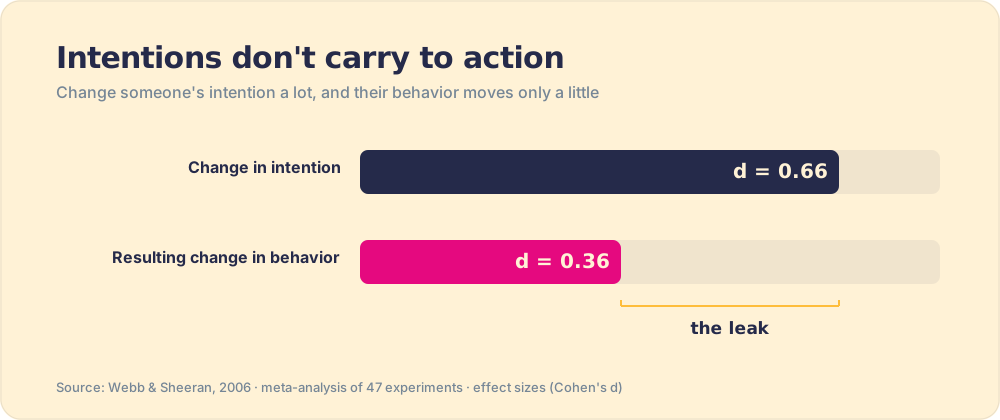
How weak is worth seeing, because it sets the size of the problem. When researchers pooled the experiments that genuinely moved people’s intentions and then watched what those people did, the doing lagged badly behind the wanting. In a meta-analysis of 47 such studies, Thomas Webb and Paschal Sheeran found that a medium-to-large shift in intention (d = 0.66) produced only a small-to-medium shift in behavior (d = 0.36) (Webb & Sheeran, 2006). Move the wanting a lot, and the doing moves about half as much. The rest leaks out in the space between the resolve and the act, the same space where your sales process goes to sit.
A documented sales process is, in the language of that research, a goal intention. “We will qualify rigorously before we demo” is a sincere statement of intent, and it has exactly the loose grip on behavior that every goal intention has. Writing it down, training it, and getting nods in the kickoff does not change the category. It is still an intention, and intentions leak. A sales process pinned to the wall is a New Year’s resolution with a logo: real, sincere, and ignored by February.
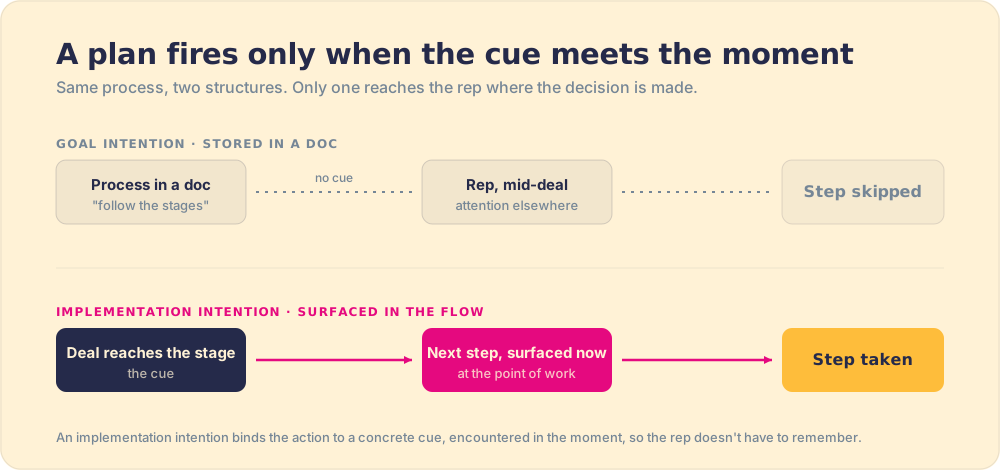
Peter Gollwitzer, the psychologist who has studied this problem longer than almost anyone, opens his 1999 paper in American Psychologist with a flat verdict: “Good intentions have a bad reputation” (Gollwitzer, 1999). His life’s work is the fix, and it is worth knowing precisely, because it tells you what to build. In a meta-analysis of 94 independent tests, Gollwitzer and his colleague Paschal Sheeran found that forming an implementation intention, a specific plan that binds an action to a concrete cue (“when situation X arises, I will do Y”), produced a medium-to-large improvement in goal attainment, an effect size of d = 0.65 (Gollwitzer & Sheeran, 2006). The mechanism is the part to hold onto. In his own words, implementation intentions hand control of goal-directed responses to anticipated situational cues, which on being encountered elicit those responses automatically. The gap between a goal intention and an implementation intention is the gap between “I will exercise more” and “when I get home and take off my shoes, I will put on my running clothes.” The second works far better, and not because the person wants it more. It works because the cue, encountered in the moment, calls up the intended action on its own, so the person does not have to remember, decide, and summon effort all at once while their attention is somewhere else.
This is the precise spot where the training-and-coaching prescription runs out of road. Coaching raises skill and conviction, which sit on the intention side of the ledger, where Gollwitzer already shows the grip on behavior is weak. The thing that closes a sales process gap is not a better goal intention. It is the cue arriving where the work happens.
Now hold a typical sales process up against that finding. The process is a goal intention (“follow the stages”). But the cue that should trigger the next action is missing from the moment of action. The criteria live in a doc; the work lives in the deal and the inbox and the dialer. The rep, mid-deal and under load, gets no prompt where the decision is made. The science predicts precisely what our data found: a large, stubborn gap between the intention and the act. The process has the form of a plan but not the structure that makes plans fire.
That reframing settles the argument with the orthodoxy. Kunkle and CSO Insights have the destination exactly right, adoption above 90 percent is where the money is, and Kunkle’s fifth step, embed the process in the workflow, is the same conclusion Gollwitzer reached in the lab decades earlier. The order of operations is where we differ. Put training and structured coaching first and you are working the intention side of the ledger, where the grip on behavior is weak, and hoping adoption catches up. Put the cue first, deliver the process in the flow of work, and adoption is no longer something you exhort or audit into existence, it is the natural result of the rep being prompted at the point of action. Measurement belongs in that same frame: tracking adherence on a live deal is not a threat, it is a cue, a prompt that says “here is what this stage requires, now.” A penalty delivered at quarter close supplies no cue and changes nothing; a measurement surfaced in the moment supplies the cue and changes everything. Training still has a job, building the skill the cue then triggers. It is the second lever, not the first.
How do you close it?
You close the sales execution gap the way the evidence says all intention-action gaps close: by binding the next action to a cue at the moment it is needed.
In practice, for a revenue team, that means the process stops being a document reps are meant to remember and starts being delivered in the flow of work. The required step, the stage criteria, and what must be true to advance reach the rep in real time, where they are working the deal, at the moment they are working it. That is an implementation intention expressed in software instead of a sticky note: when this deal reaches this stage, here is what must be true and here is the next action, surfaced right there, not filed away in a wiki the rep would have to remember to open.
Teams whose process reaches reps in the flow of work, in real time, hit quota at 49 percent. Teams whose process lives in a doc, wiki, or LMS hit quota at 15 percent.
This is the principle behind how we built Supered, named as one instance of the idea rather than the point of it. Supered is the Behavior Layer: it surfaces the process in the moment of work, in real time, so the cue arrives at the point of the decision and the gap closes where it opens, in the rep’s hands while the deal is live, not in a quarterly review. It also makes the gap visible across every open deal, so you can see drift while you can still do something about it.
So you have three ways forward, and they are not equal:
- The discipline read. Treat the gap as a willpower problem and answer it with enforcement, and you work the one variable the research says does not move.
- The knowledge read. Treat it as a knowledge problem and answer it with more training and better content, the orthodoxy’s instinct, and you raise conviction the reps mostly already had while adoption inches up the staircase slowly if at all.
- The structural read. Treat it as what the science says it is, an intention-action gap, and answer it by delivering the process as a cue at the point of action, measuring adherence on live deals so the cue carries a signal, and letting training do its real and narrower job of sharpening the skill the cue triggers.
We recommend the third without hedging. It is the only one of the three that works on the variable Gollwitzer’s 94 tests and our own 198 leaders both point to, and it turns the orthodoxy’s correct destination, adoption above 90 percent, into something a rep climbs by default rather than by exhortation.
Two threads run on from here. The underlying behavior, why a motivated rep skips a step they agree with, is the Fogg model at work in what a sales process is. And the single highest-impact move for closing the gap, delivering the process in the flow of work, gets its own treatment in where your sales process should live.
Frequently asked questions
What is the sales execution gap?+
How is the sales execution gap measured?+
Why does the sales execution gap exist?+
How do you close the sales execution gap?+
Your process, running itself.