Sales Forecasting: Why It Misses, and How to Fix the Foundation
Sales forecasting fails less often because of the method and more often because of the pipeline underneath it. The main methods, why accuracy is low, and how to fix it.
Sales forecasting is the practice of predicting future revenue from the current pipeline, and its accuracy depends less on the forecasting method than on whether the underlying deal stages measure verifiable buyer commitments rather than seller activity.
A sales forecast is a building, and the pipeline is its foundation. Forecasting methods, the run-rates and the weighted probabilities and the shiny new models, are the architecture you raise on top: the floors, the framing, the careful math. It is satisfying work, and most teams pour their effort into it. But no amount of clever engineering upstairs will hold if the foundation underneath is poured on soft ground, and the foundation of every forecast is the same humble thing: the data in your deal stages. Learning how to forecast sales well starts there, at the foundation, not in the math upstairs.
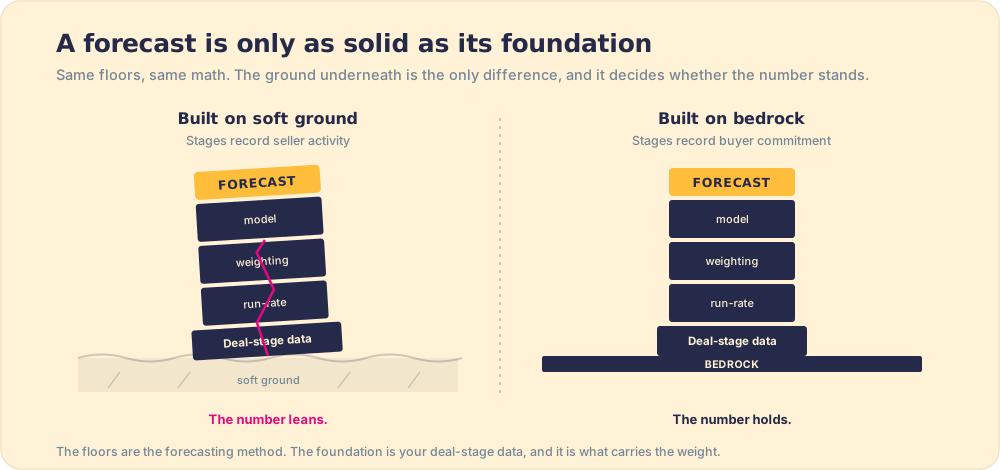
That foundation gets the least attention and carries the most weight: it is what decides whether the building stands. We can talk about methods, and we will, in full, because you came here for them. But the honest answer to “why does our forecast keep missing” is rarely the method. It is that the stages feeding it advance on what the seller did rather than on what the buyer agreed to, so the inputs are softer than they look, and a forecast can only ever be as solid as the ground it stands on.
What is sales forecasting?
Sales forecasting is predicting how much will close in a future period, usually by reading the current pipeline forward. A forecast has two parts: a method that turns deals into a number, and the deal data that method runs on. The industry talks endlessly about the first and almost never about the second, which is backwards, because the second is doing most of the work. Forecast accuracy is itself one of the sales KPIs worth watching, a meta-metric that tells you whether the rest of your numbers can be trusted.
It helps to see how shaky the building is before we admire the architecture. Gartner surveyed sales leaders and sellers and found that fewer than half have high confidence in their own forecasts (Gartner, 2020). Read that plainly: the people who build the forecast, who stake the year on it, mostly do not believe it. That is not a math problem. You do not lose faith in arithmetic. You lose faith in the numbers you are feeding the arithmetic.

Why are sales forecasts so inaccurate?
Hold the building in mind. The cracks always run up from the foundation.
A deal stage is supposed to tell you where a deal stands. On most teams it tells you what the rep last did. “Proposal sent” is an email leaving an outbox; it happens on a dead deal as easily as a live one. When the stage advances on the seller’s motion alone, with no matching buyer commitment, the deal’s position in the pipeline is a guess wearing a label, and a forecast is only the sum of those guesses. This is the deeper subject of the deal-stage mistakes that distort a forecast, and it is the foundation crack under nearly every missed number.
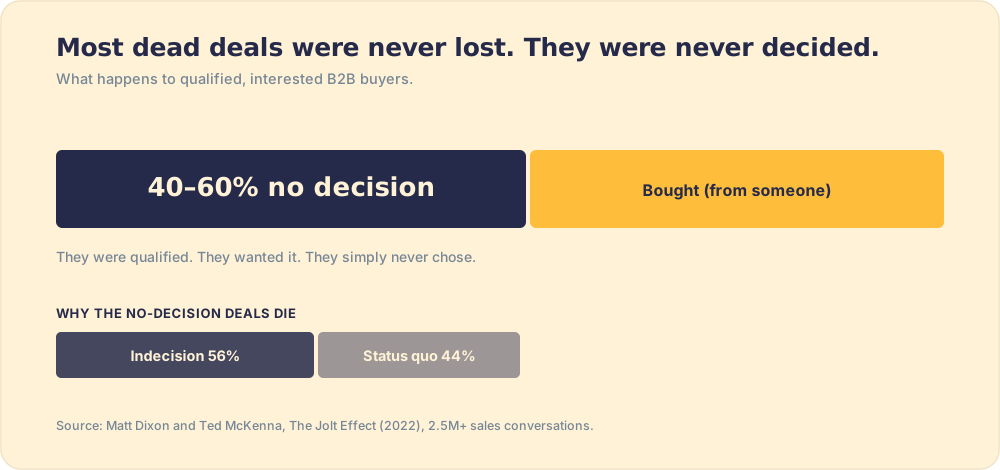
The cost shows up as slippage and disappearance. Research behind The Jolt Effect, drawn from more than two and a half million recorded sales conversations, found that 40 to 60 percent of qualified, interested buyers end in no decision (Matt Dixon and Ted McKenna, The Jolt Effect, 2022). Those deals do not announce themselves. They sit in the pipeline, forecasted as live, advancing on seller activity, until the period ends and they are gone. A forecast built on stages that cannot tell a committed buyer from a polite one will keep counting ghosts as guests.
So before we touch a single method: if your stages are built on activity, every method below inherits the same soft ground. The methods differ in their architecture. They do not differ in their foundation.
The main sales forecasting methods
Here, in full, are the methods teams use, what each keys off, when it earns its place, and how it fails. Notice that the failure is the same every time, and it is never the method’s fault.
- Historical / run-rate. Project the future from the past: last period times growth. It is fast and steady for a stable business, and it is blind to anything new, a shifting market, a changed motion, a pipeline that looks nothing like last year’s. It assumes tomorrow rhymes with yesterday, which is true right up until it is not.
- Opportunity-stage (weighted pipeline). Assign each stage a win probability, multiply every open deal by its stage’s probability, and sum. It is the most common B2B method and the most dangerous, because it borrows all its authority from numbers that may be fiction. More on that below.
- Sales-cycle-length. Forecast a deal by how far it is through a typical cycle: a deal sixty days into a ninety-day cycle is “two-thirds there.” It is useful when your cycles are consistent, and it mistakes time elapsed for progress made, which on a stalled deal are opposites.
- Intuitive (rep and manager judgment). Ask the people closest to the deal what will close. Their gut holds real signal a CRM never captures, and it also holds hope, recency, and the deeply human wish to please the boss on a forecast call. Judgment is a seasoning, not the dish.
- Multivariable / AI models. Feed many signals (engagement, email replies, stage, deal age, buyer behavior) into a statistical model. At their best these read the buyer’s side better than any single field, which is the right instinct. At their worst they launder the same bad stage data through impressive math and hand you a confident wrong answer faster.
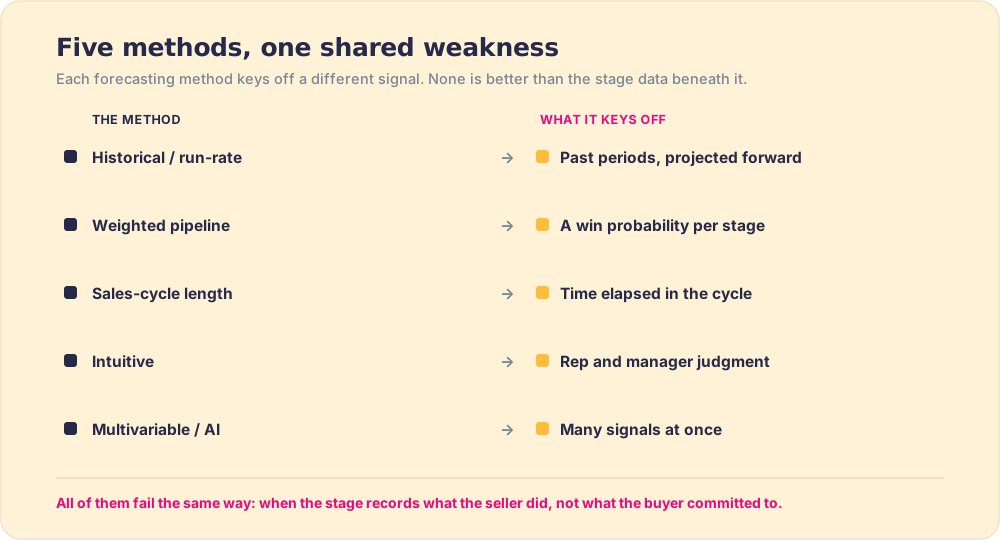
There is no villain among these. A run-rate, a weighting, a model, each is a reasonable way to turn a pipeline into a number. The trouble is never the turning. It is the pipeline.
The weighted-pipeline trap
The most popular method deserves its own warning, because it is the one that dresses soft ground in a hard hat.
Weighted pipeline multiplies a deal’s dollar amount by the win probability of its stage. A 100,000 dollar deal in a stage worth 60 percent contributes 60,000 to the forecast. It feels rigorous. It produces a number to the dollar. And it is only ever as real as that 60 percent, which is only as real as the definition of the stage. If “stage four” is reached the moment a proposal is sent, then its 60 percent is not a measured win rate; it is a hopeful label, and multiplying a genuine dollar figure by a fictional percentage gives you precise nonsense. It is measuring a rubber band with a micrometer: the instrument is exact, the thing being measured will not hold still, and the readout’s confidence is the most misleading part.
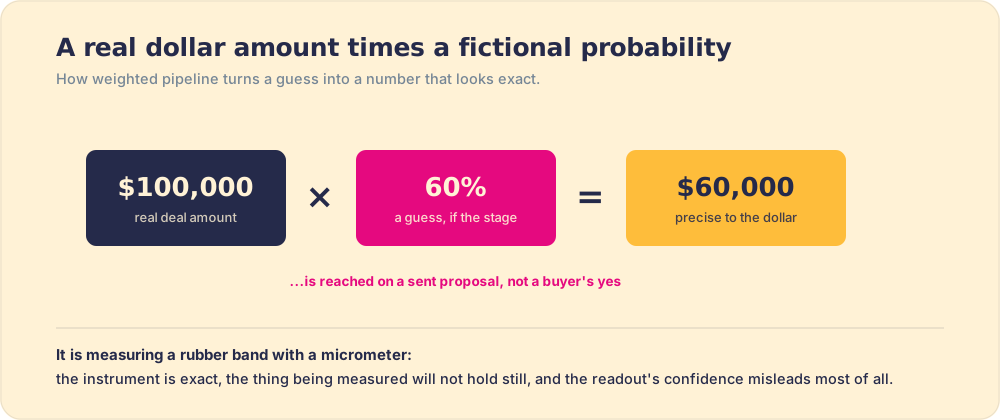
Weighting is not the enemy. It is a fine method once the stages it weights mean something a buyer confirmed. The mistake is reaching for a more elaborate model to fix an accuracy problem that lives one floor down, in the stage definitions. You cannot compute your way out of bad inputs. You can only fix the inputs.
Does a good sales process make a forecast better?
Yes, and emphatically, which is the other half of this argument and the half that keeps it from curdling into cynicism. None of this says forecasting is hopeless or that process and method are pointless. It says the reverse. A sales process built on buyer commitments, and run in earnest, is the most powerful thing you can do for forecast accuracy. The buyer’s actions are the real signal. A consistent process is what captures that signal the same way on every deal, so two reps reading the same situation file it the same way. A methodology is what teaches a rep to recognize the signal in the first place. Run together, and run consistently, they are not decoration on the forecast; they are the reason it can be trusted.
The research is plain. When CSO Insights, now part of Korn Ferry, looked at what separates organizations with predictable revenue from the rest, the dividing line was what they named dynamic alignment: a sales process mapped to the buyer’s real decision and kept current as buyers change. Only about 19 percent of organizations reach it, and the ones that do post higher win rates and, the part that matters here, materially more predictable revenue (Korn Ferry). Harvard Business Review found the same from the performance side: the high performers ran a closely monitored, formal process while the laggards ran informal ones or none (HBR, 2015). A real process, followed, is what earns a forecast the right to be believed.
So the picture is not “process bad, method pointless.” It is that the foundation is a process, the right one, run the right way.
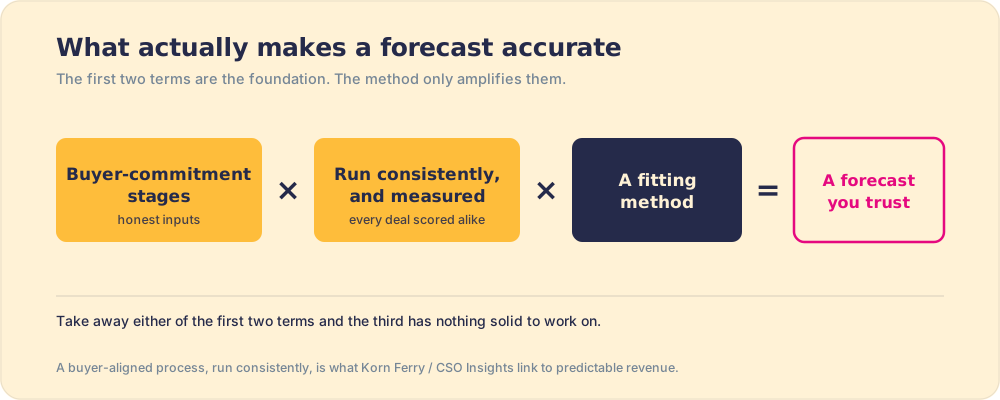
Read the formula left to right. Stages defined by buyer commitments give you honest inputs. Running them consistently, and measuring that you have, keeps every deal scored on the same scale. A fitting method then turns those clean, even inputs into a number. Remove either of the first two and the third has nothing solid to stand on. Keep all three and forecasting stops being a wager and becomes arithmetic on facts you can defend.
How to improve sales forecast accuracy
When the forecast keeps missing, you have two ways forward, and they are not equal. You can renovate upstairs: buy a better model, an AI forecasting tool, a more elaborate weighting, and try to compute your way to accuracy. Or you can repair the foundation: redefine the stages by buyer commitment and measure them. The data points hard at the second. The leaders who do not trust their forecast are not short on methods; they are short on inputs they can believe (Gartner). And the deals that wreck the number are not lost to better-modeled rivals; they dissolve into no decision while sitting in stages that could not tell a committed buyer from a polite one (the Jolt Effect). So the recommendation here is deliberately lopsided: repair the foundation first, then choose any method you like. Three moves, in order, and the order is the point.
- Define stages by buyer commitment, not seller activity. Rewrite each stage as something the buyer did that you can prove: not “demo completed” but “buyer confirmed the solution fits their problem,” not “proposal sent” but “the economic buyer agreed the terms are worth evaluating.” Now a deal’s position is a fact, not a hope, and the sum of those facts is a forecast worth trusting. (This is the heart of what a sales process is and the seven steps as buyer commitments.)
- Measure whether your live deals meet those criteria. A stage definition only helps if deals are held to it. Audit your open pipeline against the buyer-commitment criteria, continuously, so a deal forecasted as “stage four” has earned it. Measurement is the thing that keeps the foundation poured straight, and the science on why is in compliance vs adoption.
- Then pick whatever method suits your business. With clean, buyer-confirmed stages underneath, a weighted pipeline or a model finally has honest inputs, and the choice of method becomes a matter of taste rather than the difference between a forecast you believe and one you cross your fingers over.
This is the reasoning behind how we built Supered. The Behavior Layer surfaces each stage’s real buyer-commitment criteria in the moment a rep is updating a deal, and measures whether the commitment is there on every open opportunity. The forecast stops being a tower of hopeful labels and becomes a sum of verified facts, because the data underneath it was poured on rock instead of sand.
So when the forecast misses again, resist the urge to renovate the upper floors. The method is rarely the culprit. Go down to the foundation, the stage data, and ask the one question that decides everything above it: does each deal sit where it sits because the buyer moved, or because the seller did? Fix that, and the building finally holds. The full set of foundation cracks is in the deal-stage mistakes that distort a forecast, and why even a fixed process goes unrun is the sales execution gap.
Frequently asked questions
What is sales forecasting?+
What are the main sales forecasting methods?+
Why are sales forecasts so inaccurate?+
How do you improve sales forecast accuracy?+
Does a good sales process improve forecast accuracy?+
What is the weighted pipeline forecasting method, and is it reliable?+
Your process, running itself.