5 Deal-Stage Mistakes That Wreck Your Forecast
Most deal-stage mistakes come from one root error: your pipeline tracks what you did, not what the buyer did. The five that distort your forecast, with the research.
The most damaging sales pipeline stage mistakes share one root: stages defined by what the seller did (demo completed, proposal sent) instead of what the buyer committed to, which turns the pipeline into a record of your activity rather than a map of the buyer's progress.
Your pipeline is flattering you, and it flatters you in the one direction that costs real money.
Open your CRM and read the stages out loud. Demo completed. Proposal sent. In negotiation. Now notice what every one of those describes: something you did. Not one of them tells you whether the buyer moved an inch. You can run your entire process flawlessly, demo delivered, proposal out, follow-ups sent, and the buyer can be exactly where they started, or gone. The pipeline measures your effort and calls it progress, and then you forecast off it and wonder why the forecast keeps missing.
That is the root of nearly every deal stage mistake, and it has a simple shape: you drew the map from your side of the table. The five sales pipeline stage mistakes below are all versions of that one error. Fix the root and the others mostly dissolve.
The best people in this field already saw half of it. Force Management, the firm that trained a generation of B2B sellers on MEDDICC, built its whole discipline on the idea that a stage should not advance until defined exit criteria are met, and that those criteria belong to the buyer, not the rep. Their founder John Kaplan, who sold on the original PTC team where MEDDIC was born in the 1990s, calls MEDDICC an X-ray: a way to see the gaps in a deal, who the economic buyer is, what pain is real, whether a champion exists, before you call the deal qualified. “You can’t fix your deals or solve your forecasting issues without having both the x-ray to identify gaps and the treatment so you can fix them,” he writes (Force Management). On that, grant them everything. Exit criteria are right. Buyer commitment is the right thing to gate on. If you do nothing else this quarter, define what the buyer must do to leave each stage, and you will be ahead of most teams.
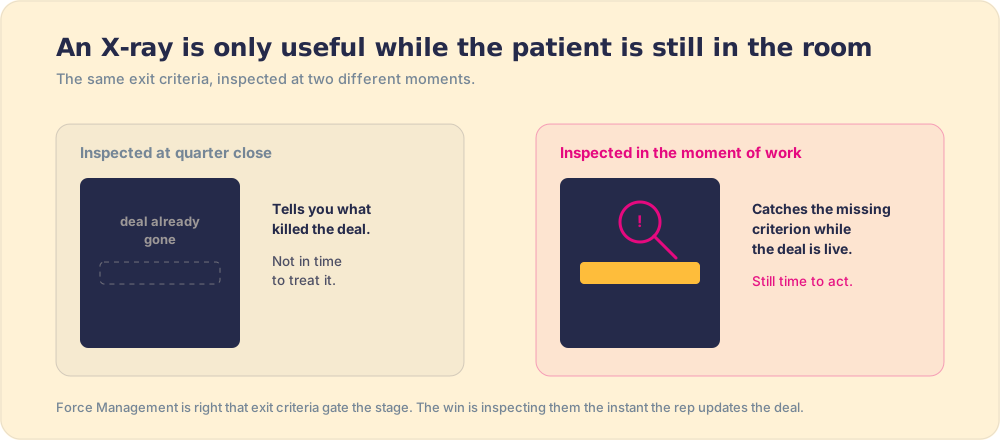
We go one step further, and it is the step that decides whether the discipline survives contact with a busy Tuesday. Force Management itself warns that most teams reduce MEDDICC to “a simple checklist,” boxes a rep ticks at the end of the week from memory. An X-ray you take at quarter close, when the patient has already left the building, tells you what killed the deal but not in time to treat it. The exit criteria are only as good as the moment you inspect them, and the deeper mistake is not the criteria you chose. It is that you draw the map once, hand it to the rep at onboarding, and never look over their shoulder while they walk it.
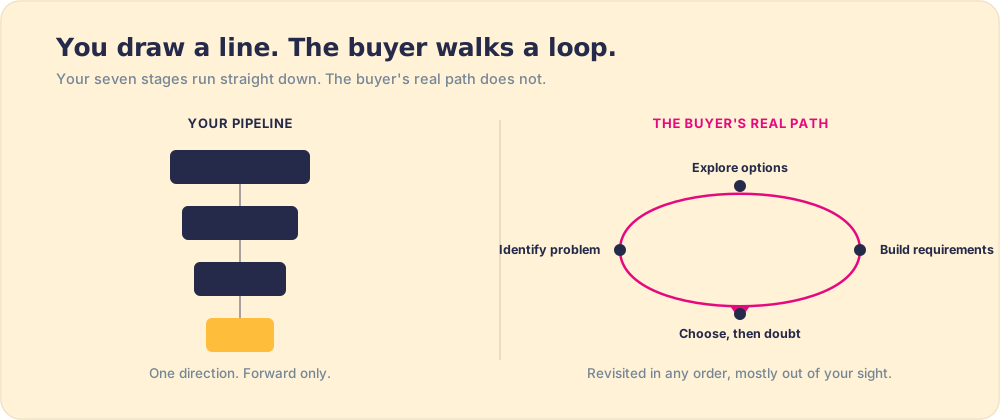
It helps to know how far the buyer is from your map. Gartner’s research on B2B buying found that buyers spend only about 17 percent of the entire buying journey meeting with all potential suppliers combined, and when they are comparing vendors, any single rep may get five or six percent of their time. The other eighty-some percent happens without you. Worse for your tidy funnel, the journey is not a line at all. Buyers loop through a handful of “buying jobs”, problem identification, exploring options, building requirements, choosing, revisiting each more than once in whatever order their organization forces (Gartner). So the buyer is running a messy, looping process of their own, mostly out of your sight, and your pipeline is a neat row of boxes describing what you did to them. No wonder the two do not match.
Mistake 1: Should sales pipeline stages advance on your activity or the buyer’s commitment?
This is the root, so it gets the most attention. A seller-defined stage answers “what have we done?” A buyer-defined stage answers “what has the buyer committed to?” Those sound similar and are worlds apart.
“Proposal sent” is an email leaving your outbox. It happens on a dead deal exactly as easily as a live one. “Economic buyer agreed the terms are worth taking to their CFO” is a fact about the buyer’s intent that you can check. The first is activity, and it is worth tracking in its own right: logging it is how you confirm the process is being run, and it shapes the experience the buyer gets. The second is progress. The mistake is not recording the activity; it is letting a deal advance on the activity alone, so a list of things you did gets read as a measure of where the buyer stands.
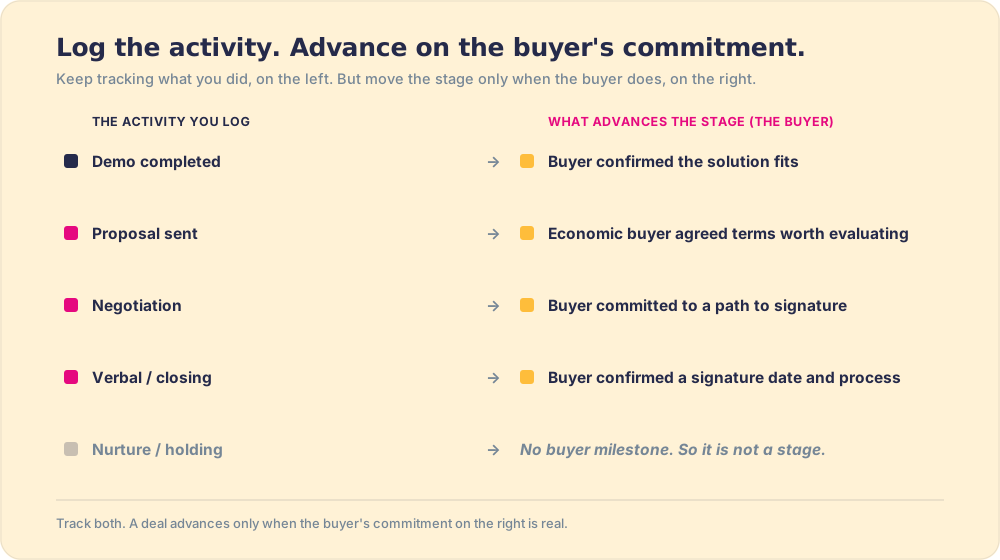
The fix: keep logging the activity, it earns its place, but make each stage’s exit criterion a buyer commitment you can verify, and advance the deal only once the buyer has met it. Not “demo completed” but “buyer confirmed the solution fits their need.” Not “negotiating” but “buyer agreed a mutual path to signature.” The wording change looks cosmetic. It is not. It forbids the most common form of self-deception in sales, which is counting your own motion as the buyer’s.
Mistake 2: The holding stage
Almost every pipeline grows a stage like this: Nurture. Holding. Long-term. Re-engage. It is the place reps move a deal they cannot bear to mark lost but cannot honestly advance. It feels responsible. It is the purest symptom of the disease.
A holding stage has no buyer milestone. Nothing the buyer does puts a deal there and nothing the buyer does takes it out; it exists entirely for the seller’s comfort, a soft drawer for deals you are not ready to grieve. So it fills up with everything that stalled, and your pipeline swells while your real chances do not. A holding stage is where the forecast goes to hide. Worse, it teaches reps that “stuck” is a place to live rather than a problem to solve.
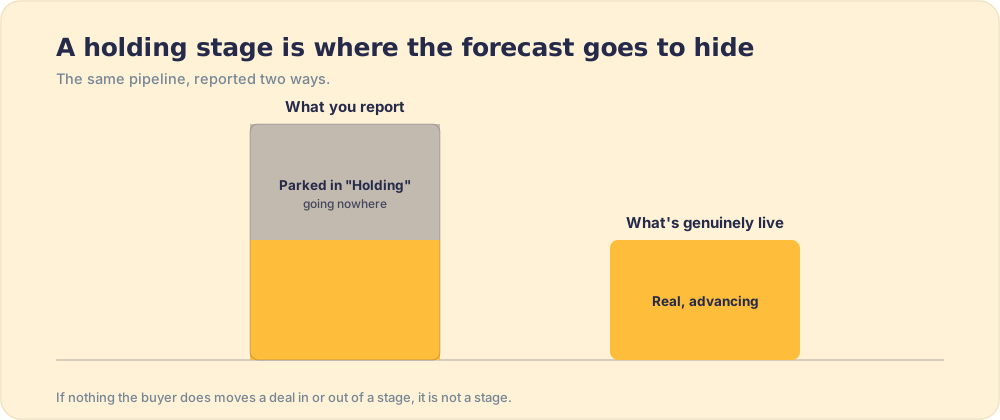
The fix: kill it. A deal either has a live, verifiable buyer commitment, in which case it sits in a real stage, or it does not, in which case it is open pipeline you are kidding yourself about. If you genuinely want to work cold deals later, that is a marketing nurture list, not a sales stage. Make the loss honest and the pipeline gets honest with it.
Mistake 3: What makes a sales stage exit criteria you cannot check?
Even teams that name their stages well leave the gates unguarded. “The champion is excited.” “It feels like stage four.” Those are not criteria; they are feelings wearing a stage number, and a forecast built on them inherits the fog.
There is a sharper failure hiding here. The moment a vague stage becomes a target, people optimize for the label instead of the truth beneath it. This is Goodhart’s law: when a measure becomes a target, it stops being a good measure. If reaching “stage four” earns praise or counts toward a number, deals will reach stage four, with or without anything real behind them, and the pipeline fills with opportunities that satisfy the name and nothing else. It is the same trap that distorts the sales KPIs a team rewards: make a number the target and people will move the number without moving the thing underneath it.
The fix: every exit criterion is a buyer action you could prove to a skeptic. “A confirmed economic buyer has agreed to the next step” survives the question “how do you know?” “They seem bought in” does not. Verifiable buyer evidence is the only thing that resists Goodhart’s law, because it pins the label to a fact.
Mistake 4: Too many stages
The instinct is that a more detailed pipeline is a more rigorous one, so stages multiply until there are eleven of them and forty required fields. The result is the opposite of rigor: nobody maintains it, the data goes soft, and the process becomes optional.
Two things are going wrong at once. First, every stage and field is a decision a rep has to make under load, and more decisions reduce follow-through, not improve it. In Sheena Iyengar and Mark Lepper’s well-known study, shoppers offered 24 jams were far less likely to buy than those offered 6, roughly 3 percent against 30 percent, because the larger set raised the cost of acting (Iyengar & Lepper, 2000). A bloated pipeline does the same to a rep at every gate. Second, and more telling, long pipelines are usually a map of your internal handoffs, SDR to AE, AE to solutions engineer, deal desk, legal, dressed up as buyer progress. The buyer does not care about your org chart, and they certainly are not moving through it.
The fix: collapse the pipeline to the five to seven moments that represent a genuine, distinct buyer commitment. If two stages tend to hold the same deals for weeks, they are one stage with extra steps. Cut until every stage means something the buyer would recognize.
Mistake 5: Why should sales pipeline stages move backward as well as forward?
Your stages almost certainly go one direction: forward, one through seven, like a board game. Real buyers do not. Remember Gartner’s looping, a buying group reopens a requirement, a new stakeholder appears with new doubts, a “done” decision comes untied. The buyer went backward. Your pipeline has no way to say so, so the rep either fudges it (leaves the deal forward, where it now misrepresents reality) or hides it (slides it to the holding stage from mistake two).
This is where even the best stage-design thinking has a blind spot worth naming out loud. Aaron Ross wrote Predictable Revenue, the book that taught a generation of SaaS teams to build a sales machine, after the outbound engine he built at Salesforce added a hundred million dollars in recurring revenue. His whole promise is in the title: “If you have a predictable way to generate sales appointments, you will be able to create predictable sales” (Predictable Revenue summary). The way you get there, in his model, is a clean ladder of statuses a deal climbs: cold, working, qualifying, passed, then on to the closing stages. Grant Ross his case in full. Defined, repeatable stages are how you turn one good quarter into ten. A rep who knows exactly what “qualified” means will qualify better than one running on feel. That part is plainly right, and most teams still have not done it.
But notice the shape of the ladder. It climbs. Ross’s statuses, MEDDICC’s exit criteria, almost every named model a buyer has read, all draw the pipeline as a thing that goes up. None of them draw the rung the buyer steps back down. That is the gap, and it is not a small one, because the buyer steps down all the time.
Picture the pipeline as a ratchet, the toothed wheel inside a socket wrench. Each tooth lets the handle click one way and locks against the other, which is exactly what you want from a wrench and exactly what you do not want from a forecast. A deal clicks from Demo to Proposal to Negotiation, and the teeth hold it there. Then the economic buyer stops returning calls, a new VP reopens the requirement, the “yes” you banked comes untied. The buyer has stepped back two rungs. The ratchet has no tooth for that. So the deal sits on Negotiation, and the gauge reads Negotiation, long after anyone is negotiating.
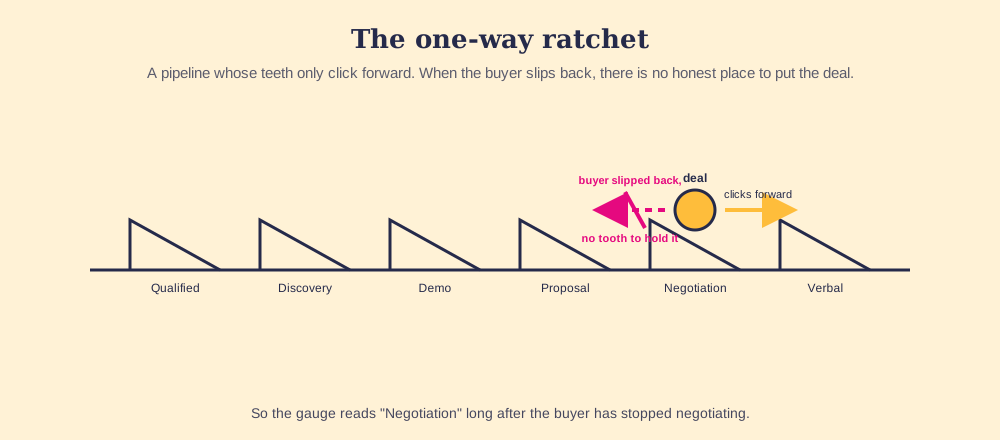
A pipeline that can only advance is a pipeline that punishes honesty. The rep who accurately moves a slipped deal back looks like they are losing ground; the rep who leaves it parked looks fine. You have built an incentive to misreport, then blamed the reps for inaccurate forecasts. The misreporting is not a character flaw in the rep. It is the only move the ratchet leaves them.
The fix: let deals move backward, and treat it as information, not failure. A deal that regresses a stage is the single most useful early-warning signal you have, an honest report that the buyer’s commitment came undone while you can still do something about it. Reward the rep who surfaces it. The goal of a pipeline is not to look good. It is to be true.
How do you fix your sales pipeline stages?
A pipeline should record both what you did and what the buyer committed to, and it should advance only on the second. All five deal stage mistakes share that cure, and here is the fix for each:
- Advance on commitment, not activity. A stage changes when the buyer does something, not when the rep logs a call.
- Delete the holding stage. Kill the parking lot for dead deals; a stalled deal is an open problem or it is out, never quietly stored where it flatters the count.
- Exit criteria you can check. “Met with the economic buyer” beats “building the relationship,” because someone other than the rep can verify it.
- Fewer stages, each meaning something. A short pipeline you actually inspect beats a granular map nobody keeps current.
- Stages that move backward. A deal that lost its buyer commitment moves back, so the board shows the real position, not the high-water mark.
Rewrite your stages this way and the forecast stops flattering you, which is the precise moment it starts being useful.
Doing this in real life runs into the same wall every process does: the rep is busy, and the discipline to capture a true buyer commitment competes with the temptation to click the stage forward and move on. That gap is its own subject, and it is why we built Supered as the Behavior Layer, surfacing the real exit criteria in the moment a rep is updating a deal, so the honest answer is also the easy one.
If this reframed how you see your own board, start one level deeper with what a sales process is, see why even a good process goes unrun in the sales execution gap, and fix the delivery in where your sales process should live.
Frequently asked questions
What are the most common sales pipeline stage mistakes?+
Should sales stages be based on buyer actions or seller activities?+
What is a holding stage and why is it a problem?+
How many sales pipeline stages should you have?+
Why is my sales forecast inaccurate?+
Your process, running itself.