What Is a Sales Process? And How to Build One Reps Follow
A sales process is the map your whole team sells from. What it is, the stages, the research on why most go unused, and how to build one reps follow.
A sales process is the defined, repeatable set of stages every deal moves through, from first contact to closed, with a clear rule for what must be true before a deal earns its way into the next stage.
Nearly every sales team has a sales process. Almost none of them runs it. We asked 198 sales leaders, and 89 percent said they have a defined process while only 36 percent said their reps follow it. Sit with that gap for a second, because it means the thing most teams call their sales process is a document, and the document and the behavior have almost nothing to do with each other.
The same gap swallows every famous sales methodology. Matthew Dixon and Brent Adamson wrote The Challenger Sale on the back of thousands of reps studied, and their finding was stark: “How you sell has become more important than what you sell” (Dixon & Adamson, 2011). They are right. A Challenger rep, a MEDDIC rep, a SPIN rep all sell better than a rep with no method at all. But a methodology is a set of moves a rep is supposed to make, and a move only counts if the rep makes it, on this deal, today. Challenger, MEDDIC, and SPIN do not fail in their design. They fail in execution, the same place a sales process fails, which is why the humbler question, what is a sales process, decides more revenue than which clever methodology you pick.
So this post does both: what a sales process is, and why the gap between the version on paper and the version reps run is the most expensive number in your business. A sales process is a behavior before it is a document, and treating it as a document is how a team ends up with one almost nobody runs.
It helps to start with a plain picture. A sales process is the closest thing a revenue team has to a map: it does not make the journey for you, but it keeps you from wandering and lets the next person take the same road without learning it the hard way. Most teams have drawn the map. Far fewer have a team that walks it.
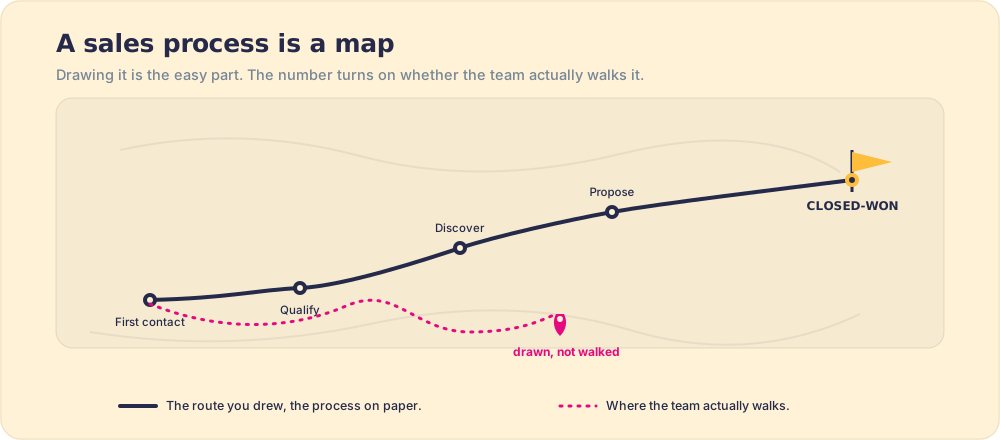
What is a sales process, underneath the diagram?
Strip away the diagrams and a sales process is a simple promise: every deal will move through the same stages, in the same order, and will not skip ahead until it has earned the right to. The stages are the few moments that genuinely decide whether a deal lives or dies. The rules are what separate a stage from a feeling.
It helps to say what a process is not, because the confusion is where most of them go soft:
- Stages, not tasks. A process names the handful of moments that decide a deal, not the fifty small actions a rep takes in a week. A to-do list is not a process.
- Criteria, not vibes. Each stage has an entry and an exit you can check. “It feels close” is not a stage, and a forecast built on it inherits the same fog.
- Shared, not personal. The point is that two reps run the same play, so a deal does not depend on who happens to own it. A process that lives only in your best rep’s head is a single point of failure, not an asset.
A process is also not the same thing as a sales methodology. The sales methodologies reps run, MEDDIC, SPIN, and Challenger, are ways of working inside the stages, mostly how a rep qualifies and runs a conversation. The process tells you where the deal is. The methodology tells you what to do once you are there. You want both, and you should not confuse one for the other. The next section is about why that distinction is worth more than it looks.
Is a sales methodology more important than a sales process?
It is the natural question, and the best-known voices in the field have a clear answer: pick the right methodology and the rest follows. The most influential of them is Challenger.
We should grant Challenger its full case, because the case is strong and the evidence is real. Dixon and Adamson studied thousands of reps and sorted them into five profiles: the Relationship Builder, the Hard Worker, the Problem Solver, the Lone Wolf, and the Challenger. Among average performers the profiles barely differed. Among top performers, the picture broke open: roughly 39 percent of star sellers were Challengers, and in complex sales that share rose past 50 percent, while the Relationship Builder, the profile most sales managers were busy hiring for, produced only 7 percent of the stars (Dixon & Adamson, 2011). The mechanism is insight. As the authors put it, “what sets the best suppliers apart is not the quality of their products, but the value of their insight, new ideas to help customers either make money or save money in ways they didn’t even know were possible.” Neil Rackham, who wrote SPIN Selling and largely invented evidence-based sales research, called the book “the most important advance in selling for many years.” This is not a fad. Insight-led selling earns its reputation.
Here is where we part ways, and it is not with the thesis. It is with what teams do next. A leader reads Challenger, agrees, and rolls out training: a two-day workshop, a deck, a certification. The reasoning seems sound, because the book is about how reps behave. The trouble is that knowing how a Challenger sells and selling like one in a live call are different things, separated by exactly the gap we opened with. Dixon and Adamson saw this themselves. Buried in their own implementation chapter is the warning that the training must not read as another top-down mandate, and the instruction to “equip reps to challenge customers,” not merely tell them to. They knew the idea was the easy part.
A methodology is a recipe. A brilliant one, in Challenger’s case. But a recipe pinned to the wall feeds no one. What gets a dish cooked the same way on every ticket is the kitchen: the stations, the order of operations, the expediter calling the line, the standard nobody is allowed to skip when the rush hits. A sales process is that kitchen. It is the operational machinery that makes a methodology happen on deal after deal instead of living on a wall. Challenger, MEDDIC, and SPIN all fail the same way and in the same place, not in the design of the recipe, but in whether the kitchen ever cooks it.
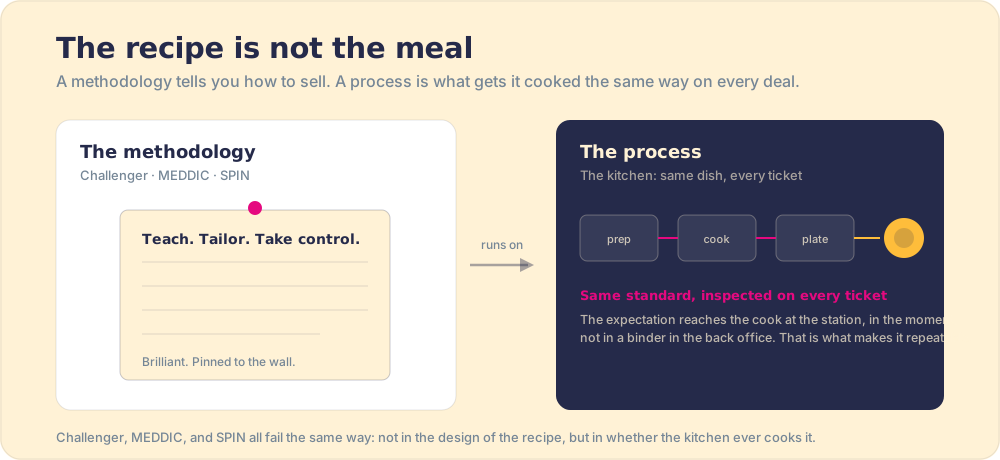
This is why the unglamorous question wins. Argue methodology all year and you are arguing about the recipe. Build a process reps run and you have built the kitchen, and the kitchen is what turns any recipe into revenue. Pick the methodology that fits your motion, by all means. Then spend the real effort making it run, every deal, the same way.
What are the stages of a sales process?
Most teams land on five to seven sales process stages. The names vary; the shape rarely does. A deal is found, qualified, understood, shown a solution, given a proposal, negotiated, and closed. People use “stages” and “steps” loosely, and the difference is worth a sentence: the stages are where a deal is, and the sales process steps are the actions a rep takes to move it from one stage to the next. A stage is a place; a step is a move.
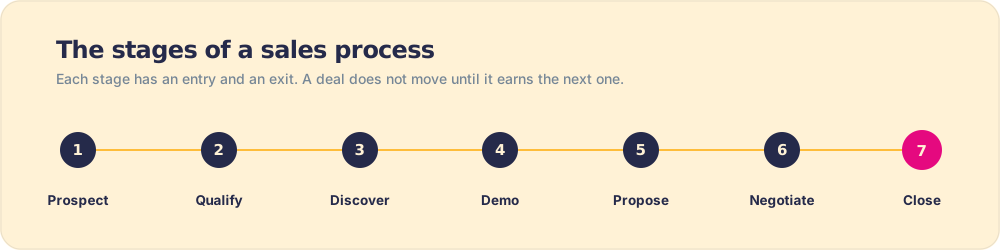
The number of stages matters less than the rules around each one. A stage with no entry criterion is a stage every hopeful deal wanders into. A stage with no exit criterion is a stage where dead deals linger on while the forecast keeps counting them. Give each stage two plain answers, what gets a deal in and what it must prove to move on, and you have a process. Leave those blank and you have a set of folder names.
Does a sales process move revenue?
This is the question worth grounding in evidence rather than belief, because the honest answer has a condition attached.
The correlation is real. Harvard Business Review, studying high- and low-performing sales organizations, found the strong performers were far more likely to run a closely monitored, formally enforced sales process, while the laggards tended to run informal ones or none at all (Harvard Business Review, 2015). CSO Insights, the research group now inside Korn Ferry, found the same shape in its sales enablement studies: teams with a dynamic process, one actively monitored and adjusted, posted materially higher win rates and quota attainment than teams without (Korn Ferry).
But the more useful finding is the condition. When CSO Insights sorted teams by how widely the process was adopted, the win rate climbed steadily, from roughly 40 percent where the process was barely used to nearly 58 percent where adoption ran above 90 percent.
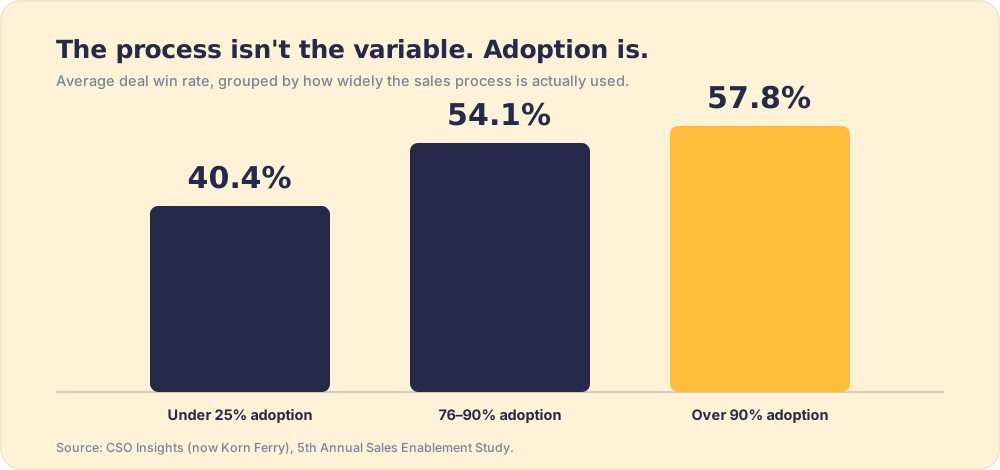
Read that carefully, because it reframes the whole subject. The document on the shelf and the document the team runs at 90 percent are the same document. The eighteen points of win rate between them are not a property of the process. They are a property of how much of it happens. Which means the interesting problem was never writing the process. It is getting it adopted.
Why don’t reps follow the sales process?
Here the field data is blunt, and it is the gap we opened with. We put the question to 198 sales leaders in our 2026 research: a defined process almost everywhere, reps running it in barely a third of teams.
The reflex is to read that as a discipline problem, reps who need more training or more accountability. The behavioral science says that reflex is usually wrong, and it is worth understanding why, because the wrong diagnosis leads to the wrong fix.
Following a process is a behavior. And behavior, in the model the Stanford researcher BJ Fogg spent two decades validating, happens only when three things arrive at the same instant: motivation, ability, and a prompt. Fogg writes it as B = MAP (Fogg Behavior Model). The piece most teams ignore is ability, which Fogg defines not as skill but as simplicity, how little time, effort, and mental load the action costs in the moment. The harder a behavior is, the more motivation it demands to fire. Make it hard enough and no realistic amount of motivation will carry it.
Now look at where a typical process lives. The playbook sits in a doc, a wiki, or an LMS. The work is happening somewhere else. Following the process means stopping the actual work, going to find the instructions, holding them in your head, and coming back, and doing all of that precisely when a rep is busiest and most loaded. That is a large ability cost landing at the worst possible moment. The behavior drops below Fogg’s action line, and a motivated, well-trained rep skips the step anyway. Not because they do not care. Because the system asked for more effort than the moment had to give.
It is the difference between a co-pilot in the seat beside you and the same instructions locked in a manual in the cargo hold. Identical words. Only one of them can speak while the plane is moving. Most companies write a brilliant manual and bolt it in the hold, then wonder why nobody flies the way it says.
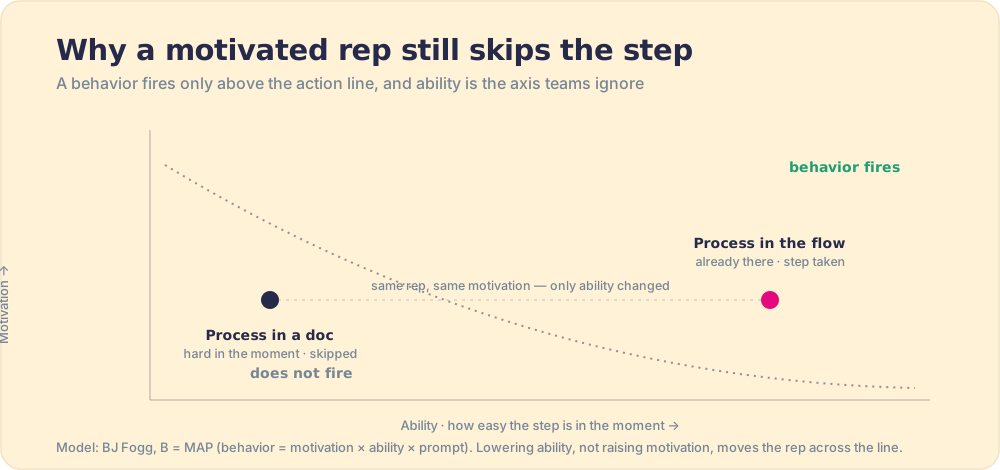
That is the mechanism underneath the 53-point gap, and it explains why the usual remedies underdeliver. More training raises motivation, which is the axis that was not broken. Tighter enforcement raises the cost of skipping, which is friction pointed the other way. Neither touches the ability problem, so the behavior stays below the line.
Two independent sources now point at the same spot. Our field data shows the gap is enormous. Fogg’s model says it is an ability problem, not a motivation problem. And the CSO Insights adoption curve shows that the teams who close that gap are the ones who win more deals. When practitioner data, a validated behavioral model, and an industry study converge, that is about as much confidence as this kind of question allows.
How do you build a sales process reps follow?
Once you accept that the bottleneck is ability, not motivation, the design rules almost write themselves. You are trying to lower the cost of doing the right thing until it falls below the cost of skipping it.
- Few stages, hard edges. A stage or field is an ability cost. Pick the five to seven moments that decide deals, write a real entry and exit rule for each, and cut the rest. A leaner process is cheaper to follow.
- The expectation reaches the rep in the moment. This is the single highest-impact move, and it is a direct application of Fogg: surface the required fields, the stage criteria, and the next step the instant the rep hits the decision, in whatever they are working in, so following the process costs almost nothing extra. Removing that trip to the doc is what Fogg calls a facilitator, raising ability instead of nagging motivation.
- Measured on live deals. You want to see who is on the process and who has drifted today, while you can still act, rather than discovering it at the quarterly review when the deals are already cold.
- Coached early, not policed late. Seeing drift the week it happens lets a manager make one small correction. Chasing field updates at quarter close raises friction for everyone and changes nothing.
This is also where a tool earns its place, not before. Reducing the ability cost of an entire team’s process, on every open deal, in real time, is hard to do with a doc and good intentions.
So here is the recommendation, and it follows straight from the evidence above. A team facing a soft number has two roads. One is to reach for a better methodology, a Challenger rollout, a MEDDIC certification, on the theory that the moves are wrong. The other is to assume the moves are roughly right and the problem is that nobody is making them, and to fix the kitchen instead of the recipe. The data points hard at the second road. The 53-point gap is an execution gap, not a knowledge gap. Fogg says the missing axis is ability, not motivation. The CSO Insights curve says the win-rate lift comes from adoption, not from the document. Three independent sources, one verdict: choose the methodology that fits your motion, then put almost all of your energy into making the process run, every deal, the same way. Writing the process is an afternoon. Getting it to live in how reps sell is the job, and the job is making the right move the cheapest one in the moment and seeing drift the week it starts. Most teams spend their energy on the afternoon and the workshop, and wonder why the year does not change.
Two threads run on from here. The drift itself, why reps leave a process they helped write, is its own subject, and we take it apart in why reps drift from a process you already documented. And the specific ways teams sabotage their own process, too many stages, unverifiable exit criteria, stages that advance on your activity instead of the buyer’s commitment, get named one by one in five common sales process mistakes.
Frequently asked questions
What is a sales process?+
What are the stages of a sales process?+
What is the difference between a sales process and a sales methodology?+
Does a sales process increase revenue?+
Why don't reps follow the sales process?+
Your process, running itself.