Where Should Your Sales Process Live? In the Flow of Work
Where should your sales process live? The honest answer is that it should not live anywhere. What matters is when it reaches the rep, with the research that proves it.
Your sales process should reach the rep in the moment of work, the instant the question arises, wherever they are, and guide them to the next best action, because when and how it reaches them, not where it is stored, is what determines whether reps run it.
Ask a room of sales leaders, “Where should the sales process live?” and you will get a fast argument: the CRM, a wiki, an LMS, the sales playbook. Underneath that argument sits an assumption: that the process lives in a place at all.
The honest answer is that it should not live anywhere. Anything that lives in a place, a doc, a wiki, a tab the rep keeps meaning to open, has already lost, because the rep is somewhere else at the moment the question hits. The right word is not where. It is when. A sales process has to reach the rep the instant they hit the decision, wherever they happen to be, and point them at the next best action. Miss that moment and the most beautifully written process in your company is furniture.
That sounds like a small distinction. It is worth a threefold difference in quota attainment.
Does location matter more than the content?
The numbers are blunt. In The State of Sales Enablement, teams whose process reaches reps in the flow of work, in real time, hit quota at 49 percent. Teams whose process lives in a doc, wiki, LMS, or recorded training hit quota at 15 percent.
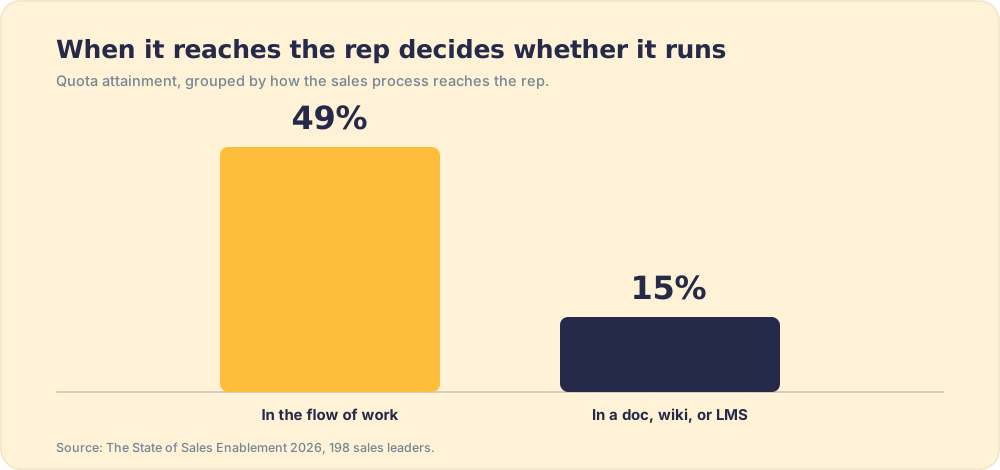
That is not a rounding difference. It is more than a threefold gap in quota attainment, separating teams that, on paper, wrote similar processes. The variable that moved is not what the process says. It is whether it showed up at the moment the rep needed it, or sat in a file waiting to be visited.
It is worth being precise about what “lives in a doc” costs, because it sounds harmless. A document is not present during the work. It is a place the rep would have to decide to leave the deal and go to, mid-task, under pressure, on the bet that what is inside is worth the trip. Most of the time the trip does not happen, so the process does not happen, and the quality of the writing is irrelevant because nobody is reading it at the moment it would have mattered. The process is not being rejected. It is absent.
Why does reaching the rep in the moment win?
The shallow answer is “it removes the tab switch,” and that is true as far as it goes. But there is a deeper, better-evidenced reason, and it comes from a field that has studied this exact problem with far more rigor than sales ever has: medicine.
For decades, hospitals faced their own version of this gap. Clinical guidelines existed, doctors knew them, and yet adherence in the moment was poor, not from ignorance but because recalling the right guideline while busy with a patient is hard. What changed behavior was not more training or thicker manuals. It was clinical decision support: putting the relevant prompt on the screen at the point of care, the moment an order was being placed. When researchers compared electronic point-of-care reminders against the same guidance delivered later as periodic feedback, the point-of-care version won clearly, improving adherence by about 20 percentage points over feedback alone (Guthrie et al., cluster-randomized trial, 2019). Reviews of the wider literature land in the same place. A systematic review of decision-support trials set out to find what separated the systems that changed behavior from the ones that did nothing, and the single strongest predictor was not the quality of the guidance but whether it was delivered automatically, inside the clinician’s workflow, at what the authors named the “time and location of decision making” (Kawamoto et al., BMJ, 2005). Of the systems that delivered guidance that way, 30 of 32 (94 percent) improved practice. The systems that missed even one of those delivery conditions improved practice in only 18 of 39 cases (46 percent). Guidance that sat beside the workflow mostly failed. Guidance that arrived inside it, at the moment of the decision, mostly worked.
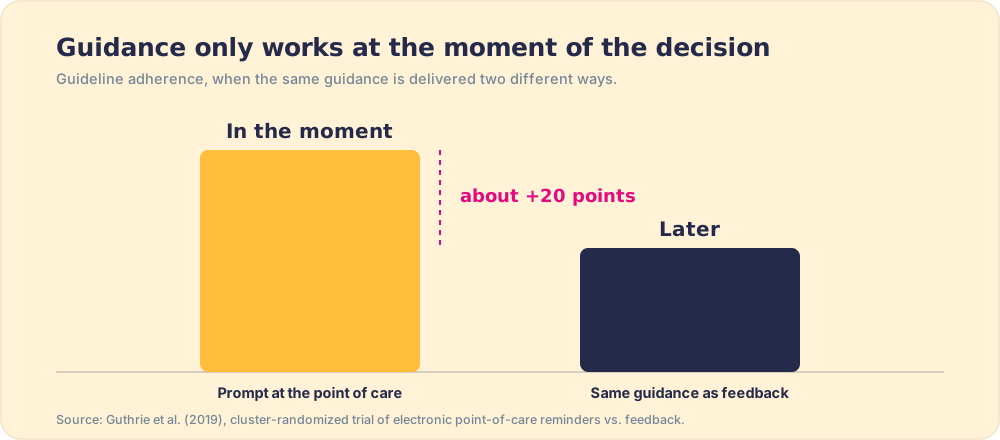
The principle generalizes cleanly, because it is about human attention, not about medicine. Guidance delivered at the moment of the decision changes behavior. The same guidance delivered before the moment, as training, or after it, as feedback and reporting, mostly does not, because by the time the decision arrives the guidance is somewhere else and the person is loaded. A doctor placing an order and a rep deciding how to advance a deal are in the identical situation: mid-task, attention spent, unwilling to leave the work to consult a reference. The doc, the wiki, the LMS, and the recorded training all share one fatal property. They are somewhere the rep is not, at the moment the rep is deciding.
What do Highspot, Mindtickle, and the CRM camp each get right?
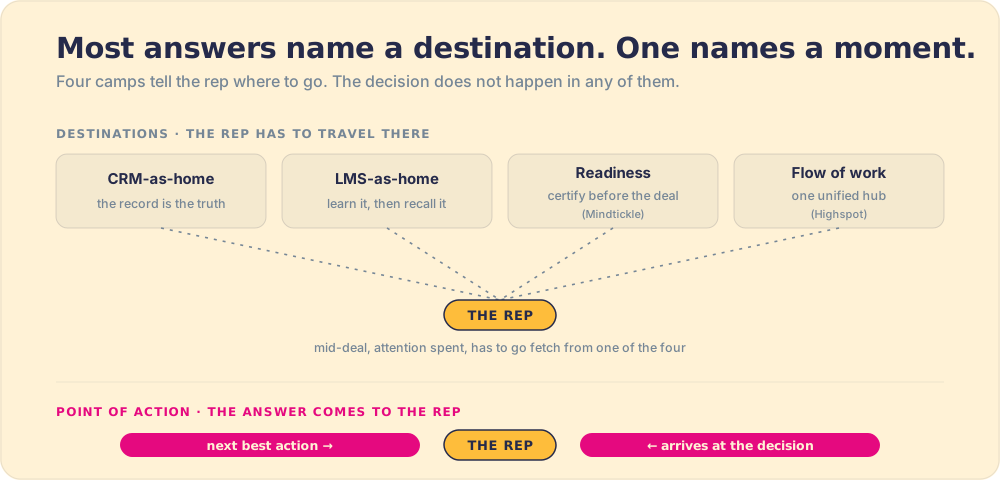
The argument so far is not happening in a vacuum, and it is only fair to put the serious answers on the table before we judge them. Four camps own this question today, each with a real strength.
- CRM-as-home. The case here is that the deal record is the one object every rep already touches every day, so the process should anchor to it. There is truth in that. A sales process in CRM sits beside the data it acts on, and reps do open the record, at least when CRM adoption is strong enough that they keep it current. It is the closest of the four to the work.
- LMS-as-home. The training camp says a rep cannot run a process they never learned, so the process belongs in the course, the certification, the onboarding path. Also true, and we will defend it below: front-loaded learning is how a rep gets the process into their head in the first place.
- Readiness. Mindtickle has built a serious business on the idea that you certify a rep as ready before they ever touch a live deal, then keep scoring their skills against a bar. As of mid-2026 Mindtickle is independent, with its ElevateOS platform anchored on more than 400 customer organizations (Mindtickle, 2026). Their strength is real: a rep who has rehearsed the motion is a better rep, and rehearsal happens before the deal, not during it.
- Enablement in the flow of work. Highspot has made this phrase its own, positioning itself as “the only unified platform for GTM enablement” that unifies content, training, deal guidance, and coaching, “all in the flow of work” (Highspot, 2026). (News-check, because it matters: Highspot and Seismic signed a definitive agreement to merge on February 12, 2026; the deal is not yet closed and the companies operate independently until it is, with the combined entity to take the Seismic name under CEO Rob Tarkoff, per GeekWire, Feb 2026.) Of the four, this camp is closest to our own view. Grant it its full force: “in the flow of work” is the right instinct, and it is the same instinct the medical evidence vindicates.
So where is the disagreement? It is one step past where these camps stop. Listen to the verbs. CRM-as-home, LMS-as-home, and readiness all describe a destination, a place the rep goes: the record, the course, the certification. Even “flow of work,” as it is usually built, resolves to “one unified hub,” a single platform the rep is meant to live inside. A hub is a better destination than a wiki, and Highspot is right that consolidation beats five scattered tools. But a hub is still a place the rep has to be in for the guidance to reach them. The medical evidence is precise about why that is not enough. Kawamoto’s strongest predictor was not “in the workflow” in the loose sense of “near the tools.” It was guidance delivered “at the time and location of decision making,” automatically, without the clinician going to fetch it. The point of care is not a hub the doctor visits. It is the screen in front of them at the instant the order is placed.
That is the gap. Most “where it lives” answers, the best ones included, still treat the process as something the rep arrives at. The only location that changes behavior is the point of action itself: the guidance shows up at the decision, on whatever surface the rep is on, without a trip. Process delivery, done right, is not a destination at all.
Where should the sales process live? In the moment of the work
Most teams stop one step short here. They accept the point and then go looking for a better place to put the process, which keeps them inside the same trap, because any place still waits for the rep to come to it. The move is to stop thinking in locations at all.
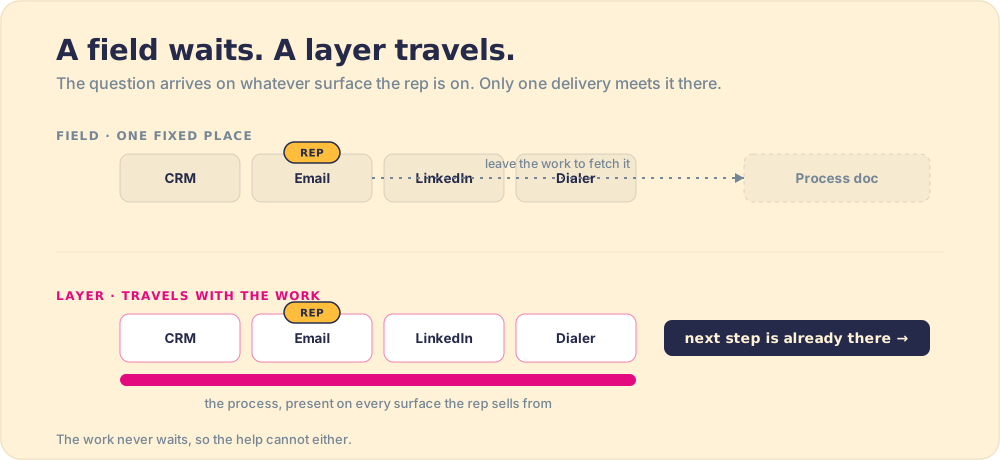
Reps do not live on one screen. A single deal moves through the CRM, but also through email, LinkedIn, a dialer, a meeting-recording tool, a shared doc, the prospect’s own website. The question, “what has to be true to advance this?”, “what do I do with this objection?”, “is this deal qualified?”, does not arrive in a fixed spot. It arrives wherever the rep is when the moment lands. So the only delivery that works is the one that meets the question on whatever surface the rep is on and turns it into a next action.
That is the difference between a static field and a layer. A field waits for the rep to come to it. A layer follows the work and shows up the instant the rep needs it. A field waits for the rep. A layer goes where the work goes.
And there is a second word hiding in this, beyond when and where: continuous. A process is not a single decision; it is a string of moments across the life of a deal. Help that fires once, at the start, and then goes silent is back to being a document, a better-placed one but a document all the same. What changes behavior over the whole arc of a deal is enablement that keeps showing up, at each decision, for as long as the deal is live, and is good enough each time to carry the rep to the next best step without making them stop and think. The test of a process is not whether it reads well. It is whether, dropped into the messiest moment of a real deal, it can move the rep forward on its own.
What does this look like in practice?
In practice it means the operational process, the part that has to fire on a live deal, travels with the rep and surfaces the instant a question arises, in whatever tool they are working in, with a clear next best action attached. The deeper reference material can stay in the wiki, where it is genuinely useful for learning and the occasional deep lookup. You are not throwing away the doc. You are separating the part that teaches, which can wait to be visited, from the part that has to act, which cannot.
This is where the readiness and LMS camps earn their keep, and it is worth saying so plainly. A rep cannot run a motion they never learned, and the certification, the role-play, the onboarding path are how the motion gets into their head before a live buyer is on the line. Mindtickle’s instinct that you rehearse before the deal is correct. The trap is mistaking the rehearsal for the performance. Knowing the process is not running the process, and a rep can pass every certification and still freeze at the decision if nothing reaches them in the moment. So use training to teach the motion up front, and use in-the-moment delivery to run it during the deal. They are two jobs, and the mistake is asking either one to do the other’s work.
This is what we built Supered to be, and it is worth naming as one instance of the principle rather than the principle itself. Supered is the Behavior Layer: it delivers your sales process in the moment of work, in real time, across the surfaces reps sell from, so the right next step shows up the instant the rep needs it, not in a file they would have to remember to open. In flow, not from memory.
So here is the recommendation, named plainly against the options on the table. If your problem is teaching a rep the motion before they sell, the LMS and readiness camps are the right tool, and you should use them for exactly that. If your problem is one trustworthy record of the deal, the CRM is home, and it should stay home. But neither of those is the question that decides whether the process gets run on a live deal. That question is answered by process delivery: whether the next step reaches the rep at the point of action, on whatever surface they are on, without a trip. Pick the camp that solves the job in front of you, and for the job of running the process during the deal, pick in-the-moment delivery over any destination, hub included.
The wording of your process matters, but it is the second question, not the first. Decide when and how it reaches the rep, then decide what it says. This is the highest-impact move for closing the sales execution gap, and it is the structural reason sales process adoption climbs the moment the process stops waiting in a document and starts meeting reps in the work.
Frequently asked questions
Where should a sales process live?+
Does where the sales process lives matter more than the content?+
Why does in-the-moment enablement win?+
Isn't the CRM the right place to put the sales process?+
What about training, playbooks, and wikis, are they useless?+
Your process, running itself.