Sales Coaching Models: They Are All the Same Spine, Renamed
GROW, OSKAR, CLEAR, FUEL: the sales coaching models look like competing systems and are the same arc in different vocabulary.
Which to pick, and the variable that matters more than the model.
Sales coaching models are structured frameworks for running a coaching conversation, and the popular ones (GROW, OSKAR, CLEAR, FUEL) are variations on one arc, so the model you pick matters far less than whether you run one consistently.
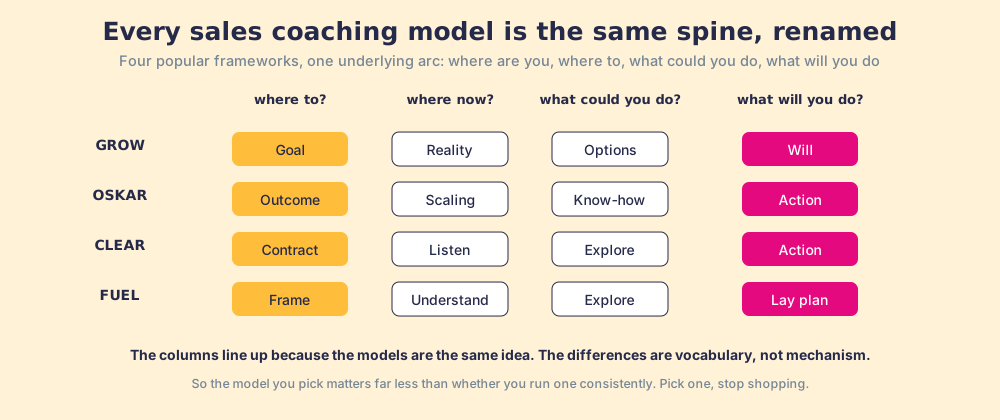
Search for sales coaching models and you meet an alphabet: GROW, OSKAR, CLEAR, FUEL, ACHIEVE, POWER. Each is presented as a distinct system with its own logic, and the implication is that choosing the right one is a consequential decision. It is not. Line the models up side by side and their steps fall into the same columns, because they are the same idea wearing different acronyms. Once you see that, the decision moves from which model to pick to whether you run one every week, and that second decision is the one that makes coaching work.
Sales coaching models are structured frameworks for running a coaching conversation, and the popular ones are variations on a single arc, where are you, where to, what could you do, what will you do, so the model you pick matters far less than running one consistently. The acronyms are the marketing. The arc is the product.
Why are the sales coaching models all the same?
Because they descend from the same source and solve the same problem. The problem is that a manager’s instinct in a coaching conversation is to tell, and telling does not change behavior. Each model is a structure that forces the manager to ask instead, by routing the conversation through four moves: establish the goal, surface the current reality, generate options with the rep answering first, and commit to an action. John Whitmore’s GROW, built out of Timothy Gallwey’s Inner Game work, named the arc most cleanly in Coaching for Performance (on the GROW model), and the later models, OSKAR from the solutions-focused tradition, CLEAR from Peter Hawkins, FUEL from the Zenger Folkman world, rearrange the same steps and rename them.
The lineage explains the sameness. The taproot is Timothy Gallwey, a tennis coach who in the 1970s noticed that his best instruction was not instruction at all. When he stopped telling players what to fix and instead asked them to watch the ball and report what they saw, they corrected faster than when he prescribed the fix. He wrote it as an equation in The Inner Game of Tennis: performance equals potential minus interference, and the coach’s job is to lower the interference, not to add more technique. John Whitmore, who trained under Gallwey, carried that into business and named the four moves GROW. The later models, OSKAR, CLEAR, FUEL, inherited the same DNA, because they all descend from the same insight: the rep already has more answer in them than the manager’s advice can supply, and the structure exists to draw it out rather than pour it in. The acronyms differ because consultants need something to brand. The mechanism is one idea, fifty years old, dressed in new letters.
This matters because it dissolves a false decision. Teams agonize over which framework to adopt, attend trainings on competing models, and switch from one to another hoping the new acronym will fix the coaching. It will not, for the same reason switching qualification frameworks rarely fixes qualification: the framework was never the binding constraint. We made that case about lead qualification, and it holds here. A manager who cannot run GROW consistently will not run OSKAR consistently either; they will own a second model they skip under pressure. The new model is a New Year’s resolution in acronym form: a fresh name for an old intention, abandoned by February for the same reason the last one was, which was never the name.
What is the GROW coaching model, step by step?
The GROW coaching model is the clearest of the family, so walk through it as the template the others vary from. Each step is a question, not an instruction, which is the point.
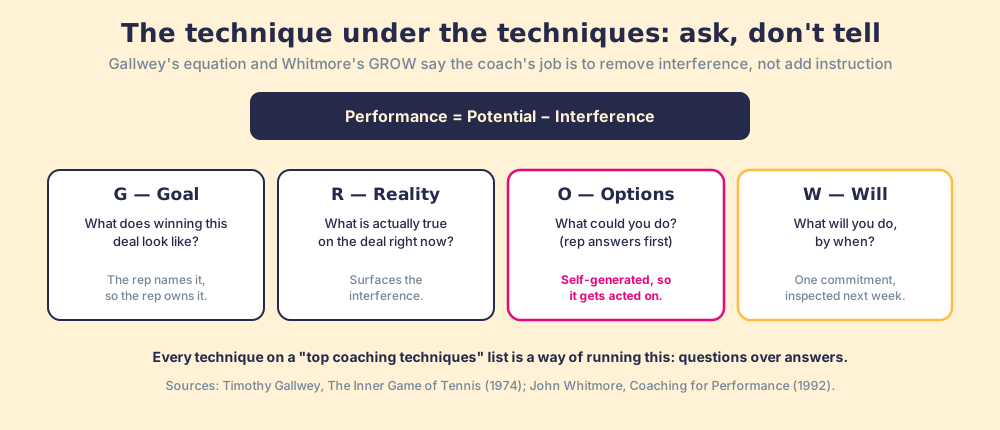
Run it on a real deal and it takes ten minutes: what does winning this look like, what is true right now, what could you do about the gap, and what will you commit to by when. The rep does the thinking at every step, and the manager’s discipline is to keep asking rather than supplying the answer. Once GROW is a habit, the other coaching models for sales are easy to read, because you can see the same four moves under their different names.
How do the sales coaching frameworks differ in practice?
They differ at the edges, and the edges are worth knowing even though the spine is shared. Pick the model whose emphasis fits the coaching problem in front of you.
- GROW, for general deal coaching. The default and the simplest, and the one to start with. Its strength is that it maps cleanly onto a specific deal: goal, reality, options, commitment.
- OSKAR, for confidence and momentum. Its “Scaling” step (“on a scale of one to ten, where is this deal”) and solutions-focus suit a rep who is stuck or discouraged, because it builds on what is working rather than dwelling on the gap.
- CLEAR, for skill development over time. Its explicit “Contract” step makes it better for a longer coaching relationship aimed at building a capability, rather than only unsticking a single deal.
- FUEL, for newer managers. Its “Frame the conversation” opening gives an inexperienced coach a clear on-ramp and reduces the chance the session drifts into telling.
The differences are real, and they are second-order. Each model is a vehicle for the same ask-don’t-tell mechanism, covered in sales coaching techniques, and each is scaffolding for the weekly loop in the sales coaching guide. The coaching frameworks for sales are interchangeable to a first approximation; what is not interchangeable is whether you run one every week against real behavior.
Why does consistency beat the model itself?
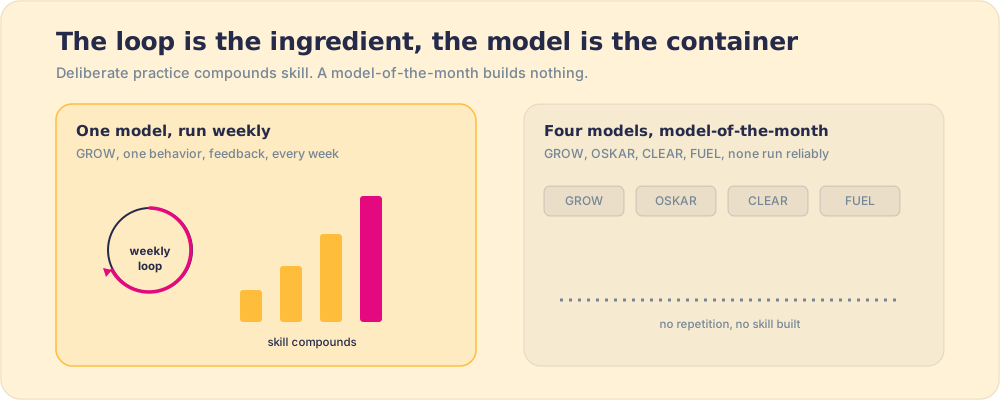
Because skill is built by repetition with feedback, and a model run once a quarter delivers neither. The cleanest evidence comes from Anders Ericsson, whose research on expert performance found that what separates the elite is not raw talent but deliberate practice: focused, repeated effort on a specific weakness, with immediate feedback, over years (Ericsson on deliberate practice). A coaching model is the delivery vehicle for deliberate practice on selling. Run weekly on one behavior with real feedback, it compounds. Run twice a year as a model-of-the-month, it changes nothing regardless of which acronym is on the slide, because the mechanism that builds skill, the repetition, never happens.
CSO Insights, now inside Korn Ferry, found that teams with a formal, dynamic coaching approach attained quota at 91.2 percent versus 84.7 percent for informal approaches, a gap that tracks the discipline of the cadence, not the choice of framework (Korn Ferry). Two independent sources converge on the same verdict: an academic theory of how skill is built, and an industry study of what moves quota, both say the recurring loop is the active ingredient and the model is the container. That is as much agreement as this kind of question offers, and it leads away from the framework debate entirely.
What we recommend
Pick one sales coaching model, ideally GROW for its simplicity, and commit to running it every week rather than collecting the rest. The evidence and the structure of the models agree: the gains come from consistency, not from the acronym, because the models are the same arc and the arc only works when it recurs. So stop evaluating frameworks as though one holds a secret the others lack. Choose the vocabulary your team will use, anchor each session on one behavior and real deal evidence, and end on one committed action you inspect the following week. A team that runs GROW imperfectly every week will out-coach a team that debates models forever, because coaching is a habit, and a habit cannot be built on a framework the team never runs.
From here: the mechanism every model runs on in sales coaching techniques, the full method in the sales coaching guide, the questions that fill the arc in one-on-one meeting questions, and the standard underneath in sales process adoption.
Frequently asked questions
What are the main sales coaching models?+
What is the GROW coaching model?+
Which sales coaching model is best?+
Do sales coaching models work?+
Your process, running itself.