Sales One-Pager: Write It for the Room You Are Not In
Most sales one-pagers are about the vendor: logo, mission, feature list. A one-pager's real job is to be forwarded, arming your champion to make your case to stakeholders you will never meet. Write it for them.
A sales one-pager is a single-page document a champion forwards to make the case for you internally, so it must arm them to sell to stakeholders you never meet, not introduce your company, because the internal decision happens in rooms the rep is not in.
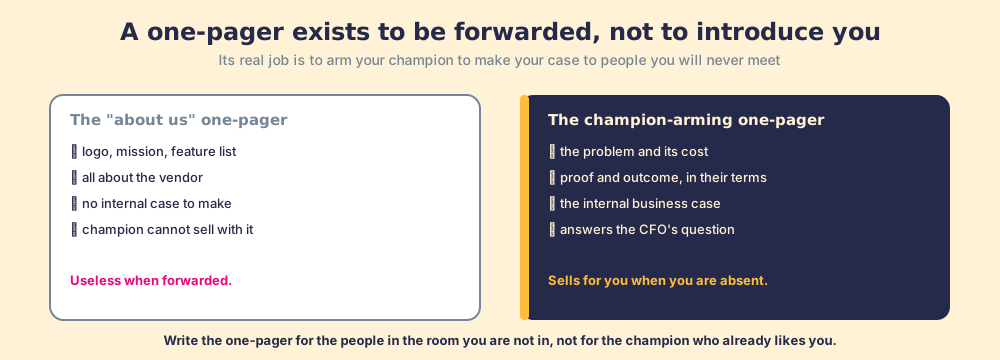
A sales one-pager has one defining property that most teams ignore when they build one: it travels. The defining job of a one-pager is that your champion forwards it, to their boss, to the CFO, to the committee, to people you will never be in a room with. Yet most sales one-pagers are built as if the champion is the only reader, and worse, built about the vendor: logo at the top, mission statement, a tidy list of features. That document cannot do the one job it exists for, because the people it reaches do not need to meet your company. They need a reason to approve the purchase, and an about-us one-pager gives them none. The one-pager that works is written not for the champion who already likes you, but for the room you are not in.
A sales one-pager is a single-page document a champion forwards to make the case for you internally, so it must arm them to sell to stakeholders you never meet, not introduce your company, because the internal decision happens in rooms the rep is not in. Build it for those rooms, and it earns its place.
Why does the “about us” sales one-pager fail?
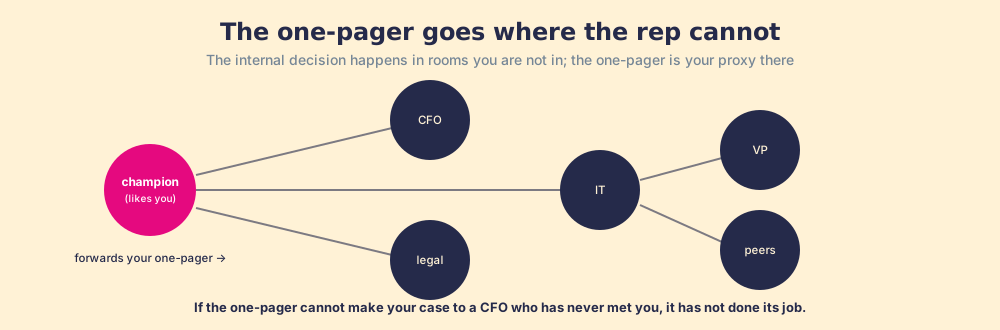
Because it cannot make a case to the people it reaches, and making that case is the only thing a forwarded one-pager is for. In a complex deal, the rep is absent for most of the buying group’s decision, which happens in internal conversations the rep never attends, the situation at the center of the B2B sales process. Gartner’s research puts numbers on the absence: buyers spend only about 17 percent of the purchase journey meeting with any supplier, so the overwhelming majority of the deliberation, and all of the internal selling, happens with no rep in the room (Gartner, on the B2B buying journey).
This is why CEB’s research on buying groups, the work behind The Challenger Customer, concluded that the seller’s real point of influence is not the meeting but the internal advocate. They named the advocate who moves a group the “Mobilizer,” and found that winning complex deals depends on equipping that person to make the case when you cannot (Adamson, Dixon, Spenner, Toman, The Challenger Customer). The one-pager is the rep’s proxy in those rooms, the thing the Mobilizer forwards. So when a champion forwards an about-us one-pager to the CFO, the CFO finds your mission statement and feature list and no answer to the only question they have, why should we spend money on this. The document introduces a company the CFO does not care about and omits the business case the CFO needs, so it advances nothing. The champion is left to make your argument from memory, which is the failure the one-pager was supposed to prevent.
The about-us one-pager fails because it was written for the wrong reader. It treats the one-pager as a brochure for the champion, who already understands the value, instead of as ammunition for the stakeholders who do not. The champion does not need to be sold; the people they forward it to do, and the one-pager that helps is the one that makes their case for them.
There is a deeper reason the document has to carry the argument on its own, and it is the children’s game of telephone. Every time your value proposition passes from one person to the next inside the buying group, it loses fidelity. The champion who heard you explain it for an hour can relay maybe half; the colleague who hears it from the champion relays a quarter; by the time it reaches the CFO it is a rumor of a benefit. A one-pager that is built to stand alone stops the decay. It is the one artifact that says the same thing in every retelling, because it does not depend on the teller. When marketers distinguish a customer-facing one-pager from an internal “product one pager,” this is the line that matters: the internal version can assume context, while the one that travels to a skeptical stakeholder must assume none. Write for the person furthest from you, and everyone closer is covered too.
What should a sales one-pager include?
The internal business case, framed in the buyer’s terms, and nothing that is merely about you. A one-pager that arms the champion holds the problem and its cost, so the absent stakeholder feels the stakes; the outcome and the proof, in the buyer’s language, so they see the payoff and believe it; and the answer to the economic buyer’s question, so the CFO finds the justification they need rather than a feature list. Anything that is about the vendor, the mission, the company history, the exhaustive feature dump, comes off, because it helps no champion make a case and signals the document was written for you. This is the same champion-enablement logic as the B2B sales playbook: the deal is decided where you are not, so equip the person who is there.
- The problem and its cost. Make the absent stakeholder feel the stakes. No problem, no reason to act.
- The outcome and the proof. In the buyer’s terms, with evidence, so the payoff is clear and credible.
- The economic buyer’s answer. The justification a CFO needs, stated plainly. Answer the question before it is asked.
- Nothing that is only about you. Mission and feature dumps help no champion. Cut them.
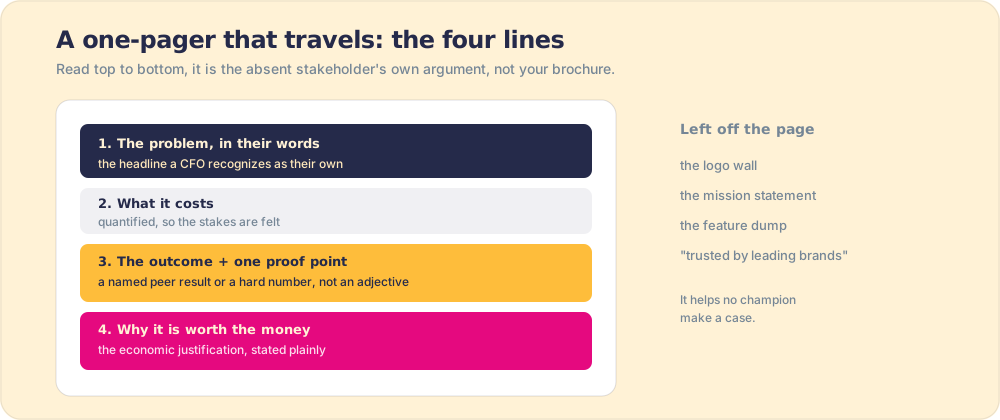
Turn that into a sales one pager template and it reads top to bottom as the absent stakeholder’s own thought process. A headline that states the problem in their words. A line or two on what that problem costs, quantified if you can. The outcome you deliver, with one proof point, a named customer result or a hard number, because a skeptical CFO discounts a claim and credits evidence. Then the single sentence that answers “why is this worth the money,” stated as the economic justification, not the feature. That is the whole page. Among useful sales one pager examples, the pattern that travels best is the one a champion could read aloud in a budget meeting and have it sound like their argument, not yours.
A note on proof, because it is the part teams skimp on and the part that does the most work. The absent stakeholder has never met you and has no reason to trust your adjectives. What they trust is a result that happened to someone like them. Robert Cialdini’s research on social proof is blunt about the mechanism: under uncertainty, people look to what comparable others did to decide what is safe (Cialdini, Influence). A one-pager that names a peer company and a specific outcome borrows that company’s credibility for your claim. A one-pager that says “trusted by leading brands” borrows nothing, because it is the same empty line every vendor uses.
How do you make a sales one-pager that gets used?
Write it for the absent stakeholder, build it from your real won-deal cases, and put it where the champion can grab it in the deal. The test of a one-pager is simple: could your champion forward it to a skeptical CFO and have it make your case without you? Build it to pass that test by framing everything around the buyer’s problem and the business case, drawn from how your won deals got justified internally, the bottom-up build of any sales playbook. Then make sure it travels with the deal, living in the digital sales room where the buying group coordinates, so the champion has it exactly when they need to forward it. A one-pager that sits in your marketing folder and never reaches the champion at the right moment helps no one, which is the sales process adoption problem in document form. The one-pager works when it is built for the absent room and delivered to the champion in the flow of the deal.
What we recommend
Write your sales one-pager for the room you are not in, because that is where it does its work, forwarded by a champion to stakeholders you will never meet. Stop building it about the vendor, the logo, the mission, the feature list, because that helps no champion make a case and tells the absent CFO the document was written for you, not for their decision. Instead, put the internal business case on the page: the problem and its cost, the outcome and the proof in the buyer’s terms, and the answer to the economic buyer’s question, all framed so a skeptical stakeholder who has never met you would have a reason to approve. Build it from how your won deals got justified internally, and deliver it to the champion in the flow of the deal so they have it when they need it. The one-pager is not your introduction. It is your proxy in the rooms you cannot enter, and it should be built to win there.
From here: the champion-enablement plays in the B2B sales playbook, the room it travels in at the digital sales room, the playbook it belongs to in the sales playbook, and the delivery underneath in sales process adoption.
Frequently asked questions
What is a sales one-pager?+
What should a sales one-pager include?+
Why do most sales one-pagers fail?+
How does a sales one-pager help in complex deals?+
Your process, running itself.