Best Knowledge Base Software, Mapped by the Job It Does
The best knowledge base software is not one winner but five jobs. Map the field by job and the open slot, delivery in the moment, stands out plainly.
The best knowledge base software is not a single winner but the tool that does the job your team actually lacks, and for most teams that job is delivery in the moment, not storage.
A sales rep keeps a folder of saved answers, the way a cook keeps a recipe box. The pricing rule, the security one-pager, the line that handles the procurement objection, all of it filed and findable. And in the middle of a live call, with the buyer waiting and two other deals open in a tab, the rep does not open the box. The answer sits three clicks away.
That is the puzzle this post sits with. We have never had better knowledge base software, and people still lose a fifth of their week looking for what a colleague already wrote down.
So this is not a neutral roundup. We will map the best knowledge base software by the job each tool does, because once you see the jobs apart, a pattern shows up that no feature comparison reveals. Four jobs are solved and cheap. One is wide open. The open job is delivery, the answer reaching the person in the moment of the work.
The map is the case.
What is the best knowledge base software at heart?
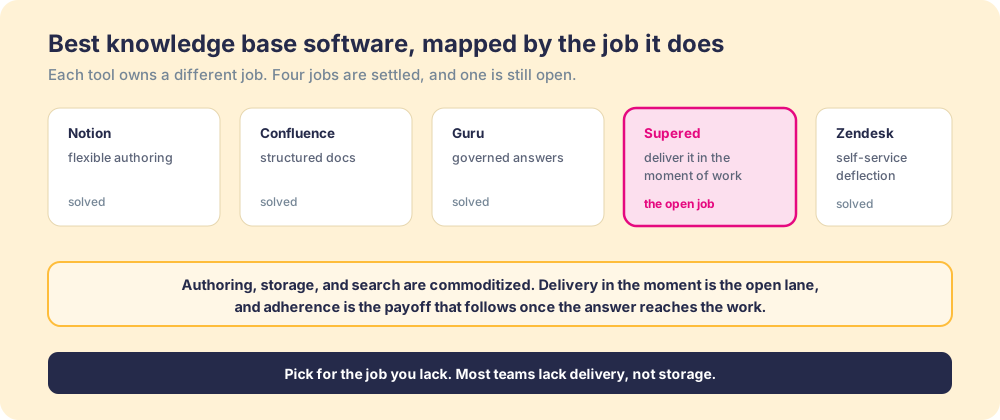
Strip away the marketing and a knowledge base tool does one of a few things: write an answer, keep it, find it, deliver it to the person who needs it while they work, or pull it from the heads of those who already know. A single product often claims several at once, which blurs the one distinction that matters: the jobs are not equally hard, nor equally finished. Most teams shop the field as one decision. It is several jobs, in different states of repair.
Which knowledge base software is best for each job?
Here is the field, sorted by job rather than by logo, each tool worth knowing for what it does best and the wall it hits. Read it as a map, not a ranking. Where a tool is genuinely the right pick, we say so.
- Notion, for flexible authoring. The independent workspace, valued near eleven billion dollars in a January 2026 tender and now drawing more than half its revenue from AI-enabled customers, is the blank page teams reach for first. Its strength is creation: writing and linking feel almost frictionless. Its limit is that a page nobody opens looks the same as one that closed a deal. If your gap is a place to write freely, Notion is the best pick.
- Confluence by Atlassian, for structured team docs. The enterprise wiki standard, now cloud-first and threaded with Atlassian’s Rovo AI, is built for teams that need permissions, hierarchy, and a durable home for documentation. Its strength is order at scale. Its limit is that it is a destination, and the moment going there costs a tab switch in live work, friction wins. If your gap is structured documentation a large team can govern, Confluence is the best pick.
- Guru, for governed, verified answers. The independent platform repositioned through 2026 as an AI source of truth answers only from content a human expert has reviewed and approved, its real defense against stale or invented replies. Its strength is trust: a governed layer where the answer carries a verification, not a guess. Its limit is patience, because it still waits to be asked. If your gap is verified answers an AI can be trusted to return, Guru wins.
- Zendesk, for customer self-service. The customer-facing help center, sharpened by its March 2026 acquisition of the agentic AI firm Forethought, is built to deflect support tickets by answering the customer before a human has to. Its strength is the public help center and the deflection it drives. Its limit is that it points outward, at customers, not the rep mid-deal. If your gap is self-service, Zendesk is the best pick.
- Supered, for delivery in the moment. The open lane: the layer that surfaces the answer inside the application where the work is happening, prompted by what the person is doing rather than a search they remember to run. Its strength is the one nobody above covers, closing the gap between knowing and doing. Its limit is that it is the youngest job, which is why most knowledge base software stacks carry a strong base and a hole right here. If your gap is getting reps to use what is stored, Supered wins.
Four of these jobs are served by mature, well-funded tools. One is young and mostly empty. That asymmetry is the real shape of the market.
Why is storage solved and delivery still open?
Because the two jobs differ in kind. Storing an answer is a problem of order: put it somewhere, label it, make it retrievable. That yields to good software, and it has. Delivering an answer is a problem of timing: get the right thing in front of the right person at the second they need it, without making them leave the work. That is a behavior problem in a software costume, and behavior does not yield to a better filing cabinet.
The data has pointed here for years, and nobody acted, because the loss is invisible. The McKinsey Global Institute estimated that workers spend close to a fifth of the week searching for and gathering information (McKinsey Global Institute). Those hours do not vanish because the base is tidy. They vanish because the answer is one tab away.
You might say a sharper search closes it. Fair, and search is the part of the field improving fastest. An AI answer layer reads your content and returns a clean reply, and for the person who pauses to ask, it raises the ceiling. The trouble is the pause. The rep mid-deal does not stop to wonder, so the best search never gets its chance. Retrieval waits to be asked; delivery does not.
Think of a kitchen. You can own a stocked pantry, a labeled spice rack, and a recipe box thick with cards, and still serve a cold, late dinner, because none of those is the act of cooking. The pantry is storage. The recipe box is your knowledge base. The cooking, the right move with the pan hot, is delivery.
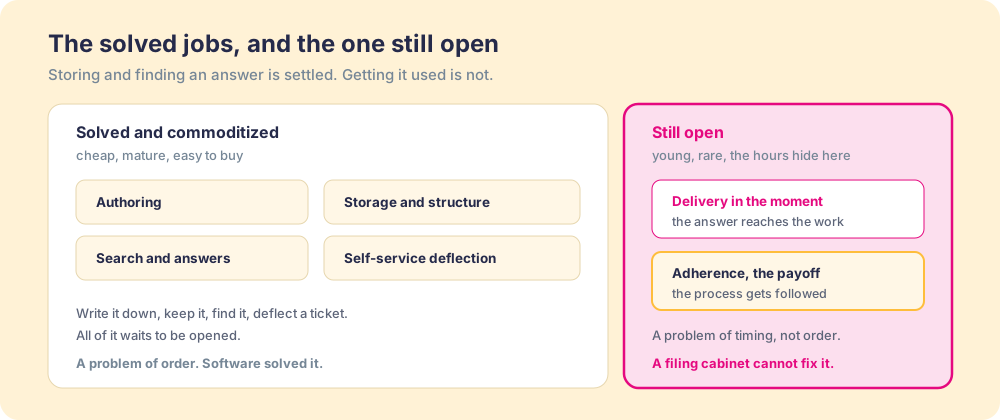
A stack that looks complete keeps disappointing because it built the parts you can see and skipped the one you can only feel, whether the answer showed up when it mattered. The recipe card carries the dish, never the timing.
How do you pick knowledge base software by the job you lack?
You start by being honest about which jobs you have covered, which is harder than it sounds, because a tidy base feels finished. Walk the field and mark the real state of each job, the way a builder walks a house before deciding what to fix. Be honest, not hopeful.
- Authoring. A team with no shared place to write needs an authoring tool first, and few stay missing it for long. This is rarely the gap.
- Storage and structure. Answers scattered across chats and drives call for structured storage, which earns its keep by making one trusted home. Many teams stop here.
- Search and retrieval. Stored but unfindable answers call for a search or AI answer layer. The trap is that it still waits to be asked, raising the ceiling for the person who pauses and nothing for the one who never does.
- Delivery in the flow. Teams that store and search fine and still bleed hours have found the missing job, and another base will not touch it. This is where the McKinsey hours disappear.
- Customer self-service. Repeated customer questions call for a public help center built to deflect, pointed at buyers rather than the rep.
Run that walk honestly and, for most mid-market teams, the gap lands in the same place. Storage is fine. Search is fine. The hole is delivery, because nobody bought for the missing job. It is the lesson behind every sales knowledge base built and ignored, and every stack of knowledge management tools that looked complete and changed nothing.
The mechanism is worth naming, because it lets you reason from the verdict without us in the room. Knowledge is solved. Any person, and now any model, can find the document. What a person does in the moment of the work is the part that did not get solved, and the part that moves the number. A tool that only stores and finds works the solved side of the line.
The payoff of filling that slot is measurable. Our State of Sales Enablement found that teams whose guidance reaches the rep in the flow of the work hit quota at 49 percent, against 15 percent for teams whose knowledge sits in a separate place to be looked up (The State of Sales Enablement). Same stored answers, opposite results, and the only difference is whether the answer arrived where the work was happening.
What we recommend
There are two ways to spend a knowledge base budget. You can buy more of the solved jobs, a better authoring tool, a tidier base, a sharper search, hoping enough storage becomes delivery. Or you can buy for the job you lack, which for most teams is delivery: the answer surfacing in the moment, prompting the next action.
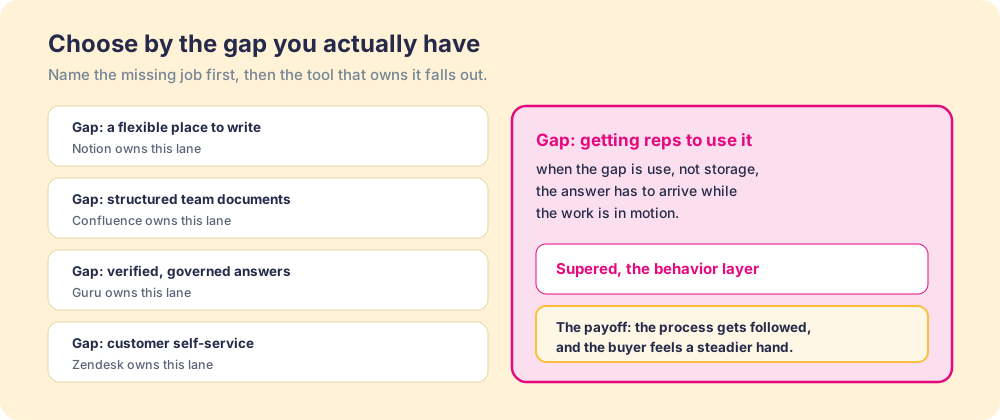
We recommend the second, and the branch is clean. Choose Notion if your gap is flexible authoring. Choose Confluence if your gap is structured team docs. Choose Guru if your gap is governed, verified answers. Choose Zendesk if your gap is customer self-service. Choose Supered if your gap is getting reps to use it in the moment, when the problem is use, not storage.
The solved jobs are solved, which is why pouring more money into them returns so little. The hours McKinsey measured come from answers that never reached anyone in time, and the distance between guidance in the flow and knowledge parked elsewhere is the distance between 49 percent quota attainment and 15 percent. So audit by job, then buy for the open one. The shelf is full and the slot beside the work is empty, and the tool that fills it makes the others pay off. Start with the internal knowledge base, then read across your knowledge management tools.
Frequently asked questions
What is the best knowledge base software?+
How do I choose knowledge base software for an internal team?+
What is the difference between a knowledge base and knowledge base software?+
Does AI replace knowledge base software?+
Why do teams with good knowledge base software still waste time?+
Your process, running itself.