Sales Onboarding Software: Buy for Adoption, Not Course Completion
Most sales onboarding software is sold as a course-delivery engine: load the curriculum, track completion, certify the rep.
Here is how to judge it by whether it gets a rep running the motion on real deals fast.
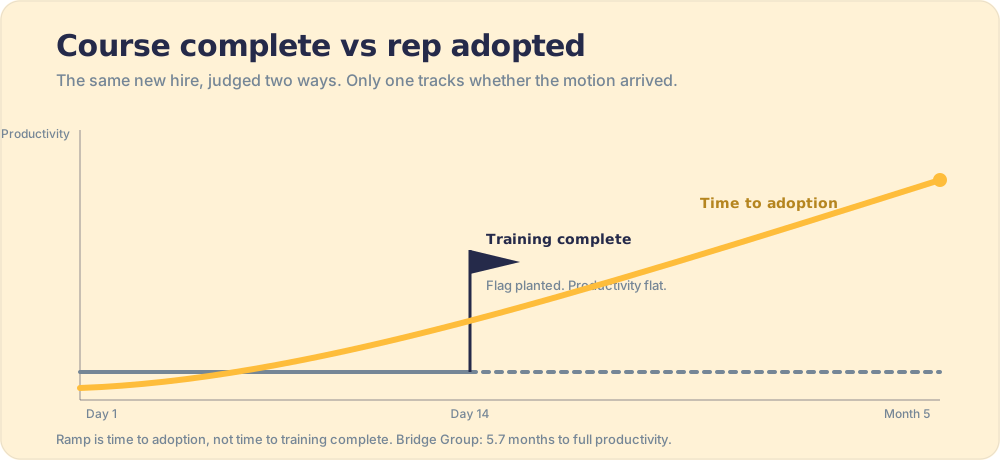
Sales onboarding software is the tooling teams use to take a new rep from day one to consistently running the sales process on real deals; the better ones are judged by time to adoption, not by course completion.
A new rep finishes onboarding and the dashboard is green: every module complete, the product certification passed, the competitive battlecards marked read. The software did exactly what it was sold to do, and the manager has a tidy report to prove it. Three weeks later that same rep is on a real call, a buyer asks a pricing question they have not seen, and the rep alt-tabs to a folder, types a guess into Slack, and promises to follow up.
The course was delivered. The behavior never showed up.
That gap is the whole subject here, and almost no buyer’s guide for sales onboarding software names it. The category is sold as a course-delivery engine: load the curriculum, track who finished, certify the new hire, watch the completion bar fill. The trouble is that completion is not the thing you are buying. You are buying a rep who runs your process on real deals, and you can hit one hundred percent course completion and produce none of that. Front-loaded knowledge evaporates before the first deal arrives, and a certificate is a receipt for attendance, not a measure of behavior.
So here is the more useful definition, and it is the one this guide is built on. Sales onboarding software is the tooling teams use to take a new rep from day one to consistently running the sales process on real deals. The better ones are judged by time to adoption, not by course completion. Ramp is time to adoption, not time to training-complete, and the software that shortens it is the software that changes what a rep does, not the software that delivers the slides faster.
What is sales onboarding software, exactly?
Strip the brand names away and sales onboarding software is whatever a team uses to get a new rep from their first day to running the playbook on real opportunities. That covers a lot of ground, from the LMS that hosts the product course to the tool that signs off a rep’s first mock pitch. Useful, ordinary, and worth defining plainly before we argue about it.
The reason the behavioral definition matters is that the two readings lead to different purchases. Read onboarding as a delivery problem and you buy the tool that delivers content best: more courses, slicker video, a tidier completion report. Read it as a behavior problem and you ask whether the rep runs the motion next month, on a deal nobody is watching. A platform that reports ninety percent course completion and produces a rep who skips discovery has filled the category and missed the point. Only one of those two facts shows up on the dashboard, and it is the wrong one.
This is the same distinction we draw between onboarding and training in the broader piece on sales onboarding: training is an input you can schedule, onboarding is an output you have to measure. Software inherits the confusion. Most of it is built to manage the input, because the input is easy to count. The output, whether the behavior took hold, is harder to see and is the only thing that ramps a rep.
What are the categories of sales onboarding tools?
However many logos a vendor list carries, the sales onboarding tools on the market organize into four working categories. Naming them cleanly is half the battle, because most teams buy by brand and then cannot say what job the tool really holds.
- Learning management systems (LMS). The course host. It loads the curriculum, delivers the modules, and tracks completion. WorkRamp is a well-known example, now an LMS inside Learning Pool after its 2025 acquisition (Learning Pool). The job is to deliver knowledge once, and it is measured on courses finished.
- Readiness and certification platforms. The proving ground. These run role-plays and recorded mock pitches, score them, and sign the rep off. Mindtickle, which added buyer enablement when it acquired Enable Us in 2023 (Mindtickle), sits here. The job is to prove the rep can, and it is measured certified yes or no.
- Content and enablement platforms. The shelf. They store and serve the decks, battlecards, and case studies a new rep sells with. Highspot and Seismic, the two giants here, completed their merger in August 2026 (the consolidation we covered). The job is to serve the right asset, and it is measured on assets opened.
- In-flow guidance, the business logic layer. The category most buyer’s guides skip. It delivers the next right step on a real deal, the instant the question arises, so following the process is the path of least resistance instead of a memory test. The job is to build the behavior, and it is the only one of the four measured on adoption.

The first three are good at their jobs, and a team needs them. A rep should learn what the product does in a room, up front, and an LMS is the right place for that. The trap is treating any of the first three as the whole of onboarding, because all three are measured on delivery, and delivery is not what ramps a rep.
Why does most sales onboarding software fail to shorten ramp?
Not because the courses are bad. Because the software is built to fight a war it cannot win: cramming knowledge into week one, exactly when the rep has no real deals to attach it to. Memory does not cooperate, and we have known it does not for almost a century and a half.
In 1885 Hermann Ebbinghaus ran the first experiments on memory and found the forgetting curve. A 2015 replication traced the same shape: relearning a list saved 47 percent of the original effort after 20 minutes, 32 percent after a day, and 4 percent after a month (Murre and Dros, PLOS ONE, 2015). The decay is steepest right after learning. So the module delivered on Tuesday is mostly gone by Thursday, and the battlecard loaded in week one is a faint trace by the time a buyer tests it in month two. Software that pours knowledge in faster than it can be used does not beat the curve. It feeds it.
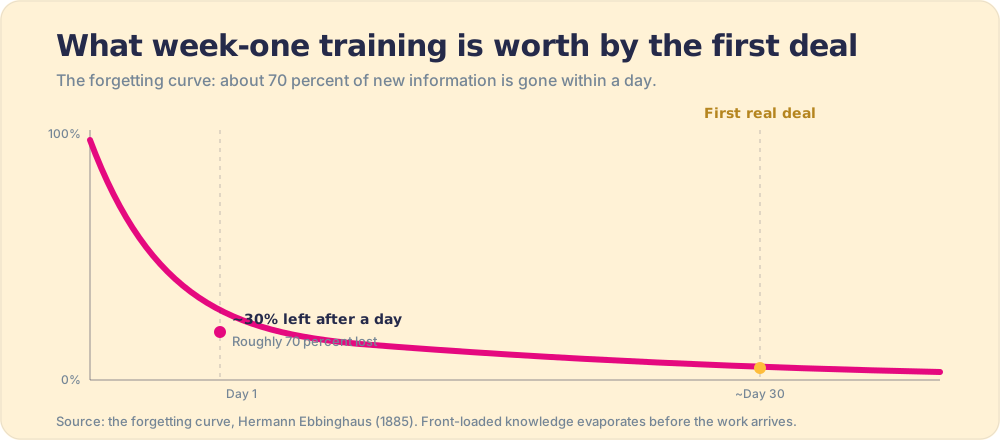
Now put a number on the timeline the software is supposed to compress. The Bridge Group, which has benchmarked SaaS sales metrics for over a decade, puts average ramp to full productivity for a new account executive at 5.7 months, up from 4.3 in 2020 (The Bridge Group, 2024 SaaS AE Metrics). Set the two facts side by side and the failure mode is obvious. Onboarding takes the better part of half a year, and the knowledge crammed into the front of it is seventy percent gone within a day. The orientation week is a small front porch on a much longer house, and most software is built to decorate the porch.
There is a quieter cost, too: surface area. Each onboarding tool a team bolts on is one more login, one more tab, one more place a rep has to go. A new hire least equipped to juggle four destinations is handed exactly that, and the math of attention is unforgiving. Capability that lives away from the work, in a separate tool, is capability a rep under pressure will not reach for. The course is bought; the behavior never arrives.
How do you choose a sales onboarding platform?
Start from the behavior you want, not the category you are missing. The conventional buying process runs the other way: spot a gap in the matrix, shortlist vendors, compare feature lists, pick the richest one. That optimizes for the wrong variable. It selects the tool with the most courses, when what you need is the tool whose guidance a new rep will follow on a real deal.
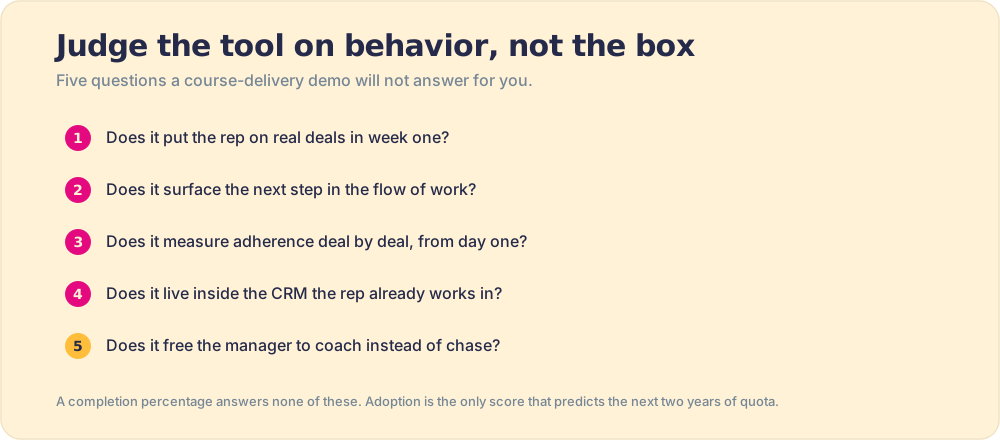
A behavior-first evaluation asks five questions of any sales onboarding platform, and a course-delivery demo will answer none of them on its own:
- Does it put the rep on real deals in week one? Ramp is a count of live reps, not classroom hours. A tool that keeps a new hire in modules for two weeks is delaying the only thing that ramps them.
- Does it surface the next step in the flow of work? The right move has to reach the rep at the moment of the work, inside the deal, not wait behind a search bar in a separate tool. Guidance the rep has to go find is guidance the rep skips.
- Does it measure adherence deal by deal, from day one? You cannot coach a drift you cannot see. A tool that reports completion but not whether the rep ran the motion is reporting the wrong number.
- Does it live inside the CRM the rep already works in? A capability reps must leave their workflow to reach is one most will not. Weight integration with HubSpot, Salesforce, and the tools the rep already opens above almost everything else.
- Does it free the manager to coach instead of chase? Inspection is necessary, but doing it by hand eats the manager’s first quarter with a new rep. The win is software that lifts that burden so the human time goes to coaching the motion.
The reason those five questions beat a feature list is in the data. The State of Sales Enablement 2026 found that teams whose guidance is embedded in the flow of work hit quota at 49 percent, against 15 percent for teams whose guidance lives in docs, wikis, and a separate tool. Same content. The variable is not which platform you bought. It is whether the guidance reached the rep where the work was already happening.
Teams whose guidance is embedded in the flow of work hit quota at 49 percent. Teams whose guidance lives in docs, wikis, and a separate tool hit quota at 15 percent. The same content, in a different moment, more than triples the share of reps hitting quota.
Why does measurement belong at the center of an onboarding stack?
Because you cannot ask “is this software working?” until you can answer “is the new rep running the motion?” Most onboarding tools report an input, courses finished or a rep certified, because the input is easy to count. The output, adoption on real deals, is the thing that predicts whether the hire pays off, and it is the thing a completion dashboard cannot see.
Our own survey makes the case in one number. Teams that consistently inspect deals against a defined process hit quota at 6.3 times the rate of teams that rarely do, the single largest effect we measured (State of Sales Enablement 2026). For a new rep this matters more, not less. Inspection in the first ninety days catches a bad habit while it is still forming, before it sets into the way that rep sells for the next two years. The catch, the reason inspection so often gets skipped, is that it is tedious by hand. So the software that earns its place is the software that automates the inspection burden, which is exactly what turns an onboarding stack from a pile of licenses into a system you can steer.
There is a second-order payoff worth naming, because the point of a consistent process is buyer-facing, not an internal control alone. Gartner has found that 77 percent of B2B buyers describe their most recent purchase as complex or difficult (Gartner). A new rep who ramps on a consistent motion gives buyers a clearer, steadier experience from their first deal, which is what actually closes deals in a market where buying already feels hard. Get the behavior right and the buyer feels it.
This is the moment a business logic layer earns its mention. Supered is the Business Logic Layer: it surfaces your process and the next right step on a new rep’s real deals inside HubSpot, Salesforce, Salesloft, Gong, and Gmail, then measures adherence from week one, so ramp becomes a time to adoption you can watch instead of a completion bar you cannot trust.
What we recommend
Strip it back and a clear choice sits under the topic, and it is not about how good your content is. You can buy sales onboarding software as a course-delivery engine, an LMS plus a certification tool plus a content shelf, and accept the slow ramp and the firehose decay that come with it. Or you can buy for behavior: a platform that puts the rep on real deals fast, surfaces the next step in the flow of work, measures adherence from day one, and frees the manager to coach.
We recommend the second, and the evidence is why. The forgetting curve says front-loaded knowledge will not survive to the first deal, with only about a third of the learning effort still saved a day later. The Bridge Group’s 5.7-month ramp says the orientation week is a sliver of the real timeline. Our own data says guidance in the flow of work hits quota at 49 percent against 15 percent, and that inspection is the largest single lever there is, at 6.3 times the quota rate. Those facts point one way: keep the LMS and the certification tool for the knowledge a rep genuinely should learn in a room, and stop mistaking their completion reports for ramp. Buy the business logic layer for the part that actually ramps a rep.
So when you next sit through a demo, do not count the courses. Watch what the tool does on a real deal in week nine, and ask whether it reached the rep. That one question reorders the whole evaluation. If you want the deeper case for why ramp is a behavior problem, start with sales onboarding; if you want the math on the clock itself, read sales ramp time; and if you want the system that makes the whole stack produce behavior instead of completion, the sales enablement software guide is the place to go.
Frequently asked questions
What is sales onboarding software?+
What are the categories of sales onboarding tools?+
How do you choose a sales onboarding platform?+
Does sales onboarding software actually shorten ramp?+
What is the difference between sales onboarding software and an LMS?+
Your process, running itself.