Sales Process Compliance vs Adoption: What Lasts
Adoption is a measurement problem. The reason your sales process did not stick is that you never tracked whether anyone ran it. The science on why measuring it is what makes it last.
Sales process compliance is reps following the process; it becomes lasting adoption only when adherence is measured and tracked on live deals in real time, because monitoring progress is one of the most reliable ways known to make a behavior stick.
Your sales process did not stick for a reason that has little to do with the process itself: you never measured whether anyone ran it.
That is uncomfortable, because measurement sounds like the boring part, the dashboard you set up after the real work of writing the process. It is backwards. Writing the process is the easy half. Whether it becomes how your team sells is decided almost entirely by one thing: whether you track adherence to it, on live deals, in real time. Adoption is, at bottom, a measurement problem, and the science on that is about as settled as behavioral science gets.
What is the difference between sales process compliance and adoption?
Start with the two words, because they get used interchangeably and they are not the same. Compliance is reps following the process. Adoption is that following surviving the first stretch of real pressure and becoming the default way the team sells. A rollout produces some compliance in week one, when the training is fresh and everyone is watching. Most of them never reach adoption.
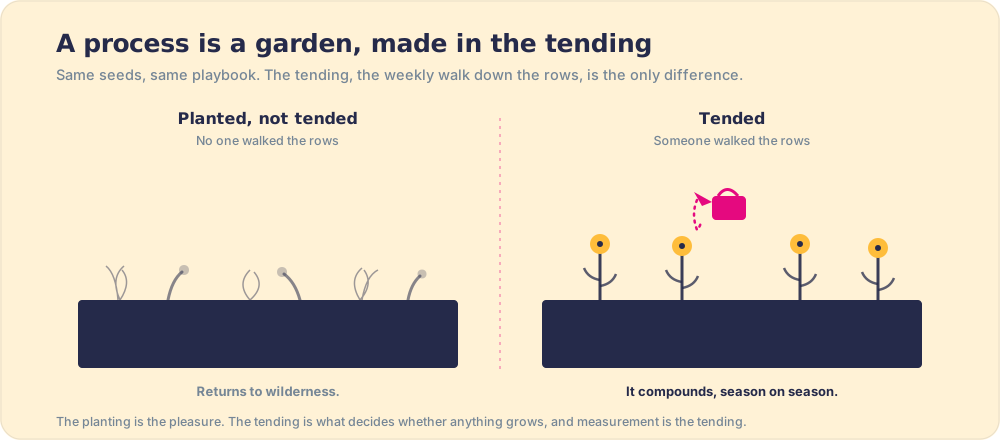
What carries a team across that gap is measurement, and the clearest way to see why is to think of a process as a garden. The planting is the part everyone enjoys: the kickoff, the well-worded playbook, the fresh beds raked out in spring. But no garden is made on planting day. It is made in the tending, the plain weekly walk down the rows to see what took root and what the weeds took back. Stop walking the rows and the beds return to wilderness on schedule, however careful the planting was. Keep walking them and the thing compounds, season on season. You can only grow what you tend, the same way you can only expect what you inspect. Measurement is the tending. It is not the afterthought to the process; it is the half that keeps the process alive.
Why does measurement make adoption stick?
This is not a hunch, and it is worth getting the evidence exactly right, because it is strong enough to plan around.
In 2016, a team led by Benjamin Harkin published the definitive test of the question in Psychological Bulletin: a meta-analysis of 138 randomized experiments covering nearly 20,000 people, all of which measured what happens when you prompt someone to monitor their progress toward a goal. The result was clear and causal: increasing how often people monitored their progress reliably increased how often they attained the goal. And the detail that matters most for a sales team: the effect was larger when progress was physically recorded or made public, rather than merely thought about (Harkin et al., 2016).
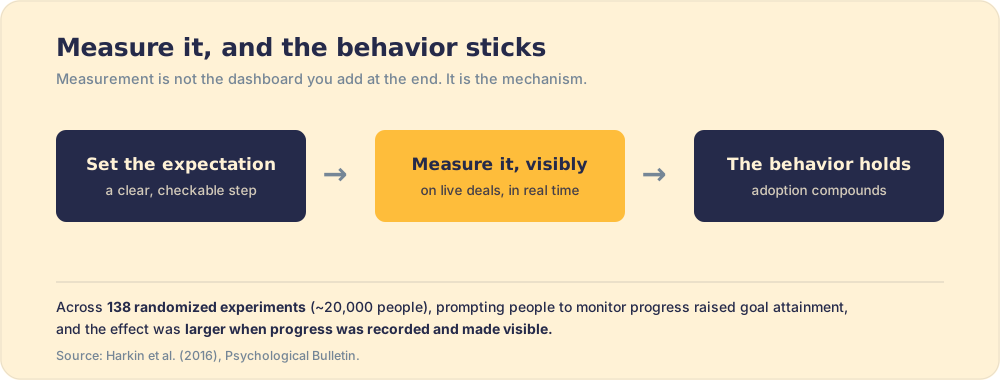
Read that last part twice, because it is the whole case for tracking. Monitoring works better when it is written down and visible. “What gets measured gets managed” turns out not to be a motivational poster; it is a replicated experimental finding. The act of measuring a behavior, and surfacing that measurement, changes the behavior. This is why a process you track gets run and a process you merely publish does not, even when the words are identical.
Harkin is not one lonely result, either. It sits on top of half a century of goal-setting research. Edwin Locke and Gary Latham, summarizing decades of studies, found that a goal lifts performance only when people get feedback on their progress toward it; a goal with no feedback, and feedback with no goal, each do little on their own (Locke & Latham, 2002). The expectation and the measurement work as one mechanism: the goal names the target, the feedback tells the rep whether they are hitting it, and only the pair moves behavior. A written sales process is the goal half, sitting alone, waiting for the feedback half that never comes.
Our own field data shows the same mechanism from the other side. Across 198 sales leaders in our 2026 research, 89 percent had a defined process and only 36 percent saw reps follow it, the 53-point gap that opens precisely where the feedback half is missing.
When a lab meta-analysis of 138 experiments, fifty years of goal-setting theory, and our own field data all point at the same lever, that is about as much agreement as a question like this offers.
It also explains the most common way rollouts die, which has nothing to do with the reps.
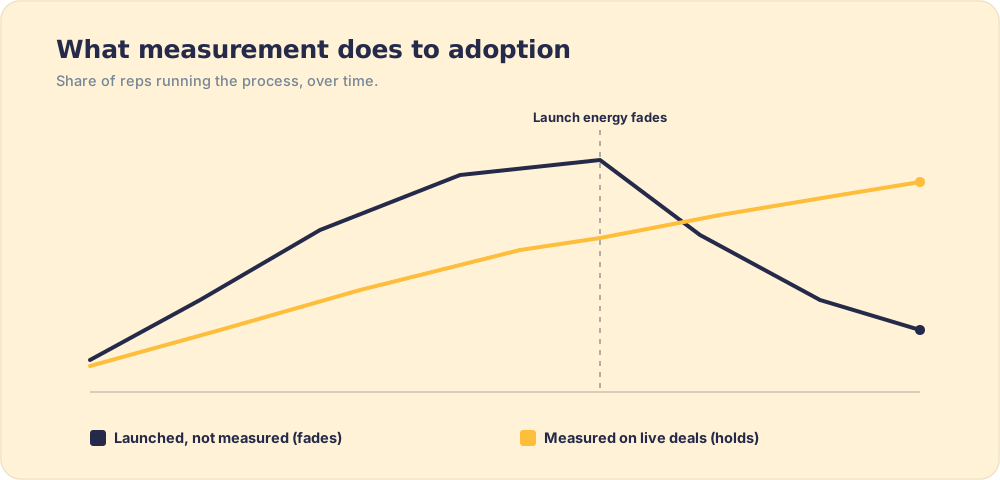
A typical rollout has a launch and then goes dark. The process ships, the training happens, and after that nobody counts whether it is being followed until the quarterly review, by which point the deals in question are cold and the drift is months old. With no live measurement, the new process competes against old muscle memory, gets no corrective feedback, and loses, deal by deal, until the drift is months deep and the forecast has already been built on top of it. The process did not fail because it was bad. It failed because it was unmonitored, and unmonitored goals are mostly abandoned. That is what the curve above is showing.
But isn’t the real answer manager coaching?
Here the sales world will object, and it has a strong case, so let us grant it in full before answering. The most respected research on sales-rep behavior does not point at dashboards. It points at the manager. When Matthew Dixon and Brent Adamson built The Challenger Sale (Portfolio, 2011) out of the Sales Executive Council’s data at CEB, the finding that held up across thousands of reps was that a good frontline coach is the single largest lever a sales organization controls. For the core 60 percent of a team, the steady middle that carries most of the revenue, CEB found a 19-point gap in quota attainment between the reps with the best coaches and the reps with the worst (CEB / Sales Executive Council, via Selling Power, 2013). Korn Ferry’s later sales-enablement research lands in the same place: teams with consistent coaching see 32 percent higher win rates and 28 percent higher quota attainment (Korn Ferry, 2023).
So if coaching is the lever, why spend a whole post on measurement? Because the two are not rivals. Read the CEB recommendation closely and it is already an argument for measurement. Adamson’s first rule for becoming a top coach is, in his words, to “coach behavior, not outcome,” and his second is that “the head of sales first must map out the behavior that defines success for each step of the sales process,” because “managers don’t have a picture of what good looks like.” A coach who is told to fix behavior, against a defined picture of the right behavior, at each step of the process, is being asked to do one thing first: see whether the behavior is happening. That seeing is measurement. The coaching the research celebrates runs on a signal the manager has to get from somewhere.
And that is exactly where it breaks down at scale. A manager can give brilliant feedback on the one deal in front of them, the same way a coach can stand on one touchline and read one game. They cannot stand on twelve touchlines at once. CEB itself found the optimal coaching window is three to five hours per rep per month, and most managers do not have it, because the hours that should go to coaching are eaten by the manual work of finding out what is even going on across the pipeline. Korn Ferry’s Becky Abraham is blunt about what a real process demands: it must be “aligned with the buying process, consistently followed, coached on and measured.” Coached on and measured, in the same breath. The coaching is the human act that changes the rep. The measurement is what tells the coach which rep, which deal, and which step, before the deal is cold.
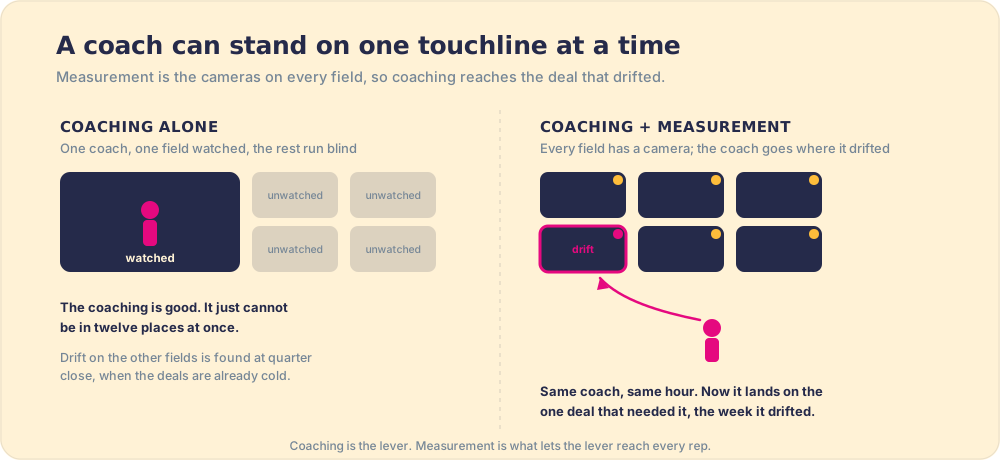
This is also where one tempting reading of the CEB work goes wrong. “Coach behavior, not outcome” is sometimes taken to mean coach instead of inspect, as if checking adherence were the enemy of good coaching. It is the reverse. You cannot coach a behavior you cannot see, and the only way to see behavior across a whole team is to measure it. Inspection and coaching are not a choice; inspection is what makes the coaching aimable. The win is not dropping the inspection. It is automating it, so the manager’s scarce hours land on the conversation instead of the chase. And when a rep drifts from the process, the lesson the research keeps confirming is that the cause is friction and missing feedback, the system around the rep, not a rep who needs a sterner talking-to.
What does it mean to measure the process?
Saying “measure adoption” is easy. Most teams that try it measure the wrong thing, at the wrong time, in the wrong place, and conclude measurement does not work. Three details decide whether it does.
- Measure the behavior, on live deals, not a survey. Adherence is whether your open opportunities meet the stage criteria they are filed under, right now. A quarterly self-report of “do reps follow the process” measures opinion, not behavior, and opinion is optimistic.
- Measure continuously, not at quarter close. Harkin’s effect comes from monitoring progress, which only works if the monitoring is close enough to the action to change it. A reading you take after the deal is dead is an autopsy, not a measurement.
- Make it visible, including to the rep. The effect is strongest when progress is recorded and seen. A number locked in a manager’s spreadsheet for an end-of-quarter review barely changes behavior, because it is not present while the rep is working. Surface it where reps can see their own adherence, and the measurement starts doing its job on its own.
There is one honest caveat, and it sharpens the point rather than softening it. The power of measurement is in feedback, not in fear. Tracking that helps a rep see their own progress and correct early is what drives adoption; the same numbers wielded only as quarter-end gotchas teach reps to game the fields and little else. So track openly and coach early. But notice that even this is an argument for more visible measurement, closer to the work, not less.
Build the loop
Put together, durable adoption is a measurement loop: set a clear, checkable expectation, track adherence to it on every live deal in real time, surface that signal to the rep and the manager, and coach the drift while it is still warm. Each turn of the loop makes the next one easier, which is why measured processes compound instead of fading.
This is the reasoning behind how we built Supered, and it is the part most enablement skips. Supered is the Behavior Layer: it measures adoption of your process on every open deal, in real time, and surfaces it to reps and managers in the flow of work, so drift is visible the week it happens and gets coached before the deal is cold. The process is the plan; the measurement is what turns the plan into behavior, and it is the part you cannot afford to treat as optional.
So you have two real ways to chase adoption, and the research lets us choose between them honestly. The first is to lean entirely on coaching and hope your managers find the drift in time. It is the lever the data loves, and on the one deal a manager looks at, nothing beats it. But it does not scale past the hours in a manager’s week, and the drift it never sees is the drift that sinks the rollout. The second is to make measuring the sales process the floor that coaching stands on: track adherence on every live deal in real time, surface it to the rep and the manager in the moment, and spend the human hours on coaching the drift the measurement found, while it is still warm. We recommend the second without hedging, because it is the only one that fits all three findings at once, Harkin’s monitoring effect, CEB’s coaching delta, and our own 53-point gap. Coaching is the act that changes the rep. Measurement is what aims it.
So when a rollout fizzles, the lesson is rarely that the process was wrong or the reps were lazy. It is that the team shipped a process and never measured whether it was followed, and an unmeasured process is one nobody is keeping. The deeper question of why reps drift even from a process they helped design is the subject of sales process adoption, the gap this whole pattern produces is measured in the sales execution gap, and the practical question of where your sales process should live so reps meet it in the moment is the next one to answer.
Frequently asked questions
What is the difference between sales process compliance and adoption?+
How do you ensure sales process adoption?+
Does monitoring the sales process change rep behavior?+
Should you measure the sales process to coach or to punish?+
Your process, running itself.