Process Map Template: Pick the One That Matches the Altitude
There is no single process map template, there are three, at three altitudes. Using a high-level one to run the work, or a detailed one to scope it, is why most maps disappoint.
A process map template is a reusable structure for drawing how work flows, and there is no single correct one, there are three at three altitudes, SIPOC for scope, swimlane for finding the seams, and detailed for running the work, each fit for a different job.
People ask for a process map template the way they ask for a ladder, as if any ladder will reach any shelf. Then they get one, a tidy swimlane with three lanes, and discover it is wrong for what they needed: too detailed to scope a new process, or too high-level to actually run the work, or missing the handoffs that were the entire reason they started. The disappointment is not in the template. It is that there is no single template, and the one that helps depends on the altitude you are working at.
A process map template is a reusable structure for drawing how work flows, and there is no single correct one, there are three at three altitudes, SIPOC for scope, swimlane for finding the seams, and detailed for running the work, each fit for a different job. Pick by the job, and the template stops disappointing.
The reason this trips people up is that the word “template” promises a single right answer, and process mapping does not have one. Each of these process mapping template forms came from a different tradition solving a different problem. SIPOC was born inside Six Sigma at companies like Motorola and GE as a scoping tool, the thing you fill out in the Define phase of DMAIC before anyone is allowed to draw a step. The swimlane traces back to Geary Rummler and Alan Brache, whose 1990 book Improving Performance argued that the white space between functions on the org chart, not the boxes, is where most performance is lost, and put roles in horizontal lanes to make that white space impossible to ignore. The detailed flowchart is the old Gilbreth-and-ASME standard, built to run and audit the actual work. Three lineages, three jobs. Hand someone the wrong one and the failure looks like a bad template when it is a mismatch of altitude.
Which process map template fits which job?
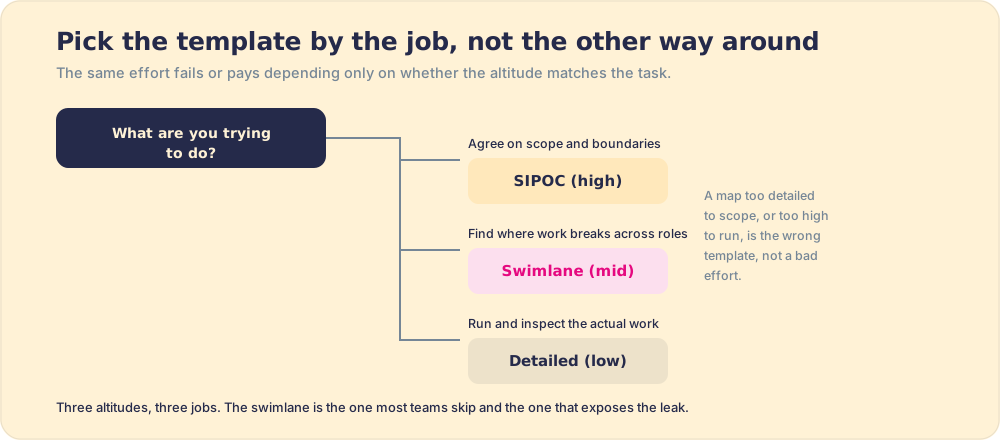
Three altitudes, three jobs, and using one at the wrong altitude is the most common mistake in process mapping.
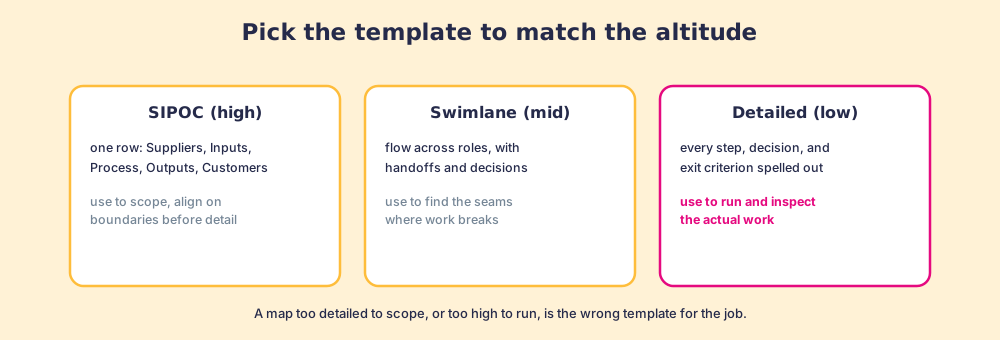
- SIPOC, the high altitude. Suppliers, Inputs, Process, Outputs, Customers, captured in a single row. Use it first, to scope the process and agree on boundaries before anyone draws a step. It prevents the classic failure of mapping detail before agreeing what the process covers.
- Swimlane, the middle altitude. The flow laid out in lanes by role, with handoffs and decisions visible. Use it to find where work breaks, because the seams between roles are where it leaks.
- Detailed, the low altitude. Every step, decision, and exit criterion spelled out. Use it to run and inspect the actual work, where the process map becomes a working procedure.
You may notice a fourth name missing: value-stream mapping, the Lean tool that traces a product or request end to end and marks where time is lost to waiting. It is genuinely useful, and for a flow whose problem is speed, where deals sit for days between touches, it is the right reach. We leave it off the core three on purpose, because it answers a different question, “where is time wasted,” rather than “who owns this step” or “what must be true to move on.” For most sales and revenue processes the binding constraint is not idle time, it is an unowned handoff or an unenforced exit rule, and the swimlane and detailed templates aim straight at those. Reach for value-stream mapping when the symptom is delay; reach for the swimlane when the symptom is a deal that fell through a crack.
Why is the swimlane template the most useful?
Because it forces the one question prose lets people dodge: at this exact step, who is responsible? A narrative description of a process can describe ten steps without ever pinning ownership, and the unowned step is the step that falls through. The swimlane puts every action in a lane, so an orphaned step is impossible to hide.
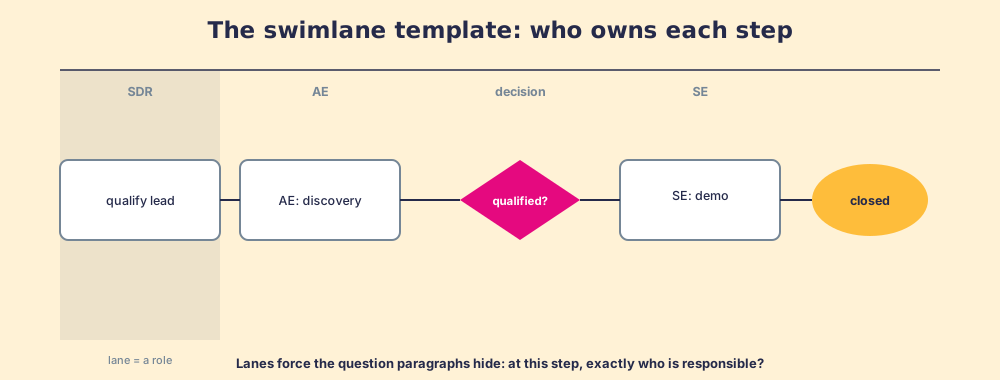
This connects to a principle worth naming, the RACI idea that every task needs someone Responsible, Accountable, Consulted, and Informed, and that ambiguity about the first two is where work dies (RACI matrix). A swimlane map is RACI rendered as a picture: the lane is the owner, and a step sitting on a lane boundary is a RACI gap you can see. That visibility is why the swimlane is the diagnosis template, the one that pays for the hour it takes to draw.
Rummler and Brache built their whole method on this point. Their insight was that managers spend their lives looking down the org chart at their own function and almost never look across at the white space between functions, even though that white space is where the customer’s experience is actually assembled and where most of it falls apart (Rummler & Brache, Improving Performance). The swimlane is the one common template that drags that white space into view and forces a name onto it. A narrative spec can list ten steps and never once say who is on the hook for the transition between step four and step five. The swimlane cannot dodge it. Put the step in a lane or admit no one owns it, and the orphaned step that was invisible in prose becomes the most obvious thing on the page.
That is also why so many teams skip it. The swimlane is the template that forces an uncomfortable meeting, the one where two leaders discover they each assumed the other owned the handoff. The discomfort is the value. A template that lets everyone keep their comfortable assumptions has diagnosed nothing.
How do you move from a template to a process that runs?
A template produces a map, and a map is a diagnosis, not a cure. Any process flow template, however clean, gets you a picture of the work, and a picture changes no behavior on its own. The detailed template gets you closest to a working procedure, but even a perfect detailed map sitting in a shared drive changes nothing until the steps reach people at the moment of work and someone can see whether they were followed. The gap is well documented: across 198 sales leaders, 89 percent have a defined process and only 36 percent see their reps follow it (The State of Sales Enablement 2026). A map is the defined half. The 53-point shortfall lives entirely on the followed half, and no template closes it. So treat the template as the first move: scope with SIPOC, diagnose with a swimlane, detail what you will run, then deliver and inspect it, the discipline covered in process documentation.
What we recommend
Stop hunting for the one perfect process map template and start matching the template to the altitude. The sequence that works runs from high to low and ends in the work itself:
- Scope with SIPOC. Agree on suppliers, inputs, outputs, and customers before anyone draws a step, so the whole effort is bounded and nobody maps a process the team has not agreed on.
- Diagnose with a swimlane. Put every step in the lane of whoever owns it and read off the orphaned steps, because the unowned handoff is where work breaks and the swimlane is the one template that cannot hide it. It is the single most valuable map most teams never draw.
- Detail only what you will run. Spell out steps and exit criteria to the depth you intend to inspect, and no further, so you do not drown a simple process in boxes nobody will check.
- Carry the map into the work. Deliver the steps at the moment of need and measure adherence, because a handsome map nobody follows improves nothing, and the diagram was never the deliverable.
The template is the start. A process that runs, the same way, by everyone, is the finish, and the distance between the two is the whole job.
From here: the practice in process mapping, the delivery-and-inspection discipline in process documentation, and the detailed-step view in workflow documentation.
Frequently asked questions
What is a process map template?+
What is a swimlane process map template?+
Which process map template should I use?+
What is SIPOC in process mapping?+
Your process, running itself.