Sales Enablement Software: Buy for Adoption, Not Features
Sales enablement software has converged on identical features, and AI is making them free. A short history of the category, why the capabilities stopped mattering, and why adoption is now the only thing worth buying on.
Sales enablement software is the category of tools that equip reps to sell: content management, conversation intelligence, training, playbook and process guidance, and analytics. After fifteen years the leading platforms have converged on the same capabilities, so the thing that predicts whether any of it works is no longer the feature list. It is adoption, properly defined: whether the tool changes what reps do on a real deal, and whether anyone can see that it did.
Walk into any gym in the second week of January and you are looking at the business model of sales enablement software. The treadmills are superb. By February most of them are holding laundry. The economists Stefano DellaVigna and Ulrike Malmendier studied this exact gap, tracking 7,752 members across three years, and their finding in the American Economic Review is one of the cleanest facts in behavioral economics: members on monthly plans of $70 and up attended about 4.3 times a month and paid more than $17 a visit, while a ten-visit pass sat on the same counter at $10. Over a membership they walked past roughly $600 in savings. They were not buying the gym. They were buying the version of themselves who goes.
The detail that turns the study from amusing to useful is the mechanism the authors pinned down. The overpayment was not a one-time slip. The same members who overestimated how often they would show up also clung to the auto-renewing monthly contract: those on the monthly plan were 17 percent more likely to still be enrolled past a year than members who had committed for a year up front, because they kept meaning to cancel and kept not doing it. DellaVigna and Malmendier traced both errors to one root, overconfidence about your own future self-control. People do not misjudge the treadmill. They misjudge themselves, predicting the disciplined future version who will go four times a week and forget the present version who is tired on Tuesday. That single bias, applied to software, is the engine of shelfware: the buyer in the demo room is not lying about the tool, they are overrating the team that will adopt it, and they sign a renewing contract on the strength of a future that does not arrive on its own.
Enablement software is bought the same way, in the demo, by a leader picturing the team that will finally use it. To see why the whole category keeps selling the purchase and missing the use, you have to see how it grew up.
How did sales enablement software become one converged category?
The category was born around a single job: getting marketing's content to sales. Seismic launched in 2010, Highspot and Showpad in 2011, all solving the same complaint, that reps could not find the right deck. Then the other jobs arrived as their own companies. Gong brought conversation intelligence in 2015, recording and analyzing calls. Training and readiness vendors built onboarding. Sales engagement tools built sequencing. For a while the market was a row of specialists, each owning one job.
What unites those founding stories explains everything that followed. The deck a rep could not find, the call nobody could review, the onboarding that did not stick, all four are versions of one complaint: the right knowledge was not in the right place at the right time. The category was built, from its first day, to solve a knowledge-access problem. That was the correct problem in 2010, when finding the approved one-pager genuinely was hard. It stopped being the binding constraint years before the vendors noticed, because storing and retrieving knowledge is the kind of problem software is good at and gets better at every year. The founders solved what they set out to solve. The trouble is that the thing they solved was never the thing that decided whether a rep ran the play. A rep with the perfect deck in hand still has to choose to use it on the call, and no content library ever reached into that moment.
Then they ate each other's lunch. The pattern is worth watching one vendor at a time, because the convergence was not a single event but a decade of each company crossing into territory it once left to a rival. Seismic, born to manage and automate content, moved into learning and coaching, buyer engagement, and meeting intelligence, until its own platform page lists content management, learning, coaching, meeting intelligence, and digital sales rooms side by side as a single "Enablement Cloud." Highspot, also born in content, added conversation intelligence, scorecards, and guided plays, and by 2026 was describing itself not as a content tool at all but, in its own words on the merger announcement, as "the only agentic GTM Performance Platform." Gong, born to record and analyze calls, pushed forward into engagement, deal boards, and forecasting. The training-and-readiness vendors, Mindtickle and Allego, built content management onto what began as onboarding software. Four companies that started in four different corners of the problem walked, year by year, toward the same center, each acquiring or building the capability the others had, until the four product tours read like paraphrases of one another.
The people whose job is to map the market said so out loud. Forrester's principal analyst Eric Zines, introducing the firm's first combined Wave for the space in September 2024, put the consolidation in one figure that no buyer should forget: "the Venn diagram is now a circle," he wrote, "readiness providers have developed content management capabilities, and content platforms now offer readiness features." Two formerly distinct product categories had collapsed into one, and the analyst tracking them could no longer draw the line between them.
Two events since then sealed it. In November 2025, Gartner retired the old sales-enablement framing and published its first Magic Quadrant for Revenue Enablement Platforms (authored by Doug Bushée, Melissa Hilbert, and Bill Yetman, November 10, 2025), and the criteria are the proof of the convergence in black and white. To even be evaluated, a vendor had to natively provide the whole list at once: digital content management, learning and practice and coaching, guided selling, buyer-engagement analytics, internal and external analytics, integration, and platform breadth, while supporting multiple customer-facing roles. A decade earlier those were the product descriptions of separate companies. Gartner now treats them as the price of admission to a single quadrant, and named Highspot, Seismic, Allego, Bigtincan, and Mindtickle among the platforms clustered inside it. When the entry ticket to a market is "do all six of the things the six former specialists each did," the specialties have merged.
Three months later, in February 2026, the two largest platforms, Highspot and Seismic, signed a definitive agreement to merge, the combined company to operate as Seismic under CEO Rob Tarkoff, with Highspot's founder Robert Wahbe joining the board, pending regulatory approval. One detail of the structure matters more than the headline. Permira, the private-equity firm that has held a stake in Seismic since 2020, remains the controlling shareholder after closing, which means the deal is less two equals joining hands than one financial owner folding a rival into the asset it already controls. The two largest brands in the category will answer to one cap table. Permira's managing director Jason Thorn was direct about the logic in the announcement: the transaction "brings together two highly complementary, customer-centric platforms with a shared ambition to invest heavily behind an AI-first product roadmap." Highly complementary is investor language for "the overlap is large enough that one of these product lines is now redundant," and an AI-first roadmap is where the combined research dollars will go.
The executive language is the same tell from the other side. Tarkoff framed the deal as "raising the bar for how technology can enable revenue organizations to plan, execute, perform, and scale." Wahbe added that "Highspot and Seismic share a belief that enablement sits at the center of how modern revenue teams operate." Two companies that spent fifteen years competing now describe a single shared belief and a single shared roadmap, owned by a single shareholder. When the analyst says everyone must do everything, and the two leaders fold into one balance sheet, the capabilities have stopped being a difference.
The buyer-review data tells the same story from the other side. On G2 in mid-2026, Highspot, Seismic, and Mindtickle all sit at 4.7 out of 5, Allego around 4.6, Showpad around 4.5: the whole leaderboard fits inside two tenths of a point, because reviews can no longer separate platforms that do the same things. When the scores converge, the score has stopped being information. This is the trap in the standard buying advice, which is still to compare feature grids: the grids are now copies of one another.
What does AI change about sales enablement software?
It finishes the convergence by driving the price of the converged capabilities toward zero. The founding job of the category, producing and retrieving content, is the job large language models do for free. A rep can ask for a tailored one-pager, a follow-up email, or a call summary and have it in seconds, with no platform in the loop. Each vendor has responded by stamping "AI" on the same five jobs, which means AI is not pulling the platforms apart; it is pressing them closer together and lowering the floor under all of them. A moat made of content management does not survive content becoming free.
That leaves exactly one thing AI does not do for you. AI can draft the discovery questions; it cannot make the rep ask them. It can summarize the call; it cannot make the rep run the next play the process calls for. Knowledge has been getting more solved for a decade, and AI has now finished the job, which throws the whole weight of competitive advantage onto behavior, the one thing that was never solved. The vendors feel this even as they market against it. Read the merger language again: Tarkoff's pitch was about helping organizations "plan, execute, perform, and scale," and the word that does the work there is execute. The leaders are reaching, in their own words, for the half of the problem their products historically left alone, because they can see that the content half has no margin left in it.
The most useful way to see this is to walk AI down the six jobs the category bundles, because it does something different to each, and the difference is the whole argument. To content management it does the most damage: producing and retrieving an asset is the thing a language model does in seconds, so the moat there is gone. To buyer engagement and digital sales rooms it adds polish, auto-assembling a personalized microsite, while leaving the underlying act the same one of delivering content. To conversation intelligence it brings the summary and the score to near-free and builds them into every meeting tool, so the standalone recorder loses its reason to exist as a separate purchase. To training and coaching it adds tireless role-play and instant feedback, which is genuinely useful and still teaching, not reinforcing the behavior on a live deal. To playbook and process guidance it can suggest the next play, a real gain, but suggesting is not the same as governing whether the play ran. And to the sixth job, measuring adherence at the deal level, AI does not lower the cost at all. It raises the stakes, because now there is a machine acting in the deal whose behavior also has to be inspected. Five of the six jobs get cheaper; the sixth gets more urgent. That asymmetry is the map of where advantage is moving.
Gartner, mapping the same shift from the analyst's chair, reached our conclusion in its own words. In an April 2026 release predicting that AI-driven enablement will deliver 40 percent faster sales-stage velocity by 2029 than traditional methods, drawn from a survey of 227 chief sales officers, Gartner VP Analyst Shayne Jackson named the founding flaw of the category directly: "Traditional enablement was built as a reactive support function, not as a system engineered to drive measurable seller performance." His prescription is the one this guide argues. "Enablement must become an AI-driven function that orchestrates seller behavior in real time," he said, and the firm's first recommendation to sales leaders was to "move beyond static content and training to deliver in-workflow, data-driven guidance." A content library is the static-content function Jackson says is no longer enough. In-workflow guidance that orchestrates behavior in real time is the sixth job. The analyst, the merger, and the price collapse all point at the same square on the board.
There is also a new reason to measure behavior that did not exist a few years ago, and it changes who the subject of adoption is. The vendors are not adding gentle assistants; they are shipping agents. Highspot now markets itself, in the merger announcement, as "the only agentic GTM Performance Platform, powered by Nexus," an engine that turns "every signal, spoken, shared, or shown, into real-time actions." Seismic's combined-company pitch is a "comprehensive AI-powered platform" spanning the full revenue lifecycle. When an AI is acting inside your deals, drafting the email, suggesting the next step, replying to the buyer, the question "is the process being followed?" now has to be asked of the model, not only the rep. An agent that advances a deal or sends a message is taking an action in front of your buyer, and you have to be able to inspect whether that action matched the standard you set, at the level of the individual buyer interaction. Governing what an AI does is the same discipline as governing what a rep does: set the expectation, make the behavior visible, check it. The difference is one of scale and speed. A rep going off-process costs you one deal at a time; an agent acting across the whole pipeline at once can carry a flawed motion to every buyer before anyone reads a single transcript, so a governance gap that used to leak slowly now floods. The marketing says "agentic" and means autonomy; the operator should hear "agentic" and ask where the inspection is. AI does not retire the adoption problem. It promotes it to the most important capability a platform can have, and it is the exact capability the category spent fifteen years skipping.
Why does most sales enablement software become shelfware?
Because buying a tool and changing a behavior are different acts, and only the second one pays. The deepest evidence does not come from sales; it comes from forty years of economists hunting for the return on technology and failing to find it. In 1987 the Nobel laureate Robert Solow named the puzzle in a line that has outlived almost everything else written about computers that decade. Reviewing a book on the information economy for the New York Times Book Review, he wrote: "You can see the computer age everywhere but in the productivity statistics." Firms were pouring money into machines, and the output figures sat flat. The puzzle had a name, the Solow paradox, before it had an answer.
The answer took two decades, and Erik Brynjolfsson and Lorin Hitt resolved the paradox firm by firm, and their conclusion, stated in the abstract of their 2000 paper "Beyond Computation" in the Journal of Economic Perspectives, was blunt: "organizational 'investments' have a large influence on the value of IT investments," and "the benefits of IT investment are often intangible and disproportionately difficult to measure." In plainer words, the computer alone did close to nothing; the return appeared only where firms also rebuilt how people worked, the processes, the habits, the way the day was organized. Brynjolfsson later put a number on the proportion: for a large system, the hardware and software is a minority of the true cost, and the majority is the complementary change in process and behavior that no invoice lists and no demo shows. The machine is the cheap part. The behavior change around it is the expensive, unglamorous part, and it is the part that produces the return.
Put the history and the economics together and you get the only equation that matters at purchase. The value a tool delivers is its capability multiplied by its adoption. Capability has converged to roughly the same high number for every vendor, so it now behaves like a constant. Adoption is the term that still varies, from near zero to high, and a multiplication is unforgiving: a great capability times an adoption near zero is a value near zero. The buying decision has inverted. The variable buyers score has stopped moving, and the variable they skip now decides the outcome.
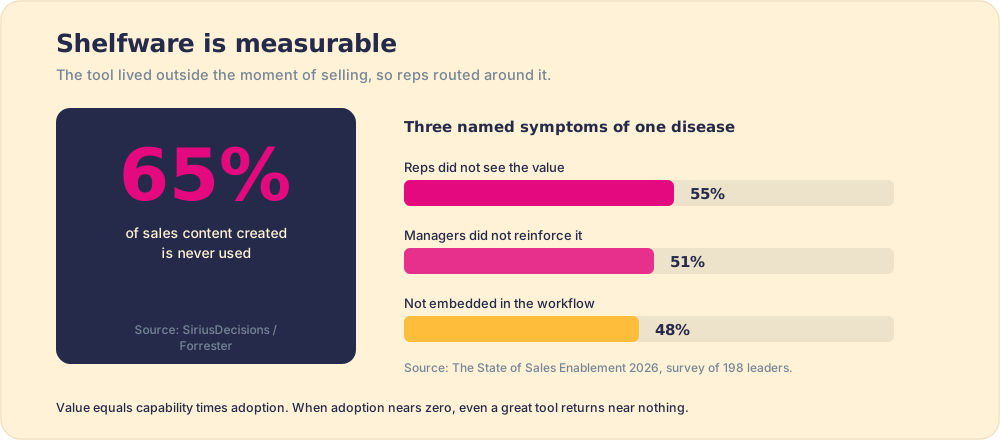
The shelfware is measurable. SiriusDecisions, now part of Forrester, found that 65 percent of the content created for sales never gets used. Our survey of 198 leaders for The State of Sales Enablement found the same disease with three named symptoms: reps did not see the value (55 percent), managers did not reinforce it (51 percent), and the tool was not embedded in the workflow (48 percent). Three descriptions of one fact. The tool lived outside the moment of selling, so reps routed around it the way water routes around a rock.
What decides whether software gets used?
If shelfware is the disease, it helps to know the mechanism, because the mechanism tells you what to look for in a tool and what to ignore. The reason a rep does not use the platform you bought has little to do with discipline and almost everything to do with where the prompt lives. The behavioral scientist BJ Fogg spent years at Stanford compressing the conditions for any behavior into one model: a behavior happens when three things converge at the same instant, motivation, ability, and a prompt. He writes it as B = MAP, and the part that matters for software is the prompt. A rep can want to send the right case study and know exactly which one it is, and still not send it, because nothing cued the action at the moment the email was open. Remove the prompt from the moment of work and the behavior does not occur, no matter how motivated or able the rep is.
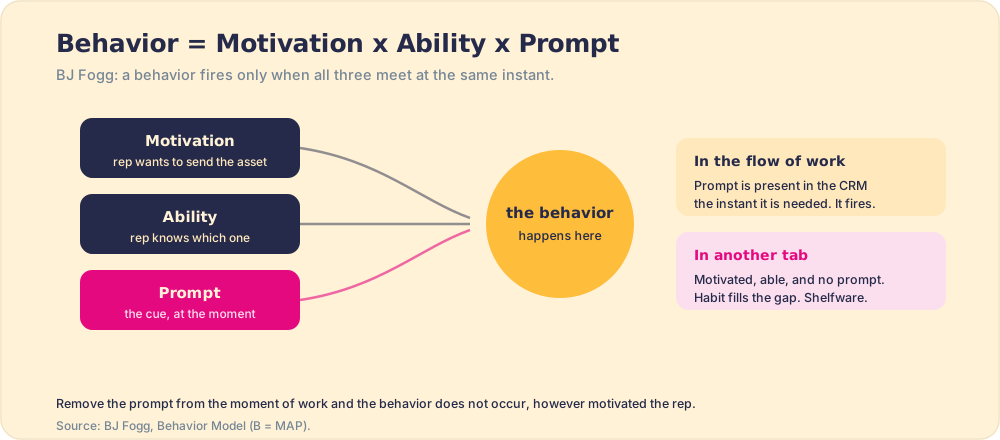
This is where the location of the software does the deciding. A tool in another tab is a prompt the rep has to go and fetch, and fetching is a cost paid against a small window of attention while a buyer waits on the other end. Small costs reliably beat good intentions; this is the same reason defaults dominate human choice everywhere they have been studied, from retirement enrollment to organ donation. The rep does not weigh the merits of the playbook and decide against it. The playbook simply is not present when the situation that needs it arrives, so habit fills the gap, and habit is whatever the rep did last time. A platform that requires a separate login is asking the rep to climb a wall every time the prompt is needed, and walls do not get climbed under quota pressure.
Brynjolfsson's finding and Fogg's model point at the same design conclusion from two directions. The economist says the return lives in the complementary change to how people work, not in the tool. The behavioral scientist says the change to how people work happens only when the prompt sits inside the moment of the work. Stack them and the buying criterion writes itself: software earns its return when it delivers the right behavior as a prompt, in the flow of the deal, in the tool the rep already has open, and it forfeits the return the instant it asks the rep to go somewhere else to get value. The category spent fifteen years building richer and richer destinations. The mechanism says the destination is the problem.
What does sales enablement software do?
The category bundles six jobs. Naming them shows what you are buying, where each leaks, and which ones AI is busy commoditizing.
| The job | What it does | Example tools | What AI is doing to it |
|---|---|---|---|
| Content management | Store, govern, and deliver selling assets | Highspot, Seismic, Showpad | Generating assets on demand, eroding the moat |
| Buyer engagement / digital sales rooms | Share content with buyers in one tracked microsite | Highspot, Seismic, Showpad, Dock | AI personalizes the room, but it is still content delivery, not rep behavior |
| Conversation intelligence | Record and analyze calls | Gong, Chorus | Summaries and scoring now near-free, built in everywhere |
| Training & coaching | Onboard reps and build skill | Mindtickle, Allego | AI role-play and feedback, still teaching, not reinforcing |
| Playbook & process guidance | Get the right play to the rep at the right stage | Guided selling, Supered | AI can suggest the play; someone must still govern whether it ran |
| Analytics & adoption | Show whether reps did what the process expects, deal by deal | Often missing entirely | The job AI makes more urgent, not less, the one most stacks skip |
It helps to see each job at work on a real deal, because the abstraction hides where each one stops. Take a mid-market rep, call her Dana, working a $40,000 deal through HubSpot. Content management is the job that lets her find the approved security one-pager instead of an outdated copy from a teammate's desktop; it succeeds the instant the right asset is reachable, and it has nothing to say about whether she sends it. Buyer engagement is the digital sales room she shares with the buying committee, and it earns its keep by telling her which of the five stakeholders opened the pricing page; it tracks the content, not her behavior. Conversation intelligence records her discovery call and flags that she never asked about budget; it is a superb rear-view mirror and a poor windshield, because the call it analyzed is already over. Training and coaching is where she learned the qualification framework in onboarding and where she can role-play a tough objection; it built the skill months ago and cannot make her use it today. Playbook and process guidance is the one job that reaches into Dana's actual moment, surfacing the next right step inside HubSpot while the deal is live, the qualification questions she is supposed to ask at this stage. And analytics and adoption is the job that, after the fact and across the team, can answer whether Dana and her thirty-nine colleagues ran that step, deal by deal, so the manager knows who to coach. Five of these jobs touched everything around Dana's decision. Only the last two touched the decision itself.
Look down the last column of the table and a pattern sharpens. Five of the six jobs are forms of storing, delivering, generating, or reviewing knowledge, and AI is driving the cost of all five toward the floor, which is why the vendors all stamped "AI" on them at once. The sixth job, measuring whether behavior changed at the level of the deal, is the only one AI makes harder to skip rather than cheaper to do, because once an agent is also acting in the deal there is more behavior to inspect, not less. The sixth job is also the one most stacks do not have at all, which is no accident: it is the only job that cannot be satisfied by moving knowledge around, the founding competence of the category. A content suite can show you which assets were opened; it was never built to show you whether the rep ran the qualification step the process calls for. That measurement gap is where the convergence ran out of road, and it is the gap the rest of this guide is about how to close.
The fuller landscape is in the best sales enablement tools, and the definition gets its own treatment in what is sales enablement software. The job nothing else can do for you is the last one, measuring whether behavior changed, and it is the one to weigh most heavily in any purchase.
Don't features matter, and don't buyers rightly compare them?
A careful reader should be uneasy by now, and the unease deserves a fair hearing rather than a brush-off. The objection runs like this: of course features matter. Buyers compare them for good reasons. A team that genuinely needs a digital sales room and a team that needs onboarding role-play are not buying the same thing, and telling them all to "buy for adoption" sounds like a way to dodge the hard work of matching a tool to a need. The feature grid is not vanity. It is how a buyer makes sure the tool can do the job at all. Grant all of that, because it is true. You cannot adopt a capability the software does not have, and a tool missing the one job you most need is disqualified no matter how smoothly it would have been used. Features are a real filter, and a buyer who ignored them entirely would be reckless.
The argument here is narrower and survives the concession intact. Features matter as a gate, not as a tiebreaker, and the two roles are different. As a gate, the feature list does honest work: it removes the candidates that cannot do the job you named, and that is a short list to check, not a grid to score. The trouble starts when buyers use features to choose among the survivors, because the survivors no longer differ on features. That is what convergence means, and it is not an assertion here, it is what the buyers themselves report when they rate Highspot, Seismic, and Mindtickle all at 4.7 on G2 and Allego and Showpad inside two tenths of a point below. When five tools clear the gate and the reviews cannot separate them, continuing to grade the grid is grading a variable that has stopped varying. The buyer who needs a digital sales room will find that four of the five finalists have a good one, and the choice among those four is not a feature choice at all. It is an adoption choice wearing a feature choice's clothes.
So both halves hold at once, and the discipline is to keep them in the right order. Use features to decide what gets onto the shortlist; never use them to decide what comes off it. The equation says why the order is not arbitrary. Value is capability multiplied by adoption, and the gate makes sure capability is non-zero, which is necessary and quickly satisfied. Past the gate, capability is roughly a constant across the finalists, so the only term left moving is adoption, and a buyer who keeps optimizing the constant is leaving the outcome to chance on the variable they stopped scoring. Comparing features is right up to the moment the features converge. After that moment, which the analysts and the G2 board agree has arrived, the comparison that decides the outcome is the one this guide is about.
How do you choose sales enablement software?
Stop scoring capability, because it has converged, and score adoption, because it has not. Five drivers predict whether software gets used rather than shelved, and each rests on a known reason, not a preference.
- In-workflow delivery. It surfaces inside the CRM, email, and the tools reps already use. BJ Fogg's behavior model is blunt about why: an action needs a prompt at the moment of motivation and ability, and a tool in another tab supplies no prompt.
- No new destination. Each extra login is friction, and friction compounds against habit. Brynjolfsson cuts the other way here too: a tool that demands a new way of working rather than fitting the existing one rarely earns the change.
- Behavior measurement. It reports what reps did at the deal level, not logins and page views. You manage what you can see, and a tool that cannot show adherence cannot be coached toward it.
- Fast time to value. Weeks, not quarters. A tool that takes two quarters to populate loses the team's belief before it earns its keep.
- CRM-native, not CRM-replacing. It enhances HubSpot or Salesforce rather than asking reps to work somewhere new, because the deal already lives in the CRM.
Turn the drivers into a scorecard and the converged category sorts itself again, this time on the axis that matters. No archetype is bad; each was built for a job, and only some put guidance into the moment of work where adoption is won.
| Archetype | In the flow of work | No new login | Behavior-level measure | Time to value |
|---|---|---|---|---|
| Content suite (Highspot, Seismic) | Partial | No, own portal | Content usage, not process | Slow, library build |
| Conversation intelligence (Gong) | After the call | No | Call analysis, not adherence | Medium |
| LMS / training | No, onboarding moment | No | Completion, not field use | Slow |
| CRM guided selling (HubSpot, Salesforce) | Yes, but static | Native | Activity, often not commitment | Heavy config |
| Behavior layer (Supered) | Yes, at the trigger | Native to the CRM | Adherence, deal by deal | Weeks |
One row of that matrix deserves a closer look, because it is where most buyers feel a tug of war. The CRM-guided-selling row scores native on login and in-flow, which is exactly what the mechanism rewards, and then scores static on delivery and weak on commitment-level measurement. The reason is that a CRM is a system of record, built to store the deal, not to coach the rep through it; its guided-selling features are real but blunt, a checklist bolted to a database. This is the line that matters most in the choice, and it is the one the strongest tools respect: the goal is to enhance the CRM, not to replace it. A platform that asks reps to abandon the CRM and work somewhere new has reintroduced the destination problem under a new name, and a platform that merely hard-codes a static checklist into the CRM has the right location and the wrong instrument. The behavior layer sits in the gap between those two, native to the CRM where the deal already lives, and dynamic enough to prompt the right next step and measure whether the rep took it.
How to sequence the effort, behavior first, then content, then AI, is the argument of sales enablement strategy, and the two product-level jobs get their own pages in sales content management software and sales playbook software.
What are the most common mistakes when buying sales enablement software?
The errors below are common because each one feels, at the moment of purchase, like good diligence. They are the ways a careful buyer talks themselves into the variable that no longer moves and away from the one that decides the outcome. Read them as a pre-purchase checklist, the questions to ask before the contract, not the regrets to catalog after.
- Buying the feature grid. The reflex is to score vendors on a capability matrix, and the matrix now lists the same capabilities for everyone, which is why the G2 leaders cluster inside two tenths of a point at 4.7. A grid where every column is full tells you nothing about which tool your reps will run. Score adoption drivers instead, and treat a long feature list as table stakes, not as a tiebreaker.
- Trusting the demo. The demo shows the tool used perfectly, by the person who built the workflow, with no quota clock running. It is the gym in the brochure. DellaVigna and Malmendier watched 7,752 real members pay more than $17 a visit for a $10 alternative because they bought the version of themselves who shows up; software buyers do the identical thing in the demo room. Ask to see the adoption data from three reference customers at month six, not the polished walkthrough.
- Counting the license as the cost. The price per seat is the visible number, and Brynjolfsson's work says it is the minority of the real one. The majority is the complementary change in process, training, and habit the tool demands. A tool that requires a heavy content build or a new way of working carries a large invisible cost that surfaces as low adoption two quarters later, long after the budget conversation ended.
- Measuring logins and page views. A usage dashboard that counts opens and views measures motion, not behavior, and motion is exactly what a shelved tool can fake. A rep who opens the platform once a week to satisfy a manager produces a healthy-looking usage chart and changes nothing on a deal. Demand measurement at the level of what the rep did on the deal, not how often they visited the destination.
- Adding a destination. The single most reliable predictor of shelfware is a tool that lives in its own portal behind its own login. The mechanism is settled: a prompt outside the moment of work supplies no prompt at all. A platform that asks the rep to leave the CRM to get value has already lost the adoption fight before the rollout email goes out.
- Sequencing AI before behavior. The newest mistake, and the one the convergence makes tempting, is to buy the platform with the most AI and assume it will fix adoption. AI amplifies the process you already have; pointed at a process reps do not run, it produces more unused output faster. Get the behavior right first, then let AI compound it, the order argued in full in sales enablement strategy.
Does the answer change for SMB versus enterprise buyers?
The adoption equation is the same for a fifteen-person startup and a five-thousand-seat enterprise, because it is a fact about human behavior, not about company size. What changes between them is how the five drivers weigh, and the differences are sharp enough that the same tool can be the right buy for one and the wrong buy for the other. It is worth being concrete, because the bad advice in this category is one-size-fits-all advice.
For a small or mid-market team, time to value and the no-new-destination rule dominate, and they dominate for a structural reason. The team has no enablement headcount to run a long rollout, so a tool that takes a quarter to populate with content and a dedicated admin to configure does not slowly underperform, it never launches. Implementation timelines bear this out: SMB-focused tools commonly stand up in two to four weeks, while enterprise suites routinely run three to six months and assume a dedicated admin team. Pricing splits the same way, from roughly $15 to $30 per user a month for lighter tools up past $100,000 a year for enterprise content suites once implementation and content build are added. A fifteen-person team pushed past $150 per user before the first implementation invoice is buying a budget it cannot defend on a tool it has no one to drive. For this buyer the winning move is almost always the CRM-native layer that needs no separate login and reaches value in weeks, because every gram of friction lands on a team with no slack to absorb it.
For the enterprise the constraints invert, but the equation does not. The deeper pockets and the dedicated enablement function mean a long implementation is survivable, which is exactly the trap, because survivable is not the same as adopted. A large content build and a heavy configuration can produce a beautiful library that a thousand reps still route around, and now the unused capability is more expensive, not less. The enterprise buyer also faces a coordination problem the SMB does not: more stakeholders sign off, more roles must be served, and Gartner's data shows the upside of getting that coordination right, organizations that collaborate on enablement content across sales, marketing, and service are 2.4 times more likely to achieve strong commercial growth. The enterprise risk is mistaking scale of deployment for depth of adoption: a rollout to five thousand seats that produces a healthy login chart and no change on the deal is the same shelfware as the startup's, multiplied. The driver the enterprise must weight hardest is behavior-level measurement, because it is the only thing that can tell a five-thousand-seat organization whether the expensive deployment changed what reps do, or merely reached their screens.
The through line is that segment changes the order of the drivers, never the test itself. SMB leads with friction and speed; enterprise leads with measurement and the discipline not to confuse reach with use. Both are scoring adoption. Neither is helped by a longer feature grid.
What does the adoption test look like on a real purchase?
The principle is easier to trust when you watch it decide a deal. Two composites, drawn from the pattern we see across the leaders in our survey, show the test doing its work in opposite directions.
Take a forty-rep mid-market team that bought the highest-rated content suite on the strength of a flawless demo and a 4.7 G2 score. The capability was real: a beautiful library, AI that drafted tailored one-pagers, digital sales rooms that tracked every buyer click. Adoption was where it came apart. The library lived behind its own login, so a rep mid-deal in HubSpot had to leave the deal to find the asset, and under quota pressure most did not. Six months in, the usage dashboard looked healthy, opens and views climbing, and the win rate had not moved. The leader had bought a high capability and an adoption near zero, and the equation collected its due: a great tool times a near-zero adoption is a near-zero return. The license renewed on the chart, not the result.
Now take a team that scored the same purchase differently. They named the one job they needed solved, getting reps to run the qualification step consistently, and they refused to grade the feature grid because the grids were copies of one another. They scored adoption drivers instead: does the guidance surface inside the CRM, does it need a new login, can it show what the rep did at the deal level, does it reach value in weeks. They picked the tool that prompted the rep with the next right step inside Salesforce, where the deal already lived, and reported adherence deal by deal. Within a quarter the qualification step was running on the large majority of open deals, and because the behavior was now visible, the manager could coach the handful of reps still skipping it rather than guess. The capability they bought was not higher than the content suite's. The adoption was, and adoption is the term that was still free to move.
The two teams bought from the same converged market, at the same G2 score, often at a similar price. The difference in outcome did not come from capability, which had converged, or from the demo, which both saw. It came from the one axis the convergence left open. That is the entire argument of this guide, watched happening twice.
Does sales enablement software increase revenue?
Yes, and the data is specific, but it tracks adoption, not ownership. CSO Insights' Sales Enablement Study found teams with a formal, well-run enablement charter reached 73.6 percent quota attainment against a 57.7 percent study average, and teams that matured from an ad hoc to a dynamic, adopted approach added 17.9 points of win rate. The load-bearing words are "well-run" and "adopted": the lift comes from enablement reps use, not from the purchase order. A tool nobody uses cannot be said to have worked or failed; it was never run, the way the unused gym membership neither got anyone fit nor proved that exercise does not work. So software raises revenue when it changes what a rep does, and feature breadth predicts none of that, which after convergence means it predicts nothing at all. Our own data draws the same line at the quota number below.
Notice that the CSO Insights finding is Brynjolfsson's law restated in sales terms. The economist found that IT spend produced a return only where firms paired it with organizational change; the enablement study found that enablement spend produced a return only where it was "well-run" and "dynamic," which is to say adopted and reinforced rather than installed and forgotten. Two bodies of research, one in macroeconomics and one in sales, arrive at the same conclusion from opposite ends: the technology is not the lever, the change in behavior around it is. When independent evidence converges like that, it is the strongest signal a buyer can act on, stronger than any single vendor's case study, because neither study was built to flatter a product. The implication for a purchase is exact. The forecast you should run before signing is not "what can this tool do" but "what fraction of my reps will run it on a real deal, and will I be able to see that they did." That second number, multiplied by capability, is the revenue the software will produce, and it is the number the demo is designed to keep you from estimating.
The recommendation
Buy the tool that changes what reps do, and stop grading the feature list, which the market has copied to a draw and AI is making free. Name the single job you most need solved, score the candidates on the five adoption drivers, and treat any dashboard of logins and views as the odometer it is. The teams that get a return did not buy more capability; they bought the complementary behavior change Brynjolfsson kept pointing at, delivered by the tool rather than demanded of the team. Supered is our entry in the category, built for the axis the convergence left open: the Behavior Layer that curates the next right step and the right content, surfaces it the instant a rep needs it inside HubSpot, Salesforce, Salesloft, Gong, and Gmail, and measures adoption in the flow of work, without adding a login. Judge us on the only test that survived the convergence and AI: does it change what your reps do on a real deal, and can you measure that it did.
The stability of this conclusion is the point. Solow noticed in 1987 that the machines were everywhere and the productivity was not. Brynjolfsson explained why through the 1990s and 2000s: the return lived in the organizational change, not the box. The sales enablement category then spent fifteen years rediscovering the same lesson the expensive way, building richer libraries and better dashboards and watching most of them go unused, until the capabilities converged so completely that two analysts and a merger had to spell out that the products were now the same. Through all of it, one variable refused to be automated. A buyer in 2026, standing in front of a converged market with AI making the features free, is facing the identical choice a manager faced in front of a mainframe in 1987, and the right answer has not changed: the technology is the cheap part, the behavior change is the expensive part, and the money follows the behavior. A tool that delivers the behavior in the moment of the work, and lets you see that it landed, is the one that pays. The principle is older than the category it now governs.
Read the category end to end: what is sales enablement software, best sales enablement tools, sales content management software, sales playbook software, sales enablement strategy, and the research underneath it all, The State of Sales Enablement.
Sales enablement software FAQ
What is sales enablement software?+
What are the main types of sales enablement software?+
How do you choose sales enablement software?+
Why does sales enablement software become shelfware?+
What is the best sales enablement software?+
Does sales enablement software increase revenue?+
How much does sales enablement software cost?+
What is the difference between sales enablement software and a CRM?+
Is AI replacing sales enablement software?+
Should SMB and enterprise teams buy sales enablement software differently?+
Bought for adoption, not the demo.