Lead Qualification: The Framework Is Not the Hard Part
Lead qualification has no shortage of frameworks. The reason pipelines fill with bad-fit deals is not a missing framework, it is that reps do not run the one they have. Here is the fix.
Lead qualification is the process of judging whether a lead is worth a rep's time and likely to buy, and the common failure is not a missing framework but inconsistent adherence to the one a team already has.
There is no shortage of lead qualification frameworks. BANT, MEDDIC, MEDDPICC, CHAMP, SPICED, ANUM, the acronyms multiply every year, each promising to be the one that finally fixes your pipeline. And yet pipelines keep filling with bad-fit deals that consume a quarter of seller time and never close. If the problem were a missing framework, thirty years of new acronyms would have solved it. It is not a framework problem. It is an adherence problem, and naming it correctly is the first step to fixing it.
Lead qualification is the process of judging whether a lead is worth a rep’s time and likely to buy, and the common failure is not a missing framework but inconsistent adherence to the one a team already has. The frameworks are knowledge, and knowledge is cheap. Running the framework on every deal, especially the deals a rep wants to believe in, is behavior, and behavior is the part that breaks.
What is lead qualification, and why does it matter?
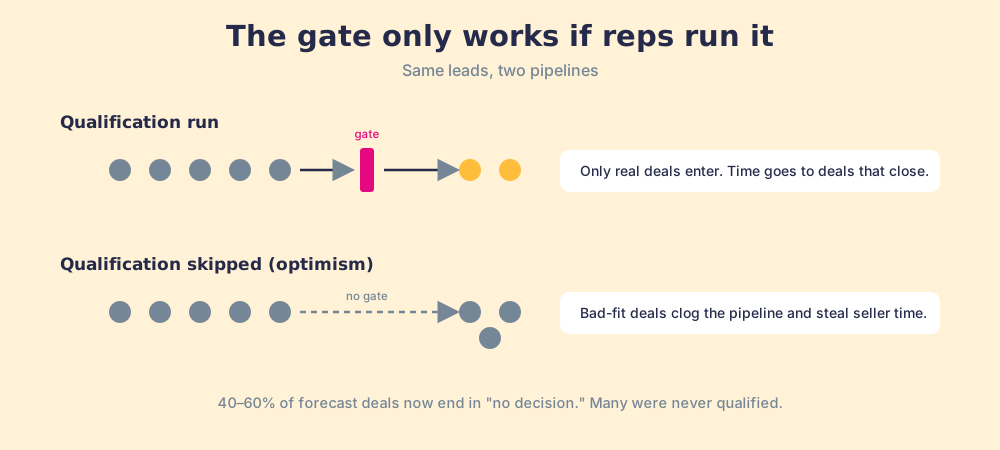
It is the discipline of deciding who deserves your limited selling time. A rep can work a finite number of deals well, so every bad-fit deal in the pipeline is not neutral; it is active theft from the good-fit deals that get less attention as a result. Qualification is the filter that protects that scarce resource. Done well, it keeps the pipeline honest and the rep’s hours pointed at deals that can close.
The cost of doing it badly is enormous and measurable. Matt Dixon and Ted McKenna, studying more than two million sales conversations for The Jolt Effect, found that 40 to 60 percent of forecasted deals now end in “no decision,” the customer who intends to buy and never acts (Harvard Business Review). Many of those were never qualified hard enough to begin with. They entered the pipeline on optimism, sat there looking alive, and died slowly while consuming the seller time that real deals needed.
What is the best lead qualification framework?
The one your team will run, every time. The frameworks differ less than their marketing suggests. BANT (Budget, Authority, Need, Timeline) is fast and works for simpler sales; BANT covers it in full. MEDDIC and MEDDPICC go deeper for complex B2B, with explicit attention to the economic buyer, decision criteria, and the internal champion; see MEDDIC and MEDDPICC. SPICED, CHAMP, and others rearrange similar ingredients.
Here is the uncomfortable truth a framework vendor will not tell you: switching frameworks rarely fixes qualification, because the framework was never the binding constraint. A team that does not consistently run BANT will not consistently run MEDDIC either; they will only have a more elaborate thing to skip. The choice of framework is a real but small decision. The large decision is whether you build a way to make running it the easy, default, inspected path.
Why do reps skip qualification, and how do you fix it?
Reps skip it because qualifying is friction that fights optimism, and optimism usually wins. Disqualifying a lead means admitting the pipeline is thinner than it looked, which no rep with a quota wants to do. Asking the hard qualifying questions early feels like risking the deal when the instinct is to rush to the demo. So in the absence of inspection, the easy path is to mark everything qualified and sort it out later, and later never comes.
The fix is the same principle that governs all execution: you can only expect what you inspect. Pick one framework, define each criterion as a checkable exit condition rather than a vague judgment, and inspect adherence deal by deal. Our research found teams that consistently inspect deals against a defined process hit quota at 6.3 times the rate of those that rarely do (The State of Sales Enablement). Qualification is the earliest and highest-impact place to apply that inspection, because a bad-fit deal caught at the gate costs nothing, and the same deal caught at the forecast costs a quarter.
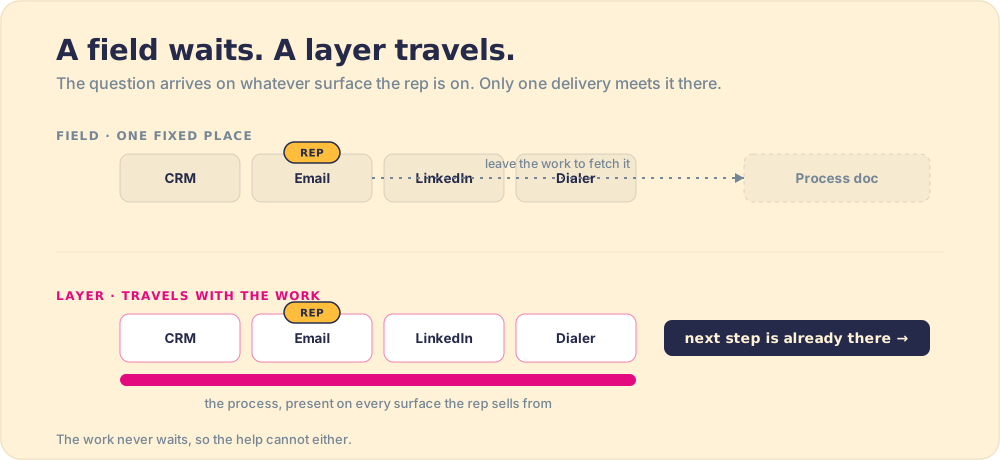
The practical lead qualification process, then, is three moves:
- Checkable criteria. Each one defined so “is this qualified?” has a clear answer, not a vibe.
- The questions in the flow. Surface the qualifying questions where the rep already works, so running them is the path of least resistance instead of the path of extra effort.
- Inspected adherence. Check it deal by deal and coach off what you see, so qualifying becomes the normal way deals enter the pipeline rather than a step reps perform when they remember to.
This is the same logic behind real sales process adoption, applied to the front gate.
The takeaway
Stop shopping for a better lead qualification framework and start building adherence to the one you have. The acronym on the wall has never been the problem; the deals that clog your pipeline were not let in by a weak framework, they were let in by a strong framework nobody ran. Pick one, make each criterion checkable, surface it in the flow, and inspect it. A qualification standard that is applied, even a simple one, beats the most sophisticated framework that lives in a slide and dies on contact with a hopeful rep.
From here: the simple framework in BANT, the deeper one in MEDDIC, the questions that do the qualifying in discovery call questions, and the adherence system underneath in sales process adoption.
Frequently asked questions
What is lead qualification?+
What is the best lead qualification framework?+
Why do reps skip lead qualification?+
How do you improve lead qualification?+
Your process, running itself.