What Is Sales Enablement Software? A 2026 Definition
Sales enablement software equips reps to sell. The honest 2026 definition, the five jobs the category does, and why more of it rarely produces more sales until it changes behavior.
Sales enablement software is the category of tools that equips reps to sell (content, training, coaching, playbooks, conversation intelligence, and analytics), and the best of it delivers the right guidance to the rep in the moment of the deal and measures what they do.
Sales enablement software is one of those categories everyone buys and few can define cleanly, partly because vendors keep stretching the word to cover whatever they sell. So start with the plain version, then the part that matters.
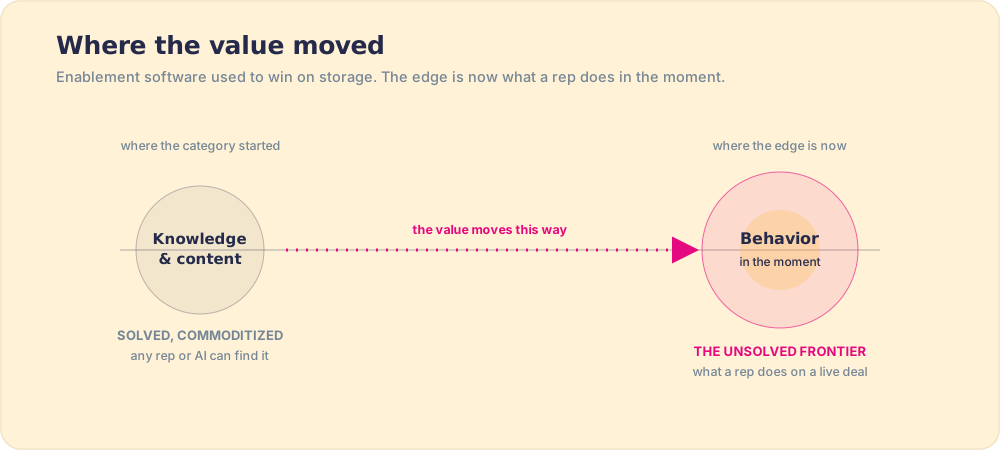
Think of the difference between a gym membership and a coach. The membership gives you access to every machine, a wall of equipment, racks of weights, more options than you could use in a year. It solves the knowledge-and-access problem completely. And most memberships go unused, because access was never what changed anyone’s body. The coach is the one standing next to you on the Tuesday you planned to skip, saying do this set, now, like this. The first generation of sales enablement software sold gym memberships: bigger libraries, better search, more content. The job that moves a number is the coach’s, and that is the shift the category is living through right now.
What is sales enablement software?
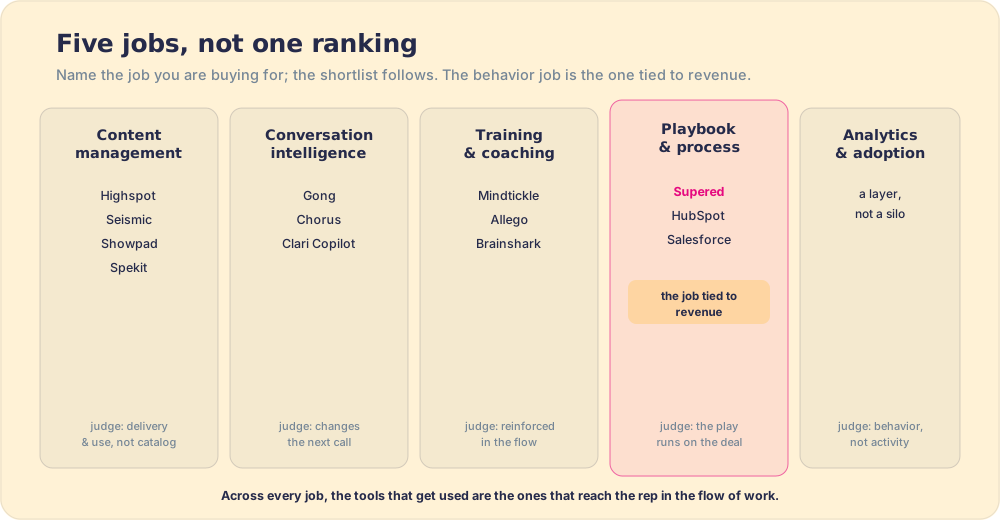
Sales enablement software is the category of tools that equips reps to sell, and increasingly, that governs what reps do at the moment of selling. Historically it meant content: the decks, one-pagers, and case studies a rep brings to a deal, organized and delivered. The definition has widened to cover five distinct jobs, and most products lead with one and bolt on the others.
- Content management. Store, govern, and deliver selling assets. Covered in depth in sales content management software.
- Playbook and process guidance. Get the right play to the rep at the right deal stage. See sales playbook software.
- Training and coaching. Onboard new reps and build skill over time.
- Conversation intelligence. Record and analyze calls to learn what works.
- Analytics and adoption. Measure what reps do, deal by deal.
The wider sales enablement software category contains all five. When someone says “we need a sales enablement platform,” they usually mean one of these jobs is on fire and they are about to buy a suite to fix it. Knowing which job you are solving is the whole of buying well.
What does sales enablement software do for a team?
In the ideal, it makes good selling repeatable: the motion your best reps run becomes the motion every rep runs, because the software puts the right content, the right play, and the right next step in front of them at the right moment, then shows leadership whether it happened. Storage, search, training, and recording are the means. Repeatable behavior is the end.
The reason the means get mistaken for the end is that the means are easy to demo and easy to measure. A vendor can show you a beautiful library and a usage dashboard in twenty minutes. What is hard to show, and the only thing that pays the invoice, is a rep three weeks later doing the discovery call differently because the software was there in the moment. Hold that distinction and most of the category’s marketing reorganizes itself in front of you.
Why doesn’t more sales enablement software produce more sales?
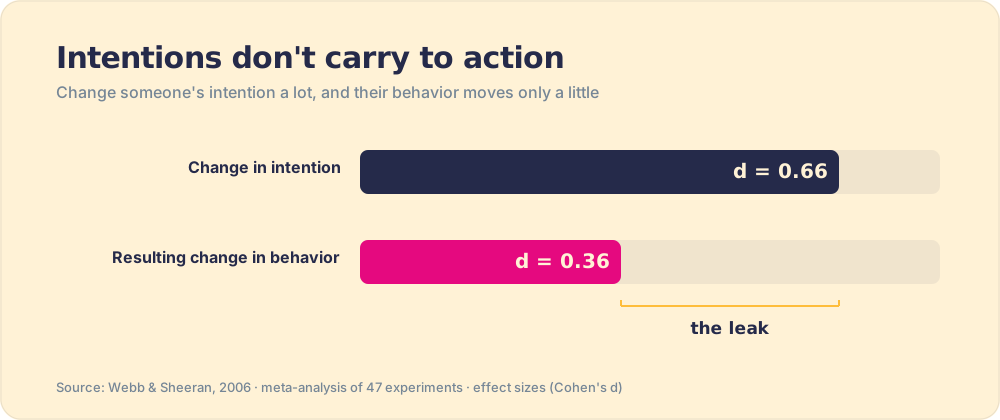
Because buying more of it tends to add capability without touching behavior, and behavior is the bottleneck. There is a name for this from organizational research: the knowing-doing gap. Stanford’s Jeffrey Pfeffer and Robert Sutton documented, across years of company studies, that organizations are full of people who know what to do and do not do it, and that knowledge alone almost never closes the gap (Pfeffer and Sutton, The Knowing-Doing Gap, 2000). Enablement software has spent two decades attacking the knowing half. The doing half is where deals are won and lost.
The decay makes it worse. Hermann Ebbinghaus’s forgetting curve, replicated for over a century, shows people lose the majority of new information within days unless it is reinforced (Ebbinghaus, forgetting curve). So a rep trained in a kickoff is running on a fraction of that knowledge by the time a real deal is in front of them, and a library in another tab is no help at the moment they have to act. Our own field data matches the academic picture: the three reasons enablement tools become shelfware are that reps do not see the value (55 percent), managers do not reinforce it (51 percent), and the tool is not embedded in the workflow (48 percent) (The State of Sales Enablement). Each is a description of software that lives outside the moment of work.
Doesn’t conversation intelligence already solve this?
This is the strongest objection, so let us give it its full weight before answering it. The most serious answer the category has produced to the knowing-doing gap is Gong’s, and it deserves a fair hearing.
Gong coined the term Revenue Intelligence and built a category on a real insight: the CRM records what happened and almost never why. Founder Amit Bendov started the company after watching sales slide at a previous firm and finding that “the company’s CRM was great at recording what happened but not why it happened” (Gong, What is Revenue Intelligence?, April 2022). So Gong records and transcribes the actual conversations, the unfiltered voice of the buyer, and mines them for signal. Gong’s own definition goes further than listening: “Revenue Intelligence automatically captures customer interactions, analyzes them to provide insights, and applies those learnings to determine the next best action for winning outcomes” (same source). They call it the platform “built on truth, not opinions,” and on that score they are right. A rep’s self-reported call notes capture maybe one percent of the words spoken; the recording captures all of them. That is a genuine and valuable thing, and any honest account of the category has to grant it, which is why we rank the field in our guide to the best conversation intelligence software.
Here is the edge of the picture, the place the analogy stops being kind. Conversation intelligence is a security camera. It is an excellent one. It records the call in full, and afterward a manager can watch the tape, see exactly where the discovery went thin, and coach it next time. But the camera films the drive after the car has already arrived. The signal it produces is retrospective by design: it tells you what the rep did on a call that already happened, about a deal that has already moved past the moment in question. The rep who needed the better discovery question needed it at 2:14pm on Tuesday, while the buyer was still on the line, not in a coaching session three days later when the moment is cold.
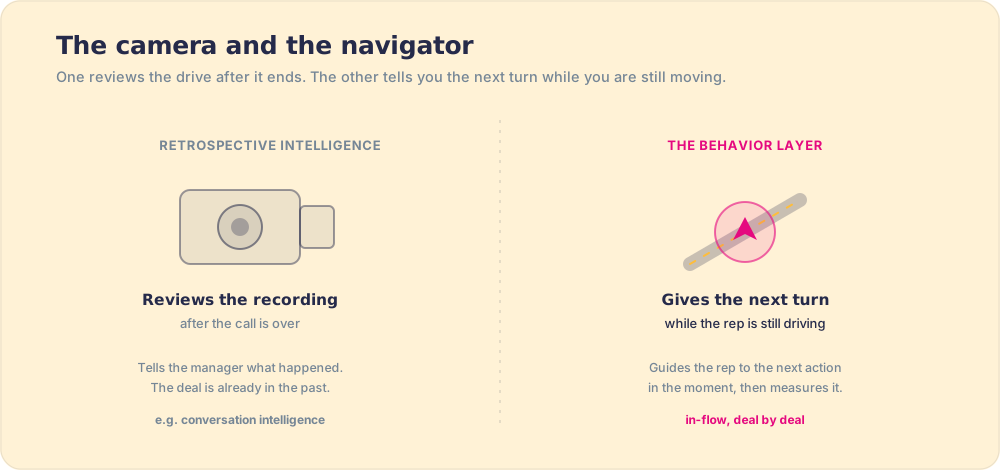
The vendors know this, which is why the whole category is now reaching toward the moment of action. Gong’s own definition ends on “the next best action,” and Highspot now markets “deal-specific guidance” that surfaces “next steps” for the rep (Highspot, 2026). The center of gravity is moving exactly where the evidence says it should. The open question is architectural: does the next action arrive as a recommendation a rep reads later, or as guidance delivered in the flow of the work, on the live deal, with whether the rep took it measured deal by deal? Signal is the input. Behavior at the point of action is the output, and the two are not the same job. A camera that has watched a thousand calls still cannot turn the wheel.
That is the line between retrospective intelligence and a behavior layer. Gong analyzes the deal that happened. A behavior layer guides the rep through the deal that is happening, then measures whether they followed the motion, the way a navigator does not grade your driving on Friday but tells you to turn left now. Both belong in a serious stack. Only one of them acts at the moment a rep is about to make a move.
What should sales enablement software do in 2026?
Reach the rep in the moment, guide the next action, and measure whether it happened. The reframe is forced by a simple fact about this decade: knowledge and content are no longer scarce. Any rep can find a battlecard, and any AI can draft a custom one-pager in seconds. When the thing your software stores is free, storing it well is not a moat. What remains scarce, and therefore valuable, is changing what a rep does on a specific deal in front of a specific buyer.
That is why the useful 2026 definition of sales enablement software is behavioral. The best of it operates as a behavior layer: continuous, in-the-moment guidance delivered where the work already happens, the CRM, the inbox, and the dialer of a sales engagement platform, with adoption measured deal by deal. Gartner’s finding that B2B buyers spend only about 17 percent of their journey with any supplier (Gartner) sharpens the point: the few moments a rep has are too valuable to spend hunting through a tool, so the tool has to come to them.
How is sales enablement software different from a CRM or an LMS?
Three systems get conflated, and separating them tells you what to expect from each.
- A CRM (HubSpot, Salesforce) is the system of record. It stores the deal; it does not, on its own, change how a rep runs it.
- An LMS or training platform builds knowledge in a classroom setting. Valuable for onboarding, limited by the forgetting curve once the rep is back in live deals.
- Sales enablement software sits across the work itself, ideally enhancing the CRM, to deliver content, plays, and next steps in the moment and measure adherence.
The practical guidance: a CRM and an LMS are necessary and not sufficient. The piece that changes behavior in the moment is the one most stacks are missing, and it is the one worth buying for.
What to take from this
There are two ways to read the category, and they lead to different purchases.
The first reads sales enablement software as a content-and-knowledge problem: buy the biggest, best-organized library and the slickest training portal, and assume capability becomes behavior. It produces an impressive stack and the category-standard shelfware, because it never touches the knowing-doing gap.
The second reads it as a behavior problem: buy the tool that reaches the rep in the moment of the deal, guides the next action, and measures whether they took it, and treat content, training, and even conversation intelligence as inputs to that. It is the harder thing to demo and the thing the evidence supports, from Pfeffer and Sutton to the 49-versus-15 split in our own data.
So here is the plain recommendation. Buy a content platform for the content job; Highspot and Seismic are the leaders there, though note the two announced a merger in February 2026 that remains pending regulatory approval, so they operate as independent companies for now (CX Today, February 2026). Buy conversation intelligence for the analysis job; Gong is the category’s pioneer and still independent. But do not expect either job to close the knowing-doing gap, because storing knowledge and analyzing past calls both sit on the knowing side of it. The piece that changes behavior at the point of action is a separate purchase, and in 2026 it is the one that decides the number.
We would buy on behavior every time, because the knowing half is solved and commoditized and the doing half is the entire edge. That is the principle behind what we build at Supered, the Behavior Layer that runs inside HubSpot and Salesforce, guiding the rep to the next action in the moment and measuring whether they took it. The principle holds whoever you buy from: enablement software earns its keep only when a rep does something different on a real deal because it was there.
From here: see the category mapped by job in the best sales enablement tools, the category overview and how to choose in sales enablement software, how to sequence the work in sales enablement strategy, and why measurement is the engine of it all in sales process adoption.
Frequently asked questions
What is sales enablement software?+
What are examples of sales enablement software?+
Is sales enablement software the same as a CRM?+
Why doesn't sales enablement software always increase sales?+
What should sales enablement software do in 2026?+
Is conversation intelligence like Gong the same as a behavior layer?+
Your process, running itself.