Sales Content Management Software That Reps Use
Sales content management software is sold as a better library. The library was never the problem. Here is what these tools do, why most of the content still goes unused, and what to look for if you want reps to use the right asset on a live deal.
Sales content management software is the system that stores, organizes, and delivers the assets reps sell with (decks, one-pagers, case studies) so the right piece reaches the right deal at the right moment, ideally inside the tools where reps already work.
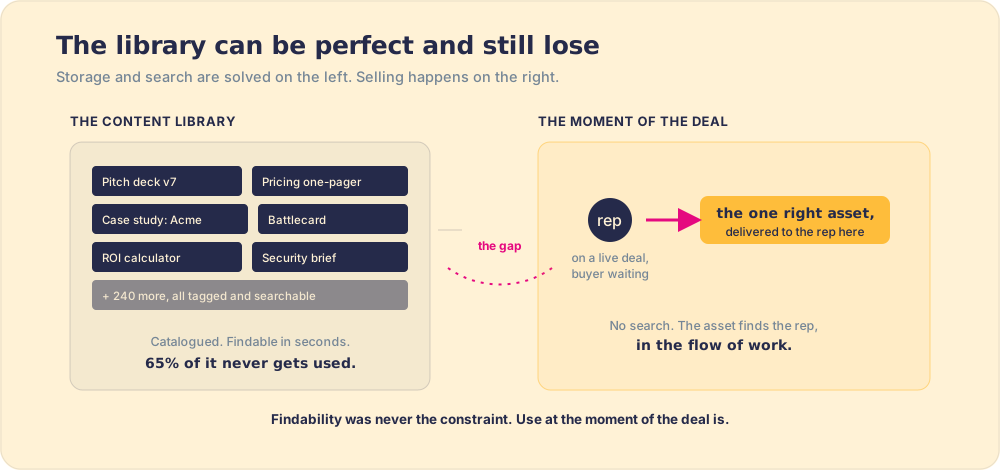
Sales content management software is sold, almost without exception, as a better library. More structure, smarter search, AI tagging, a cleaner shelf. The pitch assumes the problem is that reps cannot find the content. Sit with a sales team for a week and you will see the problem is rarely finding it. The deck is right there. The rep does not reach for the right one at the moment the deal needs it.
Picture the best-organized library in the world, every book catalogued, every shelf labelled, a search desk that finds any title in seconds. Now picture the reader who needed one of those books on the train this morning, and is back at their desk by the time they remember it exists. The library did its job perfectly. It was not where the reading happened. That gap, between where content is kept and where selling happens, is the thing most sales content management software never crosses, and it is the thing the industry’s own scorecard, the Forrester Wave, measures around rather than through. Understand that gap before you buy any of it.
What is sales content management software?
Sales content management software is the system that stores, organizes, and delivers the assets reps sell with, and, in the better tools, governs which version is current and reports on what gets used. Think decks, one-pagers, case studies, battlecards, pricing sheets, the working material of a deal. The category includes Highspot, Seismic, Showpad, Spekit, and others, and it shades into the wider sales enablement software category, of which content is one pillar (see also the best sales enablement tools mapped by job). One note on the two leaders: Highspot and Seismic announced a merger in February 2026, so the category’s two largest content platforms are consolidating into one, which we unpack in the Highspot-Seismic merger.
Strip it to the jobs it is meant to do and there are five:
- Storage. One place the content lives, instead of seven reps’ laptops and a shared drive nobody trusts.
- Organization and search. Tagging, folders, and increasingly AI search so a rep can find the right asset by description, not memory.
- Governance. The rep always gets the approved, current version, so the deck in front of a buyer is not last year’s pricing.
- Delivery. Getting the asset to the rep, and from the rep to the buyer, ideally without leaving the tool they are working in.
- Analytics. What gets used, by whom, on which deals, and whether buyers engage with it.
The first three are about the shelf. The last two are about the moment of selling. Almost every product in the category is excellent at the shelf and weak at the moment, and that imbalance is the reason content management has a reputation for expensive shelfware.
What does sales content management software do for a rep?
In theory, it puts the right asset in a rep’s hands the instant a deal needs it. In practice, most deployments stop at “the asset is stored and searchable,” which shifts the work back onto the rep: now they have to remember the asset exists, decide it is the right one, leave the deal, go find it, and bring it back. That is several steps, each one a place to lose them.
The cost of those steps is not hypothetical. McKinsey’s analysis of knowledge work found employees spend about 1.8 hours every day, roughly nine hours a week, searching for and gathering information (McKinsey Global Institute). For a seller, that is a day a week not spent in front of a buyer. A content system that only makes the search faster is optimizing the wrong verb. The win is not searching faster. It is not having to search at all, because the right asset arrived where the rep already was.
What does the Forrester Wave reward, and what does it leave out?
If you want to know how this category defines itself, read the scorecard the buyers read. For two decades the canonical one has been the Forrester Wave for Sales Content Solutions, run by VP and Principal Analyst Laura Ramos. The Q3 2020 edition scored nine vendors against 40 criteria; the Q4 2022 edition scored eleven against 33; in Q3 2024 Forrester folded the category into the Revenue Enablement Platforms Wave, 12 vendors against 32 criteria (Forrester). The named criteria areas are content organization and management, content activation, collaboration and workflow, predictive and AI capabilities, reporting and analytics, the seller experience, and integrations, all rolled up under current offering, strategy, and market presence.
Grant the Wave its due, because most of it is right. Governance matters: a rep should be unable to send last year’s pricing. Findability matters: a buried asset may as well not exist. Analytics matter, and Forrester deserves real credit here. Even in 2020 its analysts named the Leader differentiator as a blend of “AI-assisted content recommendations and in-the-moment guidance that helps sellers know how to take the conversation in a different or better direction” (Forrester). They saw the moment. They were pointing straight at it.
Here is where we part ways with how the scorecard is used. A Wave is, by its method, a feature inventory: dozens of capabilities, each scored and weighted, summed into a dot on a chart. It rewards the platform that does the most things well. That is a fair way to rank breadth, and it is the wrong way to predict use, because use does not come from having a capability. It comes from one capability firing at one instant: the right asset reaching the rep the second the deal calls for it. Spread across 33 criteria, that single decisive moment is one line item among many, outweighed by activation features, integration counts, and library depth. So a team can buy a top-right Leader, tick every box on the scorecard, and still watch most of its content sit untouched. The dot went up. The behavior did not.
The same study Forrester’s own analysts cited is where this becomes unmistakable. Forrester’s SiriusDecisions research found that roughly 65 percent of the content sales teams are given goes unused (Forrester / SiriusDecisions). That figure has barely moved across a decade of Waves and a decade of Leaders. If buying higher on the chart fixed usage, ten years of buyers climbing toward the leaders would have moved the number. It did not. Content maturity, as the scorecard measures it, does not predict whether reps reach for the right asset, which means it does not predict the one thing a buyer is paying for.
Why does most sales content go unused?
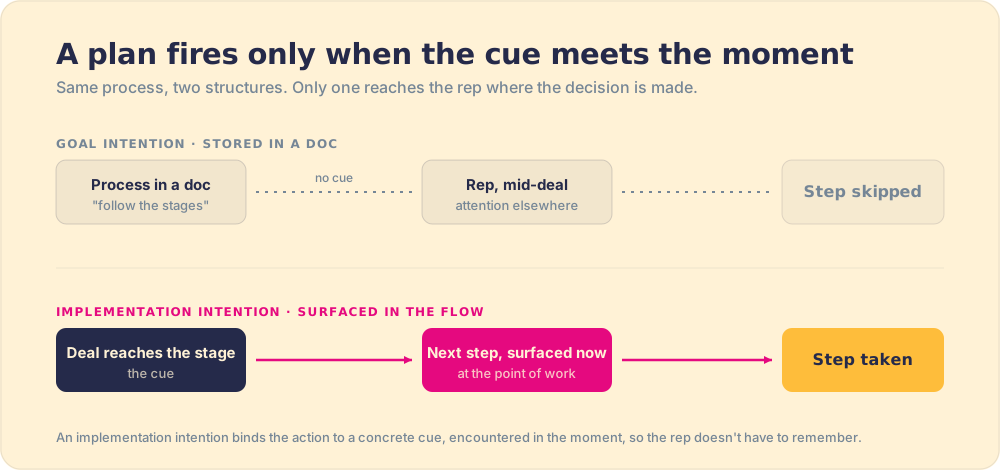
So why does findable, governed, well-tagged content still sit there? The constraint is behavioral, and it is the same one behind every enablement tool that becomes shelfware. A behavior happens when motivation, ability, and a prompt meet in the same moment (BJ Fogg, Stanford Behavior Design Lab). A rep deep in a live deal has the motivation, but a library in another tab gives them low ability (several steps away) and no prompt (nothing tells them, now, that this is the asset). So the behavior does not fire, and they reach for whatever is already open. Our own research found the three reasons tools become shelfware are a single condition wearing three coats: reps do not see the value (55 percent), managers do not reinforce it (51 percent), and the tool is not embedded in the workflow (48 percent) (The State of Sales Enablement). Each one describes a tool that lives outside the moment of selling.
The same study measured what happens when you fix that. Teams whose process and content guidance is embedded inside the CRM attained quota at 49 percent. Teams whose guidance sat in docs and separate tools attained at 15 percent. Same content. The location, and the moment of delivery, did the work. That is the variable a feature inventory cannot see, because it is not a feature. It is a place and a moment.

There is a 2026 layer on top of this, and it sharpens the point rather than softening it. Finding and even generating content is close to free now: any rep, and any AI assistant, can produce a serviceable one-pager in a minute. So a tool whose main value is storing and retrieving content is selling a solved problem. What is not solved is behavior, whether the rep uses the right, approved, current asset, on this deal, in front of this buyer. That is the job worth paying for.
What should you look for in sales content management software?
If usage is the real test, then the buying criteria reorder themselves. Library features move down the list; delivery and measurement move up. Five things predict whether content gets used rather than shelved:
- Delivery into the rep’s workflow. The content has to surface inside the tools reps already live in, the CRM, email, LinkedIn, the dialer, not in a destination they have to remember to visit. If using it requires a tab switch, friction wins.
- Usage analytics tied to deals. Not view counts. You want to see which assets get used on which deals, by which reps, and whether buyers engaged, so you can cut the 65 percent that does nothing and double down on what moves deals.
- Governance and versioning. Reps should be physically unable to send the stale deck. The current, approved version is the one that surfaces, every time.
- Findability, including AI surfacing. Search and AI recommendations still matter; they are the floor, not the differentiator. Treat them as table stakes.
- Time to value. A system that takes two quarters to populate and adopt has lost most teams before it earns its keep. Short setup, fast first use.
Notice what is not on the list: total asset count, number of integrations, breadth of features. Those describe the shelf. The buyer who shops on shelf size tends to end up with the most impressive library and the same 65 percent unused. The buyer who shops on delivery and measurement ends up with less content, used more.

How is it different from a sales enablement platform or a DAM?
Three terms get tangled here, and untangling them helps you buy the right thing.
- A digital asset management system (DAM) stores and versions creative files for the whole company: brand assets, video, logos. It is company-wide and creative-facing. It answers “where is the file.”
- Sales content management software is the sales-facing slice: the assets reps use in deals, plus governance, delivery, and usage analytics. It should answer “which asset moves this deal, and did the rep use it.”
- A sales enablement platform is the broader category that usually contains content management as one module, alongside training, coaching, and process guidance. Your sales enablement content is a pillar of enablement, not the whole of it; it sits inside that larger system.
The practical guidance: do not buy a DAM and expect rep behavior to change, and do not buy a content library and expect it to do the job of enablement. Content is necessary and nowhere near sufficient. Reaching the rep in the moment, and measuring whether they acted, is the part that changes outcomes, which is why content management increasingly only makes sense as part of an enablement layer that governs behavior. We make that argument in full in the sales playbook guide.
What should you buy?
Three honest paths exist, and they lead to different rooms.
- Buy the Wave leader, for the library job. If your problem is storage and findability at scale, a deep enterprise content library across thousands of assets and brand-controlled distribution, then Highspot and Seismic earned their leader dots, and they are the safe pick for that job. Note the corporate reality first: the two announced a definitive agreement to merge on February 12, 2026, with the combined company operating as Seismic under CEO Rob Tarkoff (GeekWire, Feb 13 2026). Both platforms keep running until close, but you are buying into a consolidation, and we treat that in full in the Highspot-Seismic merger.
- Buy a lighter content tool, for a smaller team. Showpad, Mediafly, Allego, and others sit a tier down on the same scorecard and cost less. Same shape of bet: a better shelf. The 65 percent applies to them too.
- Buy for the moment, and govern behavior. Judge each tool on whether it delivers the right asset into the rep’s existing workflow, measures use at the deal level, and governs to the current version, then treat search and library depth as the floor they are. This is the harder comparison, and the one the evidence ties to content getting used.
Our recommendation is the third path, and it is a recommendation, not a coin flip. Good content management for sales is judged by use, not by the size of the shelf. Read the scorecard, then weight it differently than it weights itself. Findability was never the binding constraint (the 65 percent was always findable). The cost of a library that lives outside the work is real and measured (the nine hours a week, the 15 percent versus 49 percent quota attainment). And in 2026 storage and retrieval are a solved, commoditized problem while behavior is not. So shortlist on the scorecard if you must, then break the tie on the one criterion the scorecard dilutes: does the right asset reach the rep at the moment of the deal, and can you see whether they used it. Buy the tool that changes what the rep does, not the one with the most dots.
That is the principle behind what we build at Supered. Rather than a library reps visit, Supered is the Behavior Layer: it surfaces the right content and the next right step in the moment a rep is working the deal, inside HubSpot, Salesforce, Gmail, and the other tools where the work already happens, and measures whether they used it. The mechanism is general, though, and it holds whoever you buy from: content gets used when it reaches the rep in the flow of work and someone can see whether it did.
From here, go deeper on the layer that makes any content tool work: why guidance has to reach the rep in the moment, why adoption, not documentation, is the real metric, and how compliance and adoption differ. The library is the easy part. Getting the right thing used on a live deal is the work.
Frequently asked questions
What is sales content management software?+
What is the difference between sales content management software and a DAM?+
Why does so much sales content go unused?+
What should you look for in sales content management software?+
Do you need sales content management software if you have a CRM?+
Your process, running itself.