CRM Adoption: It Is a System Failure, Not a People Failure
CRM adoption fails on most teams, and the usual cure (more training, more nagging) makes it worse. Why reps avoid the CRM, what the behavioral science says, and how to drive adoption by design.
CRM adoption is the degree to which reps actually use the CRM as part of how they sell, and it fails on most teams not because reps are undisciplined but because the system asks them to leave the work to feed it.
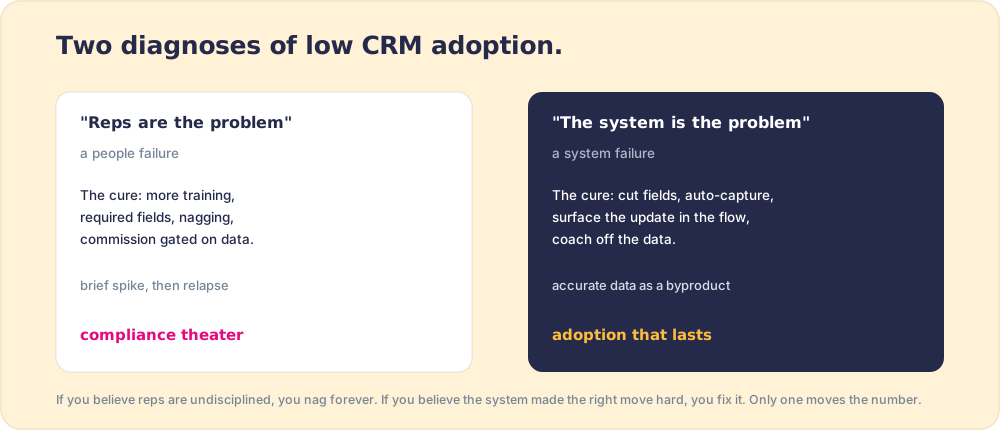
A sales leader declares a CRM adoption initiative every few quarters, and it goes the same way. New required fields, a training, a stern message about discipline, a brief spike, then a slow return to blank fields and a board nobody trusts. The initiative fails because it is aimed at the wrong target. It treats reps as the problem, undisciplined people who must be made to comply, when the reps are responding rationally to a system that asks them to stop selling in order to feed a database. CRM adoption is not a willpower contest. It is a design problem wearing a discipline costume.
So here is why CRM adoption fails, what the behavioral science says about it, and how to drive it without the annual nagging cycle. The throughline, and our point of view: when reps do not use the CRM, it is a system failure, not a people failure, and the fix is to the system every time.
Why does CRM adoption fail?
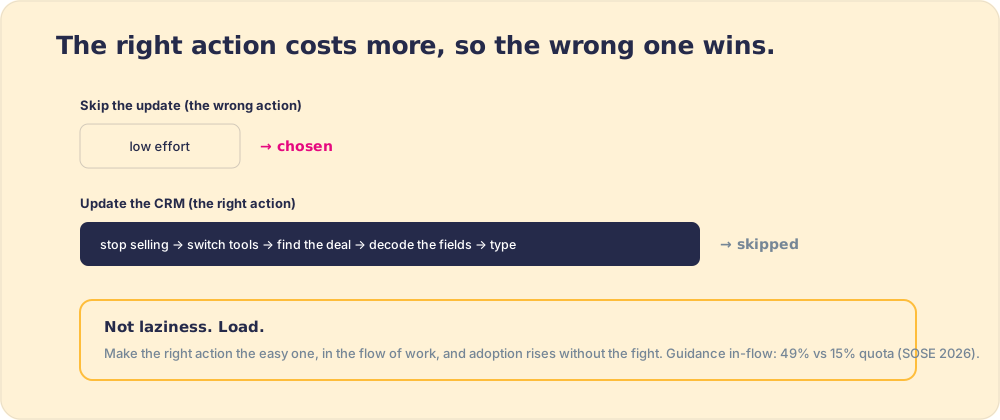
Because the CRM asks the rep to leave the work to feed it, and friction beats intention every time. The work of selling happens in the inbox, the dialer, on calls, on LinkedIn. Updating the CRM means stopping that, switching to a separate system, and typing into fields whose purpose was never explained, data that helps the manager more than the rep. When the right action costs more effort than skipping it, people skip it, not from laziness but from load.
The numbers say the load is real. In Salesforce’s seventh State of Sales report, published February 3, 2026, the finding lands flat: “Sales reps spend 60% of their time on non-selling tasks,” among them “manually entering customer notes into the CRM… instead of talking to a customer” (Salesforce State of Sales, 2026). A rep paid to sell spends most of the week not selling, and a slice of that is feeding the database. Ask a person to do the thing that pays them, or the thing that pays the dashboard, and you can predict which loses when the day runs short.
This is why the standard cures backfire, and why so many people ask why CRM fails in the first place. More training assumes reps do not know what to do; they know, and knowing is not the obstacle. More enforcement (required fields, commission gated on completeness) produces compliance theater: fields filled with whatever passes the check, complete and false. Both cures misdiagnose the disease, because both assume the rep is the broken part. The rep is the part behaving sensibly inside a badly designed system.
Why is non-adoption a system failure, not a people failure?
Because the cause sits in the design, not the person, and that distinction decides whether your fix can work. The behavioral science is unusually clean on this. BJ Fogg, who founded the Behavior Design Lab at Stanford, reduces all behavior to three things that must arrive together. His model, B=MAP, states it plainly: “Behavior happens when Motivation, Ability, and a Prompt come together at the same time. When a behavior does not occur, at least one of those three elements is missing” (Fogg Behavior Model, behaviormodel.org). Read that against a blank CRM. Motivation to hit quota is high. The prompt may even be there, a reminder, a manager asking. The element that is missing is ability, which Fogg defines not as skill but as how easy the action is to do in context. The CRM update is hard to do in the moment, so it does not happen. Non-adoption is an ability problem, which is to say a friction problem, which is to say a system problem.
The analysts who study CRM failure arrived at the same door from the other side. Forrester’s Kate Leggett, surveying 414 CRM projects, opened her February 18, 2016 analysis by naming a large graveyard of failed CRM projects. When she sorted the causes, the largest bucket, 38 percent, was “people issues such as slow user adoption,” and her prescription points straight at design, not discipline: “Don’t expect high adoption rates for CRM processes and technologies that do not have a clear benefit for CRM users” (Forrester, 2016). The graveyard is real, and the headstones do not read “lazy reps.” They read “no clear benefit to the user.” The size of the graveyard is not in dispute either: Forrester has put the failure rate near 47 percent and a widely cited Merkle study at 63 percent, and in case after case the named cause is poor user adoption rather than broken software.
Here is where we extend the analysts rather than restate them. Leggett’s frame is right but gentle: give the user a clear benefit. Our claim is sharper. The benefit cannot be a promise made in a kickoff deck; it has to be felt at the exact second the rep would otherwise type. A benefit the rep has to leave the road to collect is a benefit they will skip, every time, no matter how clearly you explained it in onboarding.
That is the deeper why behind the rule, and it is a core Supered conviction: improving crm user adoption is an exercise in lowering friction, never in raising willpower. If you believe reps are undisciplined, you will spend forever on accountability speeches that do not move the number. If you believe the system made the right move hard, you will fix the system, and the number moves. This is also why we build tooling instead of selling accountability.
How do you improve CRM adoption?
The short answer to how to improve CRM adoption: make the right update the easy one, in the flow of the work, then coach off the data instead of auditing for it. Picture the CRM the way the rep experiences it: a tollbooth set off to the side of the highway they are driving. The road is the work, the calls and emails and meetings that close deals. The booth is the update. To pay the toll, the rep has to exit the road, stop the car, and double back. So most of them drive around it. You do not raise toll compliance by scolding drivers for taking the bypass. You move the booth into the lane, so the toll gets paid as they drive.
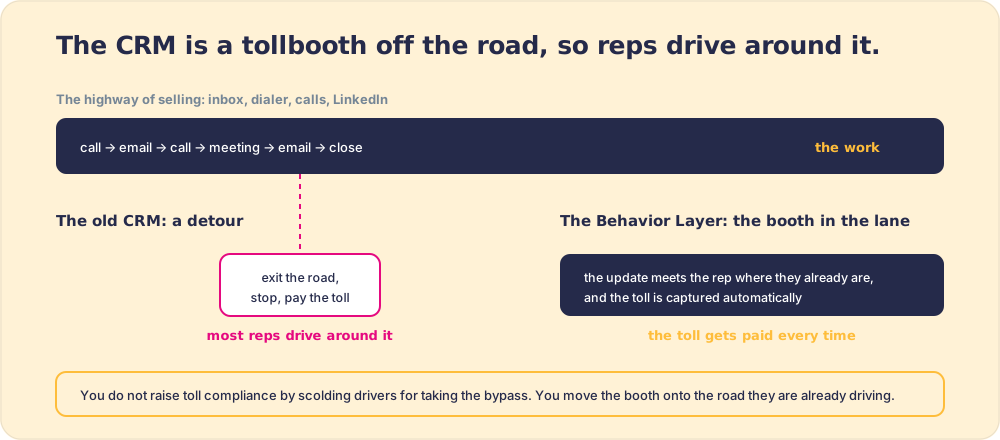
Moving the booth into the lane is the whole of a working crm adoption strategy, and the tactics underneath it are structural, not motivational. They are the same ones we lay out in CRM best practices:
- Curate the fields. Cut the form to the fields you will use to coach or forecast. A field you do not need is a toll for no road.
- Capture automatically. Calls, emails, and meeting notes can be logged by the system, not retyped by the rep. The most reliable data is the data nobody had to enter.
- Gate, do not nag. Require input only at meaningful stage transitions where the answer changes the deal, not on a daily completeness sweep.
- Surface the update in the flow. Bring the next step and the required field to the rep inside HubSpot, Salesforce, the inbox, wherever the work already lives, so following the process is the path of least resistance.
This is also where adoption and hygiene get confused, and the distinction matters. CRM hygiene is whether the data is clean and current. CRM adoption is whether reps run the system as part of selling. Hygiene is the output; adoption is the engine. A board scrubbed clean by an ops manager every Friday can be spotless and still fiction, a tidy record of stages that were never truly reached. A board reps run on stays clean on its own, because the data was a byproduct of doing the work. Chase hygiene with a mop and you mop forever. Chase adoption and the board stays clean because nobody let it rot.
The principle underneath every tactic is the same: stop asking the rep to come to the CRM, and bring the CRM to the rep. This is the Behavior Layer, in-the-moment guidance that meets the rep the instant the question arises and never takes them off the work. It does not replace the CRM; it enhances it, surfacing the update where the selling already happens. When the update happens in the flow, accurate data is a side effect of doing the work, and the annual adoption initiative becomes unnecessary, because the data was never allowed to rot. That is what sales process adoption looks like applied to the system of record, and the broader pattern is the one we call the sales execution gap.
The evidence that the design is the lever is in our own data. The State of Sales Enablement 2026 found teams whose guidance and process live in the flow of the CRM hit quota at 49 percent against 15 percent for teams whose tools sit in a separate destination (The State of Sales Enablement). Same reps, same intent; the difference is whether the system met them where they work. When our field data and Fogg’s behavioral model agree that ability-in-the-moment is the deciding variable, that convergence is the strongest case we can make.
What we recommend
Two ways to chase CRM adoption. You can run the familiar cycle: training, required fields, nagging, a brief spike, relapse, repeat, while believing the reps are the problem. Or you can treat it as design: reduce the friction, capture automatically, surface the update in the moment, and coach off the result, while believing the system is the problem.
We recommend the second, without hedging, because the evidence is one-sided. Fogg’s model says behavior fails when ability is low, and the CRM update is low-ability in the moment. Forrester found the largest cause of failure is user adoption tied to no clear benefit. Salesforce measured the rep spending most of the week not selling, a chunk of it on manual entry. And our own data shows guidance in the flow more than triples quota attainment over guidance in a separate tool. Four independent sources, one conclusion: the system, not the rep, is the variable you can move.
So stop running the adoption initiative and start fixing the system. Make the right action the easy one, and reps will adopt the CRM without being told to, because following the process became the path of least resistance. Start with the practices in CRM best practices, the broader problem in the sales execution gap, and the system that makes it stick in sales process adoption.
Frequently asked questions
What is CRM adoption?+
Why does CRM adoption fail?+
How do you improve CRM adoption?+
Is CRM adoption the same as CRM hygiene?+
Is CRM adoption a training problem?+
Your process, running itself.